
Imagine planning a destination wedding for two hundred guests without making a single list of chairs, catering needs, or flowers. You would inevitably face expensive chaos on the big day. According to veteran production managers, a film set operates on the exact same principle. You might possess a brilliant, emotionally gripping screenplay, but until every physical item is extracted for production, you are merely daydreaming. What Is a Script Breakdown becomes the first essential step in avoiding that chaos.
That essential transition from imagination to physical reality relies entirely on the script breakdown. Think of your screenplay as an architectural blueprint; the breakdown becomes the meticulous shopping list for the construction crew. It marks the exact moment you stop thinking like a writer and start acting like a producer. This process involves analyzing the text to identify necessary elements—the specific cast members, props, costumes, and vehicles required to make a scene happen. What Is a Script Breakdown if not the bridge between creative vision and execution?
Why is a script breakdown important for filmmakers? Consider what happens if you overlook the protagonist’s getaway car during a critical heist sequence. You could arrive on location with fifty paid crew members, expensive cameras, and absolutely no way to film the action. In practice, skipping this logistical step transforms minor oversights into devastating financial losses and wasted shooting days. What Is a Script Breakdown doing here? It prevents exactly these costly mistakes.
Successfully decoding a story into manageable data generates three critical outputs: a realistic shooting schedule, an accurate budget, and actionable lists for every crew department. This foundational process serves as the vital bridge bringing any cinematic vision to life.
Defining the Script Breakdown: Transforming a Narrative into a Data-Driven Blueprint
When you read a screenplay for the first time, you are naturally absorbed in the story and character arcs. However, during formal film analysis, you must read the text logistically. The script stops being a story and becomes a blueprint for construction, where you search for “production elements”—the physical items, people, and effects needed to physically film the scene. What Is a Script Breakdown at this stage? It is a structured way to extract every requirement from the script.
When determining exactly what elements are in a script breakdown, you rely heavily on the slugline. This scene heading (like INT. COFFEE SHOP – DAY) acts as your primary organizational unit, telling you where and when the work happens. Even when reviewing script breakdown examples for short films, a seemingly simple coffee shop sequence requires careful sorting. If the text reads, “Sarah angrily spills her latte on John’s suit,” you immediately need:
- Actors: Sarah, John, and background extras (like baristas and patrons).
- Wardrobe: John’s suit (and multiple identical backup suits because it gets ruined take after take).
- Props: A specific coffee cup and the safe liquid inside it.
Extracting these details from the page prevents you from showing up to set with fifty crew members and no backup wardrobe. Every physical noun in the action lines represents a cost and a logistical hurdle to clear. Organizing this massive puzzle falls to a specific set of hands: the First Assistant Director.
Why the First Assistant Director is Your Production’s Secret Weapon
While a director focuses on creative vision, logistics fall to the First Assistant Director (1st AD). The role of the first assistant director in pre-production centers on translating that creative dream into a grounded reality. By building the script breakdown, the 1st AD acts as a communication bridge between all departments. They organize this massive influx of data so the costume, props, and camera teams know exactly what to prepare before filming begins. What Is a Script Breakdown for a 1st AD? It is their core operational tool.
Beyond ordering supplies, this breakdown becomes a crucial advocacy tool. The 1st AD collaborates closely with the Line Producer—the person managing the actual budget—to ensure enough time and money are allocated to execute complex stunts safely. Without this clear plan, crew safety risks collapsing under rushed schedules. To gather this critical information accurately, they must first physically deconstruct the screenplay itself.
The Art of Lining a Script: Why Filmmakers Measure Scenes in Eighths of a Page
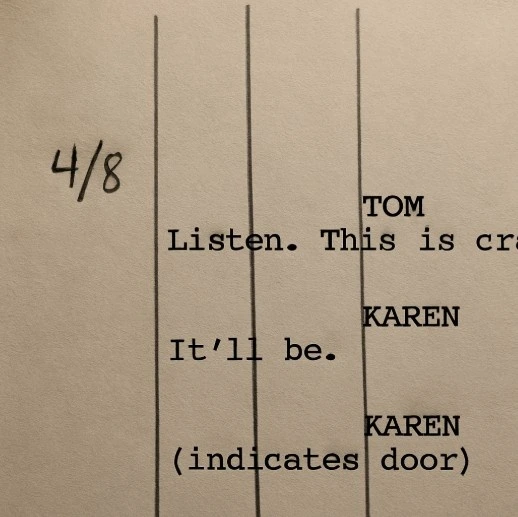
To calculate how long a scene will take to shoot, filmmakers rely on a classic rule of thumb: one formatted script page roughly equals one minute of screen time. Since scenes rarely end perfectly at the bottom margin, a precise way is needed to measure the fractions. Think of a standard page like a pie cut into eight horizontal slices. By dividing the paper this way, a 1st AD can quickly label a short scene as “three-eighths” (3/8) or a slightly longer scene as “one and two-eighths” (1 2/8) of a page.
Drawing a physical boundary around these fractions becomes the next crucial step, known as lining. Using a ruler, you draw a vertical line straight down the text to mark exactly where a specific setup begins and ends. The act of lining a script for continuity ensures that if a character spills coffee halfway through a scene, the crew knows exactly which fraction of the page requires a clean shirt and which requires a stained one.
Because time on set is literally money, knowing this exact length dictates how many hours you must schedule for the crew. A complex full-page stunt sequence might take three days to shoot, while a simple 4/8-page conversation could take just two hours. Once the page is accurately measured and bounded by these lines, you are ready to comb through the text to uncover the physical items required to film it.
The 12 Essential Element Categories: Identifying Everything from Cast to Livestock
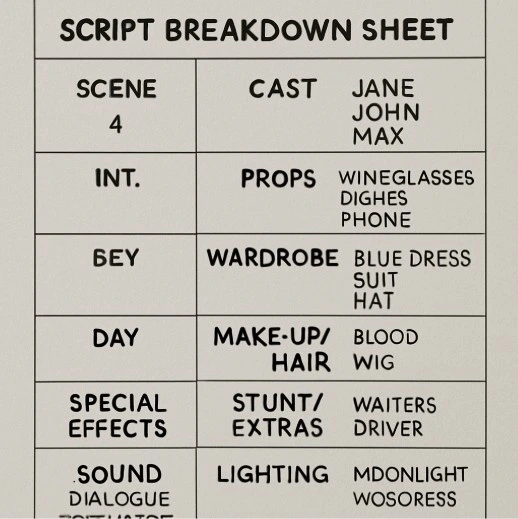
Once you have measured the length of a scene, the real detective work begins. Imagine reading a script where a character furiously throws a coffee cup across a crowded diner. To turn that single sentence into a physical reality, every noun must be pulled from the page and sorted into specific script breakdown sheet categories. What Is a Script Breakdown without categorization? It becomes incomplete and unusable.
Correctly categorizing these items prevents budget-draining surprises on set. For example, identifying cast and stunt requirements in screenplays early is critical to avoiding insurance delays and scheduling nightmares. If you assume the lead actor can safely perform a risky move, production may halt when a stunt double is required.
To capture every detail, filmmakers rely on an essential film production elements list made up of 12 standard buckets: Cast, Stunts, Extras, Props, Wardrobe, Makeup/Hair, Vehicles, Animals, Sound, Music, Special Effects, and Greenery. Sorting items into these boxes requires a sharp eye, especially when navigating tricky industry distinctions.
Mastering the Script Color Code: How to Visually Organize Your Pre-Production
Imagine handing a 100-page script to your prop master and asking them to find every item they need. Reading every word would waste valuable time. Instead, filmmakers use a universal visual system so crew members can scan a page and instantly spot their responsibilities.
This process involves highlighting element categories using a standardized set of colors:
- Red: Cast
- Yellow: Extras
- Orange: Stunts
- Blue: Special Effects
- Purple: Props
- Green: Greenery
Applying these visual cues speeds up communication and improves efficiency across departments.
Digital vs. Manual Breakdowns: Selecting the Best Workflow for Your Budget
Armed with your color key, choosing between digital and manual methods depends on project scale. Physical highlighters help beginners, but tracking every detail manually becomes inefficient for larger productions.
Modern tools replace markers with automated tagging, scanning scripts for repeating elements. These digital tags feed into centralized databases, where crews can instantly access scene requirements. As a result, scheduling and planning become faster and more accurate.
From Sheets to Strips: How to Turn Your Breakdown into a Winning Shooting Schedule
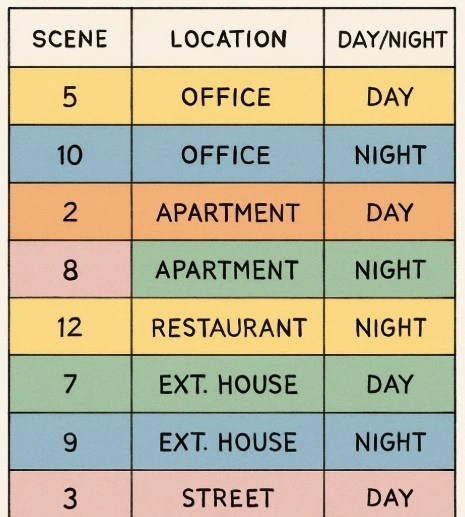
If you run errands, you avoid unnecessary travel. Film production follows the same logic. Instead of shooting scenes in order, the Assistant Director groups them by location to reduce costly moves.
Filmmakers use a strip board where each scene becomes a movable row. These strips are organized by Interior, Exterior, Day, and Night categories. This visual system helps producers understand the workflow instantly.
Rearranging these strips transforms a creative plan into an efficient shooting schedule.
The Practical Payoff: Reducing Delays and Protecting Your Film Budget
You no longer see a screenplay as just a story. Instead, a logistical blueprint is revealed within its pages. Mastering script analysis turns creative ideas into structured execution plans. The benefits become clear when even a single missing prop can cost thousands.
Professional productions rely on this process for efficiency. To begin, follow three simple steps:
- Print a short scene.
- Highlight and divide it into eighths.
- Transfer elements to a breakdown sheet.
Each completed scene builds confidence and clarity. In the end, What Is a Script Breakdown becomes more than a question—it becomes the foundation of successful filmmaking.
Why Studiovity Is the Smart Choice for Script Breakdown
Understanding What Is a Script Breakdown is only the beginning—executing it efficiently is what truly sets professionals apart. With Studiovity, filmmakers can move beyond manual processes and streamline the entire pre-production workflow in one place. From AI-powered script breakdowns and automatic element tagging to integrated scheduling, shot lists, and call sheets, Studiovity transforms complex data into actionable plans within minutes. Instead of juggling spreadsheets and disconnected tools, you get a unified platform designed for speed, accuracy, and collaboration—helping you turn every script into a production-ready blueprint with ease.