
Producing a film is a constant balancing act between creativity and finances. Every production decision affects the budget, from casting and locations to equipment rentals and shooting schedules. While filmmakers often focus on creating a realistic production budget, many overlook one of the most valuable scheduling documents that can prevent unnecessary spending—the DOOD Report, also known as the Day Out of Days Report.
Therefore, this document is more than just another production file. It helps producers, assistant directors, production managers, and coordinators understand exactly when each actor is needed during filming. By organizing cast availability into a simple timeline, the report reduces idle days, minimizes travel expenses, improves scheduling efficiency, and keeps production costs under control.
Whether you’re producing a short film, feature film, television series, web series, or commercial, understanding how this system works can make a significant difference to your budget. In this guide, we’ll explore what the document is, why it matters, and how it helps filmmakers save money throughout production.

What Is a DOOD Report?
This specific scheduling document tracks every principal actor’s status throughout the entire production schedule. Instead of listing scenes or locations, it focuses entirely on the days each cast member is required to work.
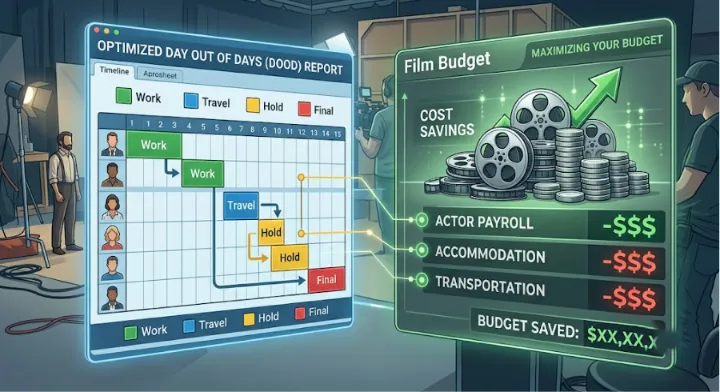
Consequently, the layout displays every shooting day in chronological order and shows whether an actor is starting work, actively filming, rehearsing, traveling, being held between shoot days, or finishing work. Since every cast member appears on the same timeline, producers can immediately identify scheduling gaps that could increase production costs.
In contrast to the shooting schedule, which organizes scenes according to production needs, this timeline organizes the schedule around the actors. This different perspective helps production teams optimize both logistics and budgeting before filming begins.
Why Is It Called "Day Out of Days"?
The term “Day Out of Days” simply refers to showing every actor’s status for every production day. Rather than reading dozens of schedule pages, producers can look at one report and understand how each performer moves through the production timeline.
Furthermore, the document uses standardized abbreviations to indicate each actor’s daily status. For example, SW means Start Work, W indicates a working day, H represents a hold day, T stands for travel, R refers to rehearsal, and F marks the actor’s final workday. These symbols make the report easy to scan while giving production teams a complete overview of cast availability.
Why the DOOD Report Is Important
Many filmmaking expenses relate directly to actor scheduling. Every unnecessary day an actor spends waiting between scenes adds payroll costs, accommodation expenses, transportation fees, catering costs, and administrative overhead. Without careful planning, these costs can quickly exceed the original production budget.
However, the overview highlights these inefficiencies before production starts. Instead of discovering scheduling problems during filming, producers can adjust the shooting schedule in advance. This proactive approach reduces unnecessary spending while improving overall production efficiency.
Additionally, the chart strengthens communication between departments. Production managers, assistant directors, casting coordinators, transportation teams, wardrobe departments, and producers all rely on accurate cast schedules. When everyone works from the same information, the production runs more smoothly and avoids costly misunderstandings.
How the DOOD Report Helps Your Budget
One of the biggest financial advantages of this analysis is its ability to reduce holding costs. Holding days occur when an actor remains under contract but does not actually film any scenes. While the actor waits for the next scheduled shoot day, the production often continues paying contractual fees along with hotel accommodations, transportation, meals, and other related expenses.
Imagine an actor films on Monday and then does not appear again until Friday. Without schedule optimization, the production might pay several days of holding costs simply because scenes were arranged inefficiently. The chart makes these gaps immediately visible, allowing producers to reorganize scenes and reduce unnecessary waiting time. Even saving one or two holding days per actor can generate substantial savings, especially on productions with large casts.
Moreover, travel expenses decrease significantly when productions use this tracking efficiently. Many projects involve actors traveling between cities or even countries. Flights, hotels, rental vehicles, airport transfers, baggage fees, and meal allowances all contribute to production expenses. Poor scheduling may require actors to travel multiple times during production.
Hence, the matrix helps group an actor’s scenes together whenever possible. Instead of making several trips throughout the schedule, performers can often complete all of their scenes during one visit. This approach simplifies logistics while reducing transportation and accommodation costs.
Payroll management becomes easier as well. Since labor costs represent one of the largest portions of most film budgets, scheduling actors efficiently has a direct impact on financial performance. A carefully planned overview minimizes overtime, reduces unnecessary workdays, and helps producers manage contracts more effectively.
Improving Production Efficiency
A successful film production depends on careful coordination between multiple departments. Hair and makeup teams prepare performers according to the shooting schedule. Costume designers organize wardrobe changes. Transportation schedules pickups and drop-offs. Catering estimates meal counts based on the number of people working each day. Production assistants coordinate call times, while assistant directors manage daily operations on set.
When actor schedules remain organized, every department benefits. The document gives each team a clear understanding of when performers will arrive, work, travel, and finish production. As a result, departments can prepare resources more accurately, reducing delays and preventing unnecessary expenses.
Thus, better scheduling creates a more efficient shooting schedule. Producers rarely shoot scenes in script order. Instead, they organize filming based on locations, actor availability, equipment requirements, weather conditions, and production logistics. The timeline helps balance these priorities while ensuring cast members spend as little idle time as possible.
Forecasting Production Costs
Accurate budgeting requires reliable forecasting. While production budgets estimate labor expenses, the tracking sheet provides detailed information about exactly when actors will work. Producers can use this information to calculate payroll with greater confidence and monitor labor costs throughout production.
Whenever the shooting schedule changes, the grid needs an update too. This process ensures budget forecasts remain accurate even when production plans evolve. Rather than reacting to unexpected payroll increases during filming, producers can anticipate financial changes before they become major problems.
Why Independent Filmmakers Should Use a DOOD Report
Many filmmakers associate these charts with large Hollywood productions, but independent filmmakers often benefit even more. Smaller productions typically operate with limited financial resources, making efficient scheduling essential.
Consequently, every unnecessary hotel night, overtime payment, or additional travel booking reduces money available for equipment, locations, visual effects, or post-production. Independent producers cannot afford waste, which makes this planning tool extremely valuable.
Indeed, even productions with only a handful of actors can identify scheduling improvements that reduce expenses and create a more manageable production timeline.
A Practical Example
Consider a feature film with eight principal actors filming over twenty shooting days. Without this matrix, one actor might work on the first day, remain on hold for three days, return for another scene, wait several more days, and then complete the remaining scenes during the final week.
Although this schedule technically works, it creates unnecessary holding costs, additional hotel stays, transportation expenses, and payroll obligations.
Now imagine the same production after reviewing the organized timeline. The assistant director reorganizes several scenes so the actor completes all required work within four consecutive days. The actor leaves production earlier, hotel expenses decrease, travel occurs only once, and payroll becomes more efficient. The script remains unchanged, yet the production budget improves simply because scheduling became smarter.
Who Uses the DOOD Report?
The document serves multiple departments throughout pre-production and production. Line producers use it to monitor labor costs and evaluate budget efficiency. First assistant directors rely on it when refining the shooting schedule and coordinating actor availability. Production managers use it to organize daily logistics, while production coordinators communicate scheduling information across departments.
Furthermore, casting directors review the status sheet to ensure performers remain available throughout production. Producers often use it when evaluating scheduling decisions and approving budget adjustments. Since the report provides a clear overview of cast commitments, it becomes one of the most frequently referenced production documents.
Manual Overviews vs. Modern Software
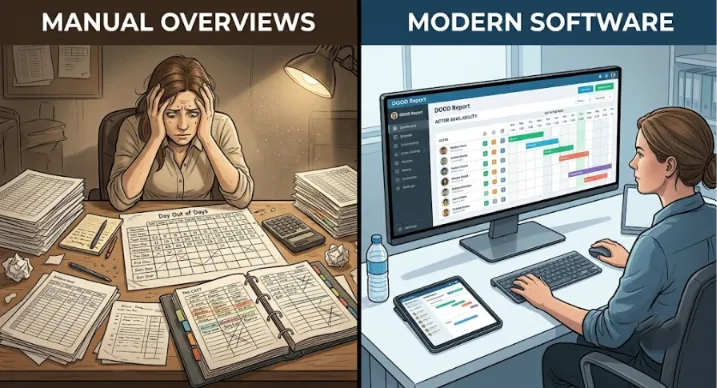
Traditionally, production teams created these grids using spreadsheets. Although spreadsheets remain useful for small projects, they become increasingly difficult to maintain as productions grow. A single scheduling change may require manual updates across multiple documents, increasing the risk of errors.
In contrast, modern production management software automates this process. When the shooting schedule changes, the breakdown updates automatically, reducing administrative work while improving accuracy. Automation allows production teams to focus more on planning and less on maintaining paperwork.
Integrated production platforms also connect script breakdowns, shooting schedules, budgeting, call sheets, and production calendars. This connected workflow helps filmmakers manage every stage of pre-production from one centralized system.
Common Mistakes That Increase Production Costs
One of the most common mistakes is ignoring holding days. Small scheduling gaps may appear harmless during planning, but they often translate into thousands of dollars in additional payroll and accommodation expenses.
Another frequent issue occurs when producers update the shooting schedule but forget to revise the tracking chart. Since actor availability changes alongside the schedule, outdated reports can create confusion across departments and lead to expensive scheduling errors.
On the other hand, some productions prioritize location grouping while abandoning actor availability. Although minimizing location moves remains important, balancing both factors usually creates the most cost-effective production schedule.
Finally, waiting until production begins to generate the sheet significantly reduces its value. The file delivers the greatest financial benefits when production teams use it during pre-production to optimize schedules before cameras start rolling.
How Studiovity Helps Production Teams
Managing production schedules manually becomes increasingly difficult as projects grow in size. Studiovity simplifies this process by bringing screenplay writing, script breakdown, scheduling, budgeting, shot lists, storyboards, and production management together in one platform.
Instead of maintaining separate spreadsheets for every production document, filmmakers can organize their entire workflow from a centralized workspace. As schedules evolve, connected production documents remain synchronized, reducing manual work and minimizing scheduling mistakes. This integrated approach helps production teams make informed decisions while keeping projects on time and within budget.
Final Thoughts
The DOOD Report may seem like a simple scheduling document, but its impact on production budgeting is significant. By providing a complete overview of actor availability, it helps producers reduce holding costs, improve payroll management, minimize travel expenses, optimize shooting schedules, and forecast labor costs more accurately.
Every production, regardless of size, benefits from careful planning. Whether you’re creating an independent short film or managing a large studio feature, using this breakdown allows you to identify scheduling inefficiencies before they become expensive problems.
When combined with modern production management software like Studiovity, the system becomes even more effective. Automated scheduling, connected production documents, and real-time updates allow filmmakers to spend less time managing paperwork and more time bringing their creative vision to life. Investing in a well-planned schedule is one of the smartest ways to protect your production budget while ensuring a smoother and more efficient filmmaking process.