
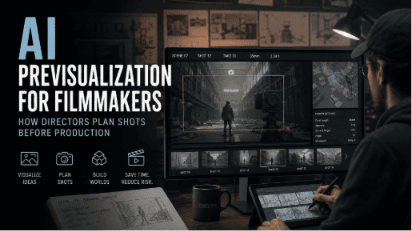
Previsualization is the practice of planning what a shot will look like before a camera rolls or a generation tool renders it for real.
Before AI, that meant hand-drawn panels, a hired storyboard artist, or hours in expensive 3D software. Now a director can go from a script paragraph to a full visual sequence in minutes, with the same character holding up across every frame.
This piece walks through five previz tools worth knowing in 2026, what each one actually does, and what it costs.
What Previsualization Actually Is, and Why It Matters
A storyboard shows framing, character position, and light direction for a single moment. An animatic adds timing and motion on top of that. Full 3D previs goes further, adding precise camera blocking where every measurement is geometrically accurate.
Serious filmmakers previsualize because changing a shot at the planning stage costs nothing. Changing it on set, or after a full production run, costs hours and often real money.
A storyboard gives the director, DP, and crew a shared visual language before anyone picks up a camera or opens a generation tool. AI previs tools shrink the gap between having an idea and having something visual to react to.
How These 5 Previz Tools Compare
Five things separate a genuinely useful previz tool from a novelty generator: whether it holds character and setting consistency across a full sequence (not just one shot), how revisions are handled, how much of the script-to-final-cut pipeline it covers, how much technical skill it demands, and what it costs to run at scale.
Judged on those criteria, invideo Agent is the strongest fit for directors who want to hand over a script and get a full sequence back, with revisions made through plain-language commands rather than re-prompting from scratch. The other four tools each trade off differently on the same criteria, covered below.
Tool | Best for | Key output | Starting price |
invideo Agent | Full-scene previz with persistent project memory | Storyboard + video | $17/mo |
Katalist AI | Script-to-storyboard with built-in animatic and video | Storyboard + animatic + video | $19/mo |
LTX Studio | Full pipeline from script to final export | Storyboard + video + timeline | $15/mo |
Luma Dream Machine | Camera-driven, single-shot cinematic previz | Video | Free tier available |
Blender | Open-source 3D camera blocking with full geometric accuracy | 3D previs + animatic | Free |
Prices as reported by each platform in 2026. Verify current rates before committing.
invideo Agent: Full-Scene Previz With Persistent Memory
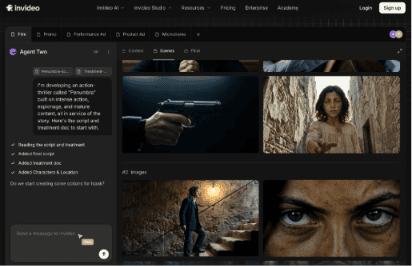
Most AI video tools work the same way underneath: write a prompt, get a clip, and if the next shot needs to match, re-describe the character’s face, costume, lighting, and location, then hope the model doesn’t drift.
invideo Agent takes a different approach. A director hands it a script, a treatment, or just a topic and a tone, and the agent plans the whole sequence.
It holds long-term project memory, so once a character, costume, or location is established in one shot, it carries into everything that follows without being re-described.
The agent also picks the right underlying model for each shot from a library of over 200 options and writes the technical prompt itself. That lets a director describe intent, “wider shot here,” “more tension in this beat,” instead of engineering prompts to suit a specific model’s quirks.
Revisions work the same conversational way: a command like “change the angle on the third shot” updates just that piece while keeping consistency intact everywhere else.
Best for: Directors and small teams who need to previz a full scene or sequence, not just a single shot, and want revisions handled through conversation rather than re-prompting from scratch.
Where it falls short: Handing model selection to the agent means less direct manual control over which specific model renders a given shot, which matters to users who want to hand-pick a model themselves.
Pricing: Plus $17/mo, Max $85/mo, Generative $170/mo, Elite $900/mo. Credit-based, with every tier including the full model library.
Katalist AI: Script to Storyboard With Animatic and Video in One Place
Katalist is built specifically around the script-to-storyboard pipeline. Paste or upload a script, and its AI Script Assistant reads it, identifies scenes and characters, and generates a visual storyboard with consistent characters across every frame.
From there, a director can adjust camera angles, character posture, staging, and scene continuity — the details that make a storyboard useful for production rather than decorative.
Where Katalist stands out is what happens after the storyboard is done. It can turn that storyboard into a rough video preview without leaving the platform, and a Premiere Pro export sends captions, timing, and metadata into a ready-made timeline.
Best for: Teams that want a script parsed into a storyboard and a rough animatic automatically, then handed to Premiere Pro without re-timing captions or metadata by hand.
Where it falls short: The video output is a rough preview rather than a polished final clip, so heavier post-production work is still expected after export.
Pricing: 7-day free trial. Essential plan at $19/mo (200 image credits plus 700 video credits).
LTX Studio: The Full Pipeline From Script to Final Export
LTX Studio isn’t a storyboard tool in the narrow sense — it’s a complete AI video production platform.
Paste in a script and LTX automatically breaks it into scenes, generates storyboard thumbnails for each one, and suggests camera framing. From there, a director refines each shot individually: swapping models, adjusting character appearances, changing camera angles, adding sound design.
A built-in timeline editor handles pacing and assembly, so the whole pipeline from concept to final cut lives in one workspace. LTX also supports animatic creation for both 2D and 3D projects natively, which is uncommon in this category.
Best for: Teams that want the entire pipeline, script, storyboard, animatic, and final edit, in a single workspace rather than moving files between separate tools.
Where it falls short: Covering the full pipeline in one platform means more surface area to learn than a single-purpose storyboard tool.
Pricing: Free tier with one-time credits. Paid tiers run from roughly $15/mo up to $125/mo depending on generation volume.
Luma Dream Machine: Camera-Driven, Cinematic Previz
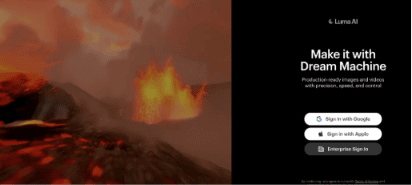
Luma’s Dream Machine, built on its Ray 3 model, is frequently the pick for filmmakers who think in a cinematographer’s terms: focal length, camera movement, lighting physics.
Its 3D volumetric architecture produces footage with an optical quality closer to physical camera capture than most competitors, which makes it a strong choice for testing the look and feel of one carefully composed shot.
Best for: Filmmakers who need one carefully composed, cinematographer-grade shot, camera movement, lighting, material rendering, rather than a full multi-scene sequence.
Where it falls short: By Luma’s own account, Dream Machine has no structured shot-planning, storyboard, or scene-memory layer built in. Producing a multi-scene sequence means manually managing prompts shot by shot, with no built-in guarantee of visual continuity across clips.
Pricing: Free tier available; paid tiers scale with generation volume and resolution.
Blender: The Most Accurate Previs Method, and the Most Demanding
Blender is open-source 3D software, and it’s the same fundamental approach used by studio previs departments on major productions.
The workflow requires building a 3D scene from scratch: model or import the set and characters, place a virtual camera, animate it through the scene, and render frames or an animatic.
Every measurement is geometrically accurate. Focal length, camera height, depth of field, and lens distortion all behave exactly as they would on a real camera.
Best for: Productions with complex action sequences, VFX shots, or architectural environments where geometrically accurate camera blocking is a hard requirement, not a nice-to-have.
Where it falls short: There’s no AI generation here, just manual 3D modeling and animation, which demands real technical skill and far more setup time than any of the AI-driven tools above.
Pricing: Free and open source.
Which One Should You Use?
Full-scene previz that holds character and setting consistency across an entire sequence, with revisions handled through plain-language commands → invideo Agent.
Script-to-storyboard with a built-in animatic and a Premiere-ready export → Katalist AI.
The most complete previs-to-production pipeline in one workspace → LTX Studio.
The most cinematic look for a single, carefully composed shot → Luma Dream Machine.
Geometrically accurate 3D camera blocking, with zero software cost → Blender.
None of these tools replace a director’s judgment on pacing, story, and tone. What’s changed is how quickly an idea can go from described on paper to something the whole team can actually watch and react to.
Frequently Asked Questions
- Which tool keeps characters consistent across a full sequence, not just one shot? invideo Agent and Katalist AI both maintain character, setting, and style consistency across an entire sequence automatically. Luma Dream Machine does not handle this natively and requires manual prompt management shot by shot.
- Can I do previz without any drawing or AI prompt-engineering experience? Yes. invideo Agent, Katalist AI, and LTX Studio all take a script or brief as input and don’t require drawing skills or deep prompting knowledge. Blender is the exception, since it requires real technical 3D skills.
- Do any of these tools handle revisions without regenerating the whole sequence? invideo Agent is built specifically around this. A plain-text command like “change the angle on scene 3” updates just that shot while keeping the rest of the sequence’s consistency intact.
- Is previsualization only useful for big-budget productions? No. Since planning a shot costs nothing compared to reshooting one, previz tools that run for $15–20/mo or free (Blender) make the same planning discipline used on major productions accessible to independent filmmakers and small teams.
- What’s the difference between a storyboard, an animatic, and full 3D previs? A storyboard shows framing and staging for a single moment. An animatic adds timing and motion across those moments. Full 3D previs adds precise, geometrically accurate camera blocking on top of both.