
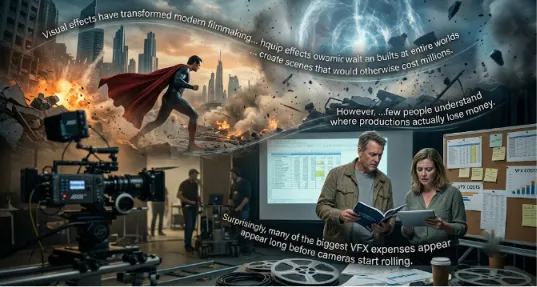
Visual effects have transformed modern filmmaking. Today, filmmakers can build entire worlds, remove unwanted objects, extend locations, and create scenes that would otherwise cost millions. However, while audiences often admire the final visuals, few people understand where productions actually lose money. Surprisingly, many of the biggest VFX Production Costs appear long before cameras start rolling.
Many producers believe VFX becomes expensive during post-production. In reality, the financial damage from escalating VFX Production Costs usually begins during pre-production. Poor planning, incomplete scripts, inaccurate budgets, and missing communication between departments create problems that continue throughout production. Consequently, every overlooked detail increases costs later.
Understanding the hidden economics of VFX helps producers, directors, and production managers protect their budgets while delivering better visual results.
VFX Costs Begin During Script Development
Every VFX shot starts as words on a page. Therefore, the screenplay becomes the first opportunity to control costs.
A script that contains vague descriptions creates uncertainty for every department. For example, a line such as “The city explodes into chaos” leaves dozens of unanswered questions:
Which buildings collapse?
How many digital extras appear?
Does smoke cover the skyline?
Does the sequence require destruction simulations?
Without clear answers, producers struggle to estimate costs accurately. Moreover, writers sometimes revise scenes repeatedly without considering the impact on VFX. Even a small script change can force artists to rebuild assets, recreate simulations, or redesign environments. As a result, unclear scripts often create budget overruns before production even begins.
Underestimating the Number of VFX Shots
One of the biggest financial mistakes impacting VFX Production Costs involves counting VFX shots incorrectly.
Many productions budget only obvious CGI scenes. However, modern films include hundreds of invisible visual effects. Artists remove microphones, erase safety equipment, replace skies, extend locations, clean backgrounds, and hide production mistakes. Therefore, a production that expects 150 VFX shots may actually deliver more than 500. This difference changes the entire financial model.
Additionally, producers often forget versioning requirements. Every revision requested by directors, studios, or clients increases labor hours. Consequently, each overlooked revision quietly expands the budget.
Late Creative Decisions Multiply Costs
Creative flexibility improves storytelling. However, late decisions create expensive technical problems.
Suppose a director decides to replace practical effects with CGI after principal photography. The VFX team now needs additional assets, tracking data, lighting references, and cleanup work. Likewise, changing costumes, props, or locations during production affects every digital element connected to those scenes. Instead of completing one task, artists repeat the same work several times. Consequently, production schedules become longer while VFX Production Costs continue rising.
Missing VFX Planning During Pre-Production
Many independent productions postpone VFX discussions until filming begins. Unfortunately, that approach almost always increases VFX Production Costs.
Successful productions identify every visual effects shot before photography starts. They systematically prepare for post-production by gathering essential data on set:
They prepare camera tracking markers.
They collect HDRI lighting references.
They photograph texture libraries.
They capture clean plates.
They coordinate with cinematographers and production designers.
As a result, artists receive everything they need during post-production. Without this preparation, teams spend weeks solving problems that proper planning could have prevented.
Poor Communication Between Departments
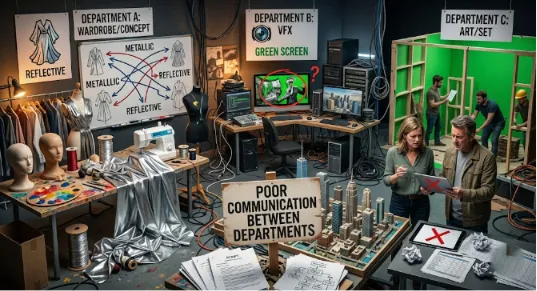
Visual effects rarely operate independently. Instead, VFX teams rely on directors, cinematographers, production designers, costume departments, lighting crews, editors, and producers. Therefore, communication directly affects VFX Production Costs.
Imagine this scenario: The costume department selects reflective fabrics without consulting VFX supervisors. Those reflections make digital compositing far more difficult.
Similarly, production designers may build sets that require unnecessary digital extensions because nobody discussed camera framing in advance. Each department performs its job successfully. However, without collaboration, the entire production spends more money. Therefore, early coordination reduces expensive surprises later.
Unrealistic Production Schedules
Many producers believe shorter schedules always reduce costs. Ironically, rushed productions often become far more expensive.
When teams rush through pre-production, they skip technical planning, reference photography, camera tests, and VFX reviews. Later, artists spend hundreds of additional hours correcting avoidable mistakes. Likewise, compressed post-production schedules increase overtime, revision cycles, and outsourcing expenses. Instead of saving money, unrealistic deadlines increase labor costs while reducing creative quality. Therefore, balanced schedules usually produce stronger financial results.
Asset Creation Is More Expensive Than Most Productions Expect
Digital assets represent one of the largest hidden investments in visual effects. A single creature may require concept art, modeling, sculpting, texturing, rigging, shading, grooming, animation testing, and lighting development. Similarly, digital environments often require extensive research before artists begin production.
Many budgets only estimate final rendering costs. However, asset development frequently consumes the largest share of overall VFX Production Costs. Moreover, if creative direction changes halfway through production, teams may rebuild entire assets from scratch. Consequently, poor planning dramatically increases costs.
Incomplete Script Breakdowns Lead to Budget Errors
Every production creates a script breakdown. However, many breakdowns focus only on cast, props, locations, and equipment. Modern productions also need detailed VFX breakdowns.
Each scene should identify:
Digital environments and green screen work
Simulations and CGI characters
Tracking markers and digital doubles
Cleanup requirements and compositing complexity
Without this information, producers underestimate both schedules and budgets. Furthermore, incomplete breakdowns make resource allocation difficult. Departments may book the wrong crew members or miss essential equipment. As a result, productions face unexpected spending before filming even starts.
Technology Cannot Replace Planning
Artificial intelligence has accelerated many parts of filmmaking. Today, AI can identify VFX elements during script breakdowns, estimate production requirements, organize scenes, and assist scheduling.
However, technology cannot compensate for poor planning. Even the best software depends on accurate scripts and complete production data. Therefore, production teams should treat AI as a planning assistant rather than a replacement for experienced decision-making. When producers combine AI with careful pre-production, they reduce errors significantly while improving budget accuracy.
Why Pre-Production Determines VFX Profitability
Every dollar invested in planning saves several dollars during production and post-production. Strong pre-production yields massive financial benefits:
It allows teams to estimate VFX shots accurately.
It improves communication across departments.
It reduces unnecessary revisions.
It organizes technical requirements.
It creates realistic schedules.
Most importantly, it gives producers confidence before spending large portions of the budget. Modern production management platforms simplify this process by connecting screenplay development, script breakdowns, scheduling, budgeting, storyboards, shot lists, and production planning in one workflow. Instead of managing disconnected spreadsheets and documents, teams can identify VFX requirements early and make informed financial decisions.
Final Thoughts
The highest VFX Production Costs rarely appear after filming. Instead, they begin during script development, planning, communication, and budgeting. Productions that overlook these early stages often spend far more money fixing preventable mistakes than creating visual effects themselves.
Fortunately, the solution does not require larger budgets. It requires smarter preparation. When filmmakers analyze scripts thoroughly, build detailed VFX breakdowns, coordinate departments early, and create realistic production plans, they protect both creative vision and financial performance.
In today’s competitive film industry, successful productions understand one important truth: the hidden economics of VFX always start before the first camera rolls.