
Have you ever set up an expensive camera, only for the resulting footage to look muddy, grey, and surprisingly cheap? Consequently, most beginners quickly blame their equipment. They feel convinced they need a better lens or a hidden menu setting to fix the problem. However, buying a pricier camera to fix a bland image is a remarkably common trap. Yet, it rarely solves the underlying issue.
On professional sets, lighting in filmmaking is utilized by cinematographers to completely transform a scene from amateur to cinematic. According to industry consensus among professional cinematographers, 80% of a “cinematic look” comes directly from light placement. It does not come from the size of your camera’s sensor.
Think of an incredibly intense, dramatic movie scene. Now, picture that exact same performance filmed under the bright, buzzing fluorescent tubes of a local grocery store. As a result, all the emotional tension instantly vanishes. The mood has been entirely ruined by flat, uninspired illumination.
Therefore, grasping the core of lighting in filmmaking requires a major mindset shift. Instead of just flipping a wall switch so viewers can see what is happening, directors use strategic shadows. This creates crucial visual depth. Furthermore, professionals call this process sculpting light. They treat illumination like clay to mold a flat video frame into a rich, three-dimensional world.
Fortunately, you absolutely do not need Hollywood budgets or massive electrical setups to achieve this compelling style. You might be using a basic desk lamp or natural sunlight pouring through a bedroom window. Either way, applying a few essential cinematic lighting tips will completely transform your videos. Indeed, it is time to stop merely brightening rooms and start actively designing your scenes.
Soft Light Secrets: Why Clouds and Shower Curtains Are a Filmmaker's Best Friends
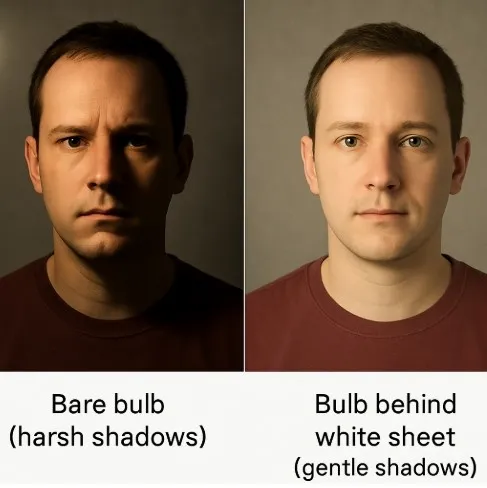
Notice how everyone looks flawless outside on an overcast day? That is the magic of soft light. While a bare bulb or a bright midday sun creates “hard” light—leaving sharp, dark shadows under the eyes and nose—a cloudy sky creates gentle, gradual shadow transitions. Therefore, differentiating between hard and soft light is your first major step toward making standard home videos look truly professional.
The secret to this flattering look comes down to one simple rule: the larger the light source relative to your subject, the softer the shadows. For example, a tiny smartphone flashlight casts harsh lines, creating an intense, dramatic look perfect for a moody mystery. However, if you want the smooth, glowing skin tones seen in standard interviews or beauty vlogs, you need to make your light source much larger.
Instead of buying expensive gear, you can achieve this by placing a semi-transparent material between your light and your subject—an industry technique called diffusion. Try these three inexpensive ways for diffusing harsh light sources on set:
Clamp a frosted white shower curtain in front of a cheap hardware store work lamp.
Next, tape a plain white bedsheet over a sunny window to soften the incoming rays.
Alternatively, aim a harsh desk lamp backward at a white wall so the wide, bouncing reflection becomes your new light source.
Once you see the incredible difference diffusion makes, you will never want to point a bare bulb directly at your subject again. Therefore, shaping a single, beautiful light is the perfect foundation for building a complete setup.
The 3-Point Formula: Placing Lights to Create Professional Depth
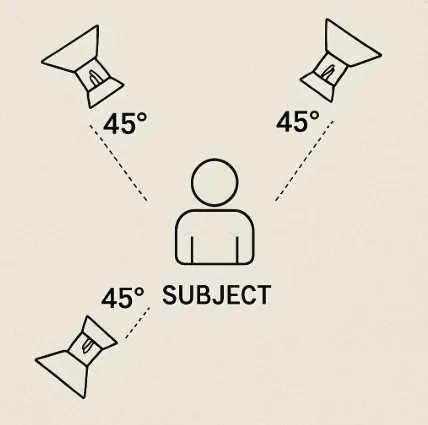
Hitting record on a great camera often results in surprisingly flat video. Because cameras capture the world in two dimensions, they easily erase natural depth. To fix this, film sets rely on a proven recipe known as the three-point lighting setup for beginners and experts alike.
The secret is putting light in the right places, rather than just blasting your subject straight on. By positioning light sources at specific angles, you carve out shadows that trick the viewer’s eye into seeing a three-dimensional image on a two-dimensional screen. Consequently, understanding this layout is essential to mastering lighting in filmmaking.
This classic Hollywood formula requires three specific lights working together to balance brightness and shadow:
Key Light: Your main, brightest light (100% power). Place this 45 degrees to the left or right of your camera to create beautiful, defining shadows on one side of the face.
Fill Light: If you are wondering what is the purpose of a fill light, it simply “fills in” those dark key shadows so the face doesn’t completely disappear into darkness. It sits on the opposite side of the camera at roughly 50% power.
Back Light (Rim Light): Placed behind the subject pointing toward their back, this creates a glowing “halo” on the shoulders and hair, acting like a pair of scissors to cut them away from the background.
You don’t need expensive studio gear to pull this off. The role of a gaffer—the chief lighting technician on a movie set—is really just about balancing these ratios. Therefore, act as your own gaffer by using a sunny window as your key, a cheap white poster board for your fill, and a basic desk lamp for your backlight.
Try this simple setup today by turning off your overhead room lights and positioning just three distinct light sources around your subject. Once you see that gorgeous cinematic depth, the natural progression is learning how to justify these artistic lights within your actual scene.
Motivated Lighting: How to Make Studio Lights Look Like Natural Sunlight
Even with a perfect three-point setup, throwing too many studio lights into a room can accidentally make your video look artificial, like a brightly lit sitcom set. To prevent the over-lit look that screams amateur production, filmmakers rely on a realistic concept called “motivated lighting.” This simply means your off-camera lights should mimic a believable, real-world source inside the room. Using motivated lighting in film is the ultimate secret to making your perfectly crafted shadows feel authentic rather than staged. Therefore, it is a foundational pillar of effective lighting in filmmaking.
The easiest way to sell this illusion is by incorporating visible, everyday lamps—known as “practicals”—into your actual shot. Thus, you are essentially using practical lights to create depth and establish a logical reason for brightness. Once you turn on a visible desk lamp or string of fairy lights in your background, position your stronger off-camera Key Light in the exact same direction. Consequently, the viewer’s brain automatically assumes the beautiful, bright glow on your subject’s face is coming from that tiny background lamp, perfectly hiding your movie magic in plain sight.
Try this on your next video: place your subject near a window, then angle your off-camera light to shine from the exact same direction as the sun. While this instantly makes the scene feel natural, you might notice that your indoor studio gear looks strangely orange compared to the bright daylight. This distracting color mismatch ruins the illusion quickly, making color temperature a crucial element to master.
Kelvin Basics: Why Your Footage Looks Too Blue or Orange
Filming near a window often leaves subjects looking half blue and half orange. This distracting “mixed lighting” happens because every light has a specific color tint, known as color temperature. Our brains auto-correct these differences instantly, but cameras need help. Mixing cool window light with a warm desk lamp confuses your lens and ruins natural skin tones.
Fixing this requires White Balance, a setting that tells your camera what “true white” looks like in your current room. Filmmakers measure this using the Kelvin scale. Don’t let the name intimidate you; just think of Kelvin (K) as a simple thermometer for light. Lower numbers are warm (orange), while higher numbers are cool (blue). Therefore, matching your camera to your main light source is exactly how to balance indoor and outdoor exposure without ugly color clashing.
Beyond fixing visual mistakes, you can use these temperatures to subconsciously signal the time of day or season to your viewer. Keep this quick Kelvin reference guide handy for common light sources:
- Candlelight (1900K): Extreme, cozy warmth.
- Sunset (3200K): Golden, standard indoor studio lamps.
- Daylight (5600K): Crisp, neutral white noon sun.
- Overcast (6500K+): Cool, slightly blue shadows.
Once your colors match seamlessly, you can use brightness to dictate the overall emotion and visually tell a richer story.
High-Key vs. Low-Key: How Lighting Instantly Changes the Mood
Think of your favorite comedy, then picture a gritty detective movie. Even if the actors read the exact same script, the scene’s emotion changes entirely based on how bright the room feels. This invisible switch is controlled by your contrast ratio—the brightness difference between the lit side of your subject’s face and the dark shadow side. Mastering these basic filmmaking lighting techniques allows you to instantly dictate the underlying emotion of a scene before a single word is spoken. Because of this psychological impact, emotional control remains a vital goal of lighting in filmmaking.
By adjusting your standard 3-point setup, you can easily build two distinct atmospheres. High-Key lighting blasts away shadows to feel open and safe, much like a bright midday sun. Conversely, Low-Key lighting intentionally leaves shadows dark, creating a mysterious, flashlight-in a-dark-room vibe. When deciding on your high-key vs low-key lighting mood, use this guide to match your video’s genre:
High-Key: Low contrast ratio, very soft shadows. Mood: Upbeat, clean, and safe (Great for YouTube vlogs or tutorials).
Low-Key: High contrast ratio, deep and heavy shadows. Mood: Dramatic, serious, and tense (Perfect for moody short films).
Controlling this emotion is as simple as turning your secondary “fill” light down or off completely. If you don’t own a lighting kit to practice these dramatic visual shifts, you can achieve beautiful cinematic contrast using basic natural elements.
Natural Light Mastery: Using Windows as Your Primary Studio
You don’t need a massive budget to make your footage look incredible. Placing your subject next to a large window instantly creates a professional-grade softbox that wraps gentle light around their face.
To add dramatic depth, hang a dark blanket on the actor’s shadow side. This technique—called negative fill—absorbs bouncing room light and carves out moody contrast without plugging anything in.
Stepping outside requires careful timing, as direct midday sun creates harsh, scary shadows under the eyes. For the best natural light cinematography outdoors, always film in open shade to naturally soften the sun’s rays. If you must shoot under the open sky, plan around these three ideal windows:
Dawn: Just before sunrise for a cool, even atmospheric glow.
The Golden Hour: The hour right before sunset, offering warm, soft, horizontal light.
Overcast Days: Thick clouds act as nature’s perfect overhead diffuser.
Mastering these cinematic lighting techniques for low budget projects proves that gorgeous visuals rely on smart positioning, not hefty price tags. Once you can confidently control the sun, you are ready to build a dedicated, budget-friendly lighting kit.

Your First Lighting Kit: Essential Gear That Won't Break the Bank
Relying on artificial light often tempts beginners straight to the local hardware store. While halogen work lights seem like a bargain, they run dangerously hot and cast sickly, unnatural tints over human skin. The best budget LED lighting for indie film solves both problems: they stay cool to the touch and feature a high CRI (Color Rendering Index). Think of CRI as a simple “color accuracy score”—a high rating ensures your actors look vibrant and lifelike rather than washed out or green. Consequently, picking the right gear is a milestone when studying lighting in filmmaking.
Your essential cinematography lighting equipment list shouldn’t require draining your savings to get that professional look. You only need this versatile starter kit:
Bi-color LED Panel ($50-$100): Your primary Key Light. “Bi-color” means you can adjust a dial to match the warm orange of a desk lamp or the cool blue of a window.
Light Stand ($25): Essential for safe, precise positioning so you don’t have to dangerously tape heavy gear to bookshelves.
5-in-1 Reflector ($20): The smartest investment you can make. It bounces your key light to fill in shadows, practically serving as a second bulb for a fraction of the price.
That cheap reflector is also your first modifier—a tool designed to change a light’s texture. Unzip the outer cover to reveal a translucent center, which acts just like a cloud to diffuse harsh LED beams into a flattering, gentle glow. Now equipped with the gear to build a reliable 3-point setup anywhere, you are fully equipped to transform an ordinary room into a cinematic set.
Your 48-Hour Lighting Challenge: Transforming One Room Into a Cinematic Set
You no longer have to settle for flat, washed-out video. Instead of just turning on a lamp so the camera can see, you now possess the skills to shape mood, build depth, and guide your audience’s eyes. Therefore, you can confidently practice lighting in filmmaking in any environment.
To transform your existing space into a professional-looking studio, use this mental checklist before hitting record on your next shoot:
Turn off overheads and position your primary light source to establish the mood.
Add visual depth by separating your subject from the background with a backlight.
Soften the harshness by controlling shadows with light modifiers, like a plain white bedsheet or foil reflector.
Try this tonight: pick one corner of your room and light a simple object or a friend using the three-point method. Remember, practice always beats expensive gear. Ultimately, mastering lighting in filmmaking isn’t about buying the brightest bulbs; it’s about discovering how moving light around a room elevates your work from merely brightening a scene to true visual storytelling.
Take Your Visual Storytelling to the Next Level with Studiovity
Now that you possess the tools to shape beautiful depth and mood on set, it is time to organize your creative vision. True visual storytelling requires seamless coordination between your lighting designs, storyboards, and scripts. That is exactly where Studiovity steps in to streamline your production workflow.
As an all-in-one filmmaking platform, Studiovity lets you map out shot lists, breakdown scripts, and collaborate with your crew in real time. Do not let your perfectly planned three-point setups get lost in chaotic paperwork. Bring your cinematic ideas to life and manage your entire project flawlessly from script to screen with Studiovity today.