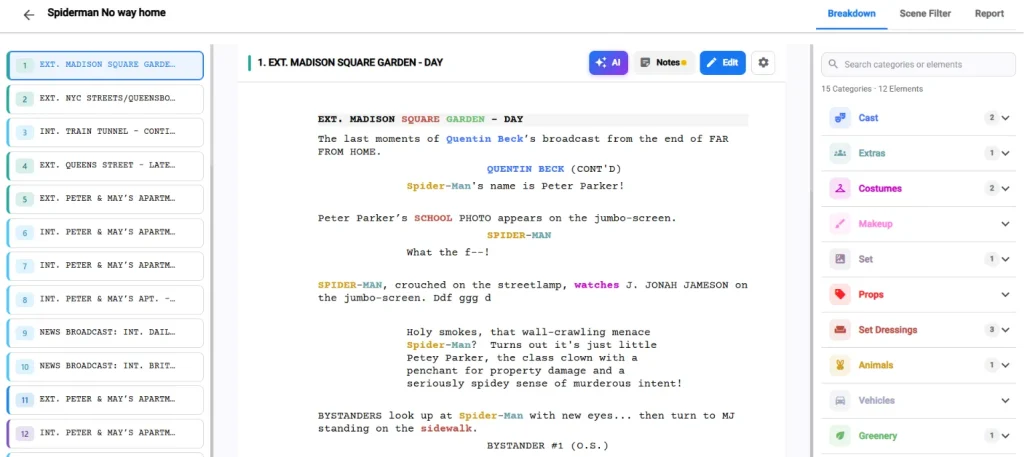
First, a production team must translate the script into a practical roadmap. They do this before scheduling shoots, estimating costs, or securing locations. Consequently, that translation is called a screenplay breakdown. Moreover, it remains one of the most vital steps between creative development and physical production.
Importantly, this process identifies every element in the script. Producers must plan, budget, or source these elements. Thus, it turns story pages into actionable data for department heads. Ultimately, whether you prep an indie short or a series, these tips will help you avoid expensive surprises.
What Is a Screenplay Breakdown?
Specifically, this method analyzes a script scene by scene. It identifies all required production elements. For example, these include cast, props, wardrobe, stunts, and special equipment. Typically, the assistant director or producer performs this task. Ultimately, their primary goal is to understand the demands of each scene.
For instance, consider a simple line like “Rain pours over the crowded street as a police car skids.” Instantly, this triggers multiple needs:
Rain effects and water trucks
Background actors
Street control and police vehicle clearance
Precision driving
Wardrobe duplicates
Why This Process Matters in Film Production
Undeniably, this step influences nearly every major production decision. Furthermore, a strong analysis helps the team achieve the following:
Otherwise, teams risk missing elements. Consequently, they might incur overtime or face creative compromises.
Start With a Clean, Locked Script Whenever Possible
First, ensure the script is nearly locked before beginning. This means you have fixed scene numbers and trackable changes. Additionally, check that the script includes:
Clear scene headings
Consistent formatting
Numbered scenes
Accurate character names
Indeed, a clean script prevents scheduling confusion down the line.
Read the Script Once for Story Before Analyzing It
Admittedly, the most useful tip is the simplest. First, read the script once without marking anything. Instead, focus on story, tone, character, and pacing. Then, ask yourself:
What is the overall tone?
Which scenes are emotionally essential?
What are the biggest production challenges?
Otherwise, jumping straight into technical details can flatten the creative purpose.
Analyze the Script Scene by Scene
Next, treat each scene as its own production unit after the first read. Specifically, for each scene, identify:
Scene number and page count.
Location details.
Cast and background performers.
Props, vehicles, and stunts.
Always consider both page length and production complexity. For example, a half-page action scene takes much longer than a half-page dialogue scene.
Use Categories Consistently
Above all, consistency is key. Therefore, if you label an element one way initially, use the same label later. Generally, common categories include Cast, Props, Wardrobe, Makeup, Special Effects, and Sound. Consistently categorizing elements makes scheduling much easier.
Pay Close Attention to Cast and Character Usage
Similarly, every scene should clearly identify speaking and non-speaking characters. Additionally, you must track specific needs:
Do they require special makeup?
Do they perform physical action?
Are they subject to child actor restrictions?
Meanwhile, watch for implied appearances. This prevents you from realizing too late that you forgot to schedule an actor.
Identify Background Actors Early
Naturally, background actors significantly affect costs and logistics. Therefore, note the approximate number and specific looks needed. Furthermore, a “busy street” differs vastly from an “empty street.” Thus, you must be specific enough to aid budgeting.
Track Props With Continuity in Mind
Importantly, a prop is not just an object. Actually, actors handle, damage, or eat these items. Consequently, ask yourself:
Who uses the prop?
Does it appear in multiple scenes?
Do you need duplicates for multiple takes?
Particularly, items like food and weapons require special attention for safety.
Separate Props From Set Dressing
Crucially, an actor handles a prop. Conversely, set dressing remains part of the background environment. Therefore, differentiating them ensures the correct department sources the items.
Watch for Wardrobe and Makeup Changes
Additionally, wardrobe and makeup affect continuity and scheduling. Therefore, track outfit changes, blood, scars, or dirt. Moreover, continuity becomes critical when you shoot scenes out of order. Always track a character’s physical condition.
Flag Stunts, Fights, Weapons, and Safety Concerns
Immediately, you must flag any physical risk. Specifically, this includes falls, driving scenes, firearms, and extreme weather. Furthermore, even a simple shove requires choreography and safety oversight. Thus, identify these early to plan responsibly.
Note Special Effects and Visual Effects Separately
First, Special Effects happen practically on set. Meanwhile, post-production teams create or enhance Visual Effects. Therefore, note both separately. Ultimately, early planning prevents costly post-production fixes.
Look Beyond What Is Written on the Page
Moreover, a strong analysis captures implied details. For instance, a wedding scene implies wardrobe, décor, guests, and food. Similarly, a hospital room implies medical equipment and background staff. Therefore, read carefully to uncover the production reality.
Group Locations for Scheduling Efficiency
Often, you can group scenes sharing the same location. This works even if they remain far apart in the story. Additionally, look for repeated locations. Finally, factor in parking and permit logistics to save time.
Identify Time of Day and Continuity Constraints
Next, go beyond just “Day” or “Night.” Instead, ask if the scene requires sunrise or sunset. Furthermore, day exteriors rely on available light. Conversely, night scenes demand extensive lighting setups and extra time.
Mark Sound and Music Requirements
Also, flag scenes involving live music, crowds, or whispered dialogue. Indeed, music creates rights and clearance questions. Meanwhile, noisy practical environments alert the sound department to prepare accordingly.
Create Notes for Budget Risks
Additionally, mark scenes that drastically affect costs. For example, these include multiple locations, stunts, or complex VFX. Consequently, these notes help producers allocate resources effectively.
Use Color Coding or Software, But Do Not Rely on Tools Alone
Admittedly, scheduling software helps organize reports. However, it does not replace human judgment. For instance, a program cannot inherently know that a “muddy party” requires cleanup time. Therefore, combine tools with careful analysis.
Review Your Notes With Department Heads
Next, share your notes with your Director and Production Designer. Specifically, the costume designer will spot duplicate wardrobe needs. Simultaneously, the stunt coordinator will flag safety adjustments. Ultimately, collaboration reduces on-set surprises.
Keep Everything Updated Through Revisions
Inevitably, scripts change. Therefore, check every revision against your notes. Did a location change? Did someone add props? Thus, you must maintain a revision log to avoid incorrect assumptions.
Common Screenplay Breakdown Mistakes to Avoid
First, analyzing only explicit details.
Second, missing wardrobe continuity.
Third, underestimating night exterior scenes.
Next, confusing set dressing with handled props.
Finally, failing to update after revisions.
Practical Example: Analyzing a Simple Scene
For example, imagine a teenager entering a quiet diner at night. She carries a cracked phone. Meanwhile, a cook watches her. Outside, lightning flashes. Consequently, the highlights include:
Cast: Teenager, cook.
Props: Cracked phone, backpack.
Wardrobe/Makeup: Wet clothing.
SFX: Rain, lightning effect.
Vehicles: Pickup truck.
Indeed, even a short scene touches nearly every department.
Best Practices for Better Results
First, read for story.
Next, work scene by scene.
Then, use consistent categories.
Also, track implied elements.
Furthermore, flag risks early.
Additionally, separate creative wants from production needs.
Finally, update after every revision.
From Planning to the Shooting Schedule
Ultimately, this completed document builds the foundation for the shooting schedule. Then, the team groups scenes based on cast availability and locations. Otherwise, without a screenplay breakdown, scheduling remains pure guesswork.
Final Thoughts
In conclusion, a screenplay breakdown is where creative vision meets production reality. Furthermore, a detailed document prevents unnecessary overwhelm. Simultaneously, it ensures you ignore no critical details. Ultimately, it serves as a vital planning tool, protecting the story from script to screen.