
We all imagine film school as visionary students behind cameras yelling “Action!” Yet, industry data reveals aspiring filmmakers spend 80% of their time battling an administrative nightmare of messy spreadsheets. Therefore, making a movie requires pre-production—drafting a detailed blueprint before building the skyscraper. Unfortunately, many institutes still teach this critical phase using disconnected methods from the 1990s. Consequently, this creates a massive pre-production bottleneck.
Fixing this paperwork gridlock means embracing “Film School 2.0” through a unified digital hub like Studiovity. By modernizing film school production workflows, educators eliminate chaos so students actually have time to create. Thus, driving digital transformation in film education is no longer optional. Indeed, adopting a modern Film Education Software is the only way to prepare students for modern cinema and turn the exhausting math of filmmaking back into magic.

From Script to Schedule in Minutes: How Automated Breakdowns Save Weeks of Manual Labor
Creating cinematic magic requires massive preparation before the cameras ever start rolling. Traditionally, this meant someone sitting down with highlighters, reading a 100-page screenplay, and manually logging every item needed for the shoot. Clearly, it is a grueling process that often triggers the “Midnight Panic”—that terrifying moment when a filmmaker realizes they forgot to secure a crucial vehicle because a sticky note fell off their desk.
Thankfully, modern technology replaces this exhausting administrative math with a single click. Through targeted Studiovity education initiatives, an automated script breakdown for film students instantly scans the entire story. Moreover, this smart Film Education Software eliminates human error by automatically identifying and organizing three core elements:
Characters needed for the scene
Props and wardrobe items
Locations and set requirements
Serving as the project’s “Digital Spine,” this automated system flawlessly bridges the gap between a purely creative script and a highly logical daily schedule. Because this advanced Film Education Software saves up to 40 hours of manual labor per project, directors can finally focus on making art rather than formatting spreadsheets. With this foundational blueprint established, the entire crew needs seamless access to it.
The Digital Hub: Why Real-Time Collaboration is the 'Google Docs' of Modern Cinema
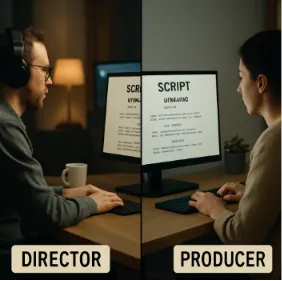
Perfectly planned student films often fall apart on set due to the dreaded “lost email” syndrome. For example, a director emails a script change at midnight, but the costume department shows up the next morning using an outdated printout. When essential film departments—like the director, producer, and crew—rely on disconnected text messages and paper trails, costly miscommunications are virtually guaranteed.
However, a digital “Flight Control Center” ensures everyone involved looks at the exact same blueprint. By utilizing cloud-based collaboration for student film projects, the entire team is finally working from a single version of truth. Furthermore, this is precisely why specialized Film Education Software is becoming vital. If a writer changes a scene from a sunny beach to a rainy diner, that update instantly ripples across everyone’s device.
Consequently, this unified ecosystem replaces confusion with clarity through real-time script revision tracking for film schools. Creative changes seamlessly sync to production logistics instantly, ensuring nobody wastes time preparing for a scene that no longer exists. Ultimately, mastering these collaborative workflows does more than just save today’s project; it completely transforms student readiness.
Bridging the Career Gap: Why 'Industry-Standard' Literacy is the New Resume Gold
Graduating with a beautifully shot short film no longer guarantees a Hollywood job. Instead, major studios seek applicants who already understand an Industry-Standard Workflow—the exact sequence of professional digital steps required to bring a script to the screen. By learning production management through Studiovity, students are actively bridging the gap between film school and industry expectations. Therefore, they prove to employers that they can step into a fast-paced, high-stakes set without needing months of basic software training.
Instead of handing interviewers a messy binder of graded assignments, these graduates present a Digital Production Archive. This serves as a complete, interactive record of every schedule, script breakdown, and budget they managed during their education. In addition, enhancing student film portfolios with professional Film Education Software gives young filmmakers a massive competitive edge. Consider how this living ecosystem outperforms a traditional folder of static PDFs:
Proof of Process: It shows exactly how a student solved complex scheduling problems, rather than just showing the final result.
Financial Literacy: It demonstrates the practical ability to track real-time budgets without going into the red.
Collaborative Footprint: It highlights their specific, measurable contributions within a larger creative team.
Instant Accessibility: Recruiters can click through a comprehensive project history in seconds.
Certainly, mastering this modern production ecosystem transforms academic exercises into undeniable proof of employability. Yet, students aren’t the only ones benefiting from this technological leap. When an entire curriculum runs on an organized network, it creates a massive ripple effect for faculty.
Transforming the Classroom: How Centralized Platforms End Administrative Burnout for Teachers
Professors frequently try to oversee thirty student films simultaneously by digging through endless emails and scattered spreadsheets. Thus, optimizing film school curriculum for the digital age requires rescuing educators from this massive administrative burnout. Enter the Centralized Academic Dashboard—a digital “Flight Control Center” that lets teachers monitor dozens of student film projects from a single screen. Rather than chasing missing paperwork, faculty can instantly see where every production stands.
Reclaiming this lost time fundamentally transforms the classroom dynamic. Because instructors can provide instant feedback on script-to-budget logic directly within the system, they stop acting as document chasers. Instead, they return to their true calling: creative mentorship. Thus, the real benefits of a centralized Film Education Software lie in letting institutions prioritize art over busywork. Consequently, relieving this heavy faculty burden smoothly sets the stage for the future of film education.
The Future of Film Education: Equipping the Next Generation of Visionaries
Modernizing film school production workflows is not just a tech upgrade; it protects a student’s educational investment from outdated, paper-based chaos. To build the future of film schooling today, institutes must take actionable steps to adapt:
Pilot: Test the digital hub on a single student short film.
Integrate: Blend these collaborative tools into the core curriculum.
Scale: Connect the entire campus through one centralized ecosystem.
Indeed, this clear evolution demonstrates exactly why universities need specialized Film Education Software. Technology should never replace creativity; rather, it exists to protect it. By eliminating the midnight panic of lost schedules, Studiovity ensures educators prioritize art over admin. Therefore, by implementing the right Film Education Software, tomorrow’s filmmakers leave campus not just knowing how to survive the modern industry, but fully prepared to lead it.