
Imagine showing up to an empty plot of land with piles of bricks and wood, but no floor plan to guide the builders. Chaos would inevitably break out as everyone tried to guess where the walls should go. Filmmaking operates on the exact same logic, yet many beginners try to grab a camera and start shooting without a map. Therefore, proper script planning for film is about avoiding that expensive afternoon of confusion.
Before a single actor steps on set, a movie is built entirely on paper. While you might use a screenplay writing guide to craft a compelling story, that initial document is just a creative sketch of dialogue and action. Consequently, to actually make the movie, that story must be transformed into a production blueprint—a logistical tool that tells everyone from the actors to the prop designers exactly what they need to do.
According to established industry standards, every page of properly formatted text translates to roughly one minute of screen time. This 1:1 page-to-screen ratio is the mathematical foundation of film scheduling. Knowing that a ninety-page script equals a ninety-minute feature allows directors to calculate exactly how many days, locations, and resources they need before spending a single dollar.
Relying on spontaneity might feel like the ultimate artistic choice, but winging it actually kills your ability to capture great moments. Frantically trying to figure out where to point the camera leaves no mental energy to help actors give their best performances. Ultimately, working through a rigorous pre-production checklist for filmmakers handles the stressful logistics upfront, giving you the true creative freedom to play, experiment, and capture magic on set.
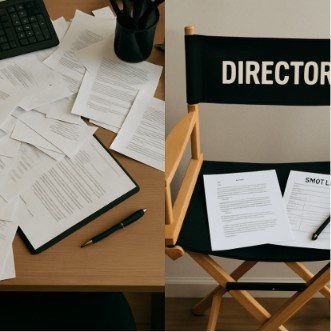
Standard Screenplay Formatting: How One Page Equals One Minute of Screen Time
Have you ever wondered why Hollywood still uses old-fashioned typewriter text? This industry-standard screenplay formatting isn’t a quirky tradition; it is a carefully calibrated timing tool. By strictly using Courier 12-point font, filmmakers can reliably estimate that one page of text equals exactly one minute of screen time. Thus, a 90-page script simply equals a 90-minute movie.
Beyond timing, a predictable movie script structure acts as a clear architectural blueprint for the crew. Every practical screenplay writing guide relies on four essential elements to communicate what happens on screen:
Slugline (Scene Heading): A short, uppercase line stating the exact location and time of day (e.g., EXT. PARK – DAY).
Action: A straightforward description of what the camera actually sees happening.
Character Name: Centered text showing exactly who is about to speak.
Dialogue: The specific words the actors will say out loud.
Mastering that first element—the Slugline—turns a creative story into a manageable construction project. Because these headings instantly identify where a scene takes place, directors can easily group matching locations together to film them all at once. Once you learn how to spot these location clues, you are entirely ready for the next logistical step: creating your film’s “grocery list” of props, actors, and gear.
The Script Breakdown: Creating Your Film’s 'Grocery List' of Props, Actors, and Gear
Showing up to bake a complex wedding cake only to realize you forgot the flour guarantees failure. In the movie world, missing a critical prop or costume can halt an entire day of shooting, which is why script planning for film requires shifting your brain. Specifically, you must transition from reading for the creative story to reading purely for logistics. This step is called a script breakdown, and it acts exactly like creating a massive grocery list for your production.
To build this list, filmmakers comb through the text looking for every single physical item needed on set. This process of organizing film scenes for production is known as “tagging.” By highlighting specific elements within the scene descriptions, the crew can prevent the dreaded “forgotten prop” delays that stall a shoot and waste valuable time. For example, if the script says a character drops a glass of water, tagging ensures someone actually remembers to bring both the cup and the water to the location.
Professionals use a universal color-coding system to categorize these physical items, making the script look like a colorful roadmap. While you can use any markers you have, standard industry highlighting includes:
- Red: Cast members (the specific actors needed).
- Orange: Stunts or specialized camera moves.
- Yellow: Extras and background actors.
- Purple: Props (objects the actors physically handle).
- Blue: Specific wardrobe or special makeup requirements.
Once your pages are fully highlighted, you will know exactly what physical pieces are required to bring the action to life. However, sometimes the action descriptions don’t tell the whole story, forcing you to identify production requirements directly from dialogue to catch hidden costs.
Mining Dialogue for Gear: How a Single Line Can Change Your Entire Budget
It is incredibly easy to read a script and only highlight the action, but spoken words often hide massive logistical traps. Because the traditional movie script structure separates what characters do from what they say, beginners frequently miss the invisible price tags attached to casual conversation. Deep screenplay analysis requires looking beyond the emotion of a scene to realize that an actor’s dialogue directly dictates your real-world physical constraints. Therefore, effective script planning for film means budgeting for what is said just as much as what is seen.
Consider a simple dinner sequence where a character casually remarks, “It is freezing out there.” Suddenly, identifying production requirements from dialogue becomes your biggest planning challenge. That one innocent line implies your actors need heavy winter coats, the sound team must record howling wind, and the lighting crew might need to fake frost on the windows. Thus, a single spoken phrase instantly impacts your prop, wardrobe, and location budget.
Even off-screen noises mentioned by actors demand immediate preparation long before the editing phase begins. If someone yells about a loud passing train, you must plan how to capture that specific audio chaos while filming. Once you have excavated every hidden prop and environmental cue from the text, you must translate those written details into visual plans through storyboards and shot lists, deciding exactly where the camera points before you arrive.
Storyboards vs. Shot Lists: Deciding Exactly Where the Camera Points Before You Arrive
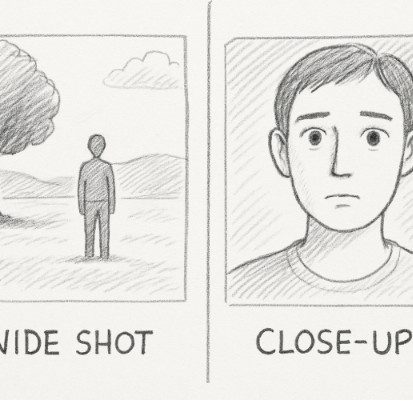
Just as a house needs blueprints, transforming a script into reality requires two crucial tools: storyboards and shot lists. While both aid script planning for film, they serve completely different purposes. A storyboard is a comic-book version of your scene, mapping visual narrative flow through simple sketches so everyone understands the overall mood. Meanwhile, a shot list is a strict logistical checklist of every specific camera angle needed that day. Understanding storyboard vs shot list importance prevents an expensive afternoon of confusion and missed opportunities.
Without enough angles, your scene will be impossible to cut together. Capturing these different viewpoints is called “coverage.” Before recording this coverage, you must lock in your “blocking,” which simply means deciding exactly where your actors will walk and stand in the room. You can guarantee you have enough editing options by planning these five essential setups:
Wide: Shows the entire room and character locations.
Medium: Captures actors from the waist up for casual interaction.
Close-up: Focuses tight on a face to highlight intense emotion.
Over-the-shoulder: Looks past one character to film whoever they are talking to.
Point-of-view: Shows exactly what a specific character is seeing.
Mastering this basic menu lets you communicate visual ideas clearly to anyone without needing a cinematography degree. However, knowing where to place the camera is only half the battle. Even beautifully planned footage feels lifeless if the performance falls flat.
Character Motivation Mapping: Giving Your Actors the 'Why' Behind Every Movement
A perfectly lit set means nothing if your actors look completely lost. Successful script planning for film involves more than camera logistics; it requires guiding the human element. This is character motivation mapping—a simple technique where you define the underlying “why” driving every action before filming begins.
Finding that hidden “why” means dividing your scene into emotional beats, which are distinct shifts in a character’s mood or tactics. As a core part of any step-by-step guide to screenplay analysis, you must locate exactly where a conversation turns from friendly to hostile. These inner emotional shifts directly dictate physical movement on set. For instance, an actor losing an argument might naturally retreat toward a doorway, giving your camera a compelling reason to follow their motion.
Providing this clear emotional roadmap ensures your cast feels prepared and purposefully directed rather than abandoned. When performers understand their precise goals within a room, you capture authentic moments instead of stiff, awkward blocking. Once these emotional performances are confidently planned, your focus shifts from the creative “why” to the logistical “when” of scheduling.
The Logic of Shooting Out of Order: Saving Thousands by Filming All Kitchen Scenes on Monday
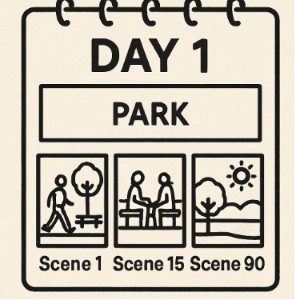
The reason making a movie takes so long is that organizing film scenes for production means ignoring the chronological story. If the opening scene and the grand finale both happen in a kitchen, you film them both on the exact same Monday. This strategy is called location stripping—pulling apart your script to group every scene set in one specific place. Because of this, detailed script planning for film becomes your primary weapon against budget waste.
Packing up crews and cameras to drive across town is known as a company move, and it wastes valuable hours. Learning how to schedule a film shoot effectively relies on avoiding these moves at all costs. Instead, you lock down one location and stay there. The advantages of thematic scene breakdowns and location-based scheduling include:
Location consolidation: Pay rental fees for a coffee shop once, not three separate times.
Actor schedules: Film a supporting character’s entire role in a single weekend.
Lighting consistency: Once your lights are perfectly set for a living room, you quickly film every scene happening in that space.
Treating your film like a logistical puzzle rather than a straightforward story saves your budget and protects your sanity. But how do you extract these locations and actors from a massive script without losing your mind? Choosing the right tool to organize your scene elements makes all the difference.
Manual vs. Digital Tagging: Choosing the Right Tool to Organize Your Scene Elements
Manually tracking every specific prop across a 100-page script is a logistical nightmare. Historically, script planning for film relied on highlighters to physically color-code pages—orange for actors, pink for props. This paper approach remains fantastic for short sketches because it forces you to deeply visualize the shoot without any learning curve. However, as your story expands, finding a single missed note on a printed page becomes incredibly difficult.
Upgrading to production software fundamentally changes how you handle this data. Instead of marking a physical page, you highlight text on your screen and assign categories, creating an instant database. The hidden logic of streamlining filming with scheduling software is automated cross-referencing. If you tag a red umbrella in scenes four and ninety, the program instantly generates a master prop list. Therefore, this digital method perfectly suits complex projects requiring computerized speed to track dozens of moving parts.
Choosing between manual vs digital tagging methods comes down to project scale, but the golden rule is always consistency. Whether you trust the tactile reliability of paper or the automated power of software, you must label every element uniformly. Consequently, this step simplifies your broader script planning for film efforts. Once you have successfully cataloged these physical ingredients, the final puzzle piece is mapping them onto a calendar.
Creating the Shooting Schedule: How to Balance Sunlight, Actor Hours, and Fatigue
Mapping out how to schedule a film shoot resembles building a puzzle where the pieces constantly shift. Since we shoot out of order based on location, your calendar must prioritize the environment first. For instance, a romantic sunset scene requires planning around “Golden Hour”—that brief, magical window of soft natural light just before dusk. You cannot fake the sun, so those environmental moments dictate exactly when your cameras must roll. Therefore, execution of script planning for film relies heavily on tracking natural constraints.
Beyond catching perfect sunlight, avoiding production delays through preparation requires balancing four strict boundaries:
Lighting: Chasing the sun or securing dark spaces for night scenes.
Location access: Knowing exactly when a rented property forces you to leave.
Actor ‘wrap’ times: Calculating the strict deadline to send people home (“wrap” means finishing the workday) so they can sleep.
Scene complexity: Allotting extra time for a complicated stunt versus a simple conversation.
Managing human energy proves just as crucial as tracking the weather. To keep the cast from burning out while waiting around, producers use a “Day-out-of-Days” (DooD) report—a simple chart showing exactly which days a specific actor works or rests. This document prevents you from accidentally scheduling someone to work fourteen days straight until they drop from fatigue. Once your calendar protects both your lighting and your crew’s stamina, you can confidently finalize your pre-production checklist.
The Essential Pre-Production Checklist: 5 Things You Must Verify 24 Hours Before 'Action'
Discovering on set that your lead actor’s red shirt blends perfectly into the red brick wall behind them is a completely avoidable visual disaster. You can prevent these setbacks by reviewing the essential elements of a production draft and conducting a “tech rehearsal”—a practical practice run where you test your camera angles and wardrobe against the actual environment. Before anyone steps on set, you need a bulletproof pre-production checklist for filmmakers to catch missing items. Thus, systematic script planning for film guarantees you catch these errors before they cost money.
To prevent a chaotic morning, verify these five critical details 24 hours before filming begins:
Battery charge: Ensure every camera and lighting power source is sitting at 100%.
Memory cards: Format your digital storage so you aren’t scrambling to delete old files on set.
Location keys: Confirm you have physical access to the building or property.
Weather check: Review the local forecast for sudden rain, wind, or cloud cover.
Call sheet sent: Distribute the “Call Sheet“—a daily master schedule telling every cast and crew member exactly when and where to park, eat, and work.
Checking these final boxes guarantees that every physical item you planned for is actually in your hands. Once your gear is tested and your team knows the plan, you are fully prepared to transition from script to screen.
Transitioning from Script to Screen: Turning Your Blueprint into a Finished Motion Picture
You no longer have to view filmmaking as a chaotic mystery. You now have the power to look at a screenplay not just as a story, but as an architectural blueprint. By recognizing the direct relationship between the script, the logistical breakdown of ingredients, and your schedule, you are equipped to build a production on solid ground. This foundational understanding of script planning for film ensures your creative energy is spent capturing great performances, not panicking over missing props.
To put this knowledge into practice, execute a simple three-step strategy for your personal film project. First, take a short scene and read it purely for logistics, circling every required actor, prop, and location. Next, translate those circled items into preparation documents so you know exactly what to bring. Finally, group the scenes by location rather than chronological order, allowing you to shoot complex setups early in the day.
Following this method acts as a reliable pre-production checklist for filmmakers of any experience level. Mastering script planning for film and learning how to transition from script to screen means you are actively engineering a movie’s success. Each time you apply this process, you will gain the leadership confidence needed to guide your crew efficiently, saving time and money while keeping morale high.
The next time you watch your favorite movie, you will see past the stunning visuals to the meticulous logistical framework holding it together. Understanding this logistical framework transforms you from a passive fan into a capable creator. Grab a script, map out your blueprint, and step onto your set as a director ready to bring your vision to life.
Streamline Your Script Planning for Film with Studiovity
Transforming a creative screenplay into a bulletproof production blueprint requires precision, but you do not have to handle the logistics alone. Studiovity simplifies your script planning for film by automating the heavy lifting. From instant, digital script breakdowns and color-coded character tagging to dynamic shot lists and smart production scheduling, Studiovity unites your creative vision with real-world logistics in one intuitive platform. Stop wrestling with cluttered spreadsheets and missing props. Sign up for Studiovity today, build your ultimate movie blueprint, and step onto your next film set with absolute director confidence.