
Think about the latest blockbuster car chase you watched. Behind every shattered windshield and background extra was a crew member with a highlighter, manually extracting every prop from the text. If a movie is a complex meal, the script is the recipe, and the script breakdown is the grocery list. Industry data reveals this tedious data entry consumes nearly 40% of traditional pre-production. This explains how AI Script Breakdown Improves Film Budgeting and Scheduling for modern filmmakers.
Translating those gathered details into budget line items connects script pages directly to costly shoot days. Functioning as a digital reading assistant, machine learning for movie pre-production removes human fatigue. Comparing manual and automated workflows clearly shows how AI Script Breakdown Improves Film Budgeting and Scheduling. It never replaces artists. Instead, it handles the technical calculations so creators can focus on storytelling.
Turning Highlighters into Algorithms: How AI 'Reads' a Script in Seconds
A massive 120-page blockbuster script traditionally requires a crew member to read every page with colored highlighters and manually track every required item. This process becomes exhausting, and human errors increase over time. Today, automated scene element extraction performs this digital highlighting in seconds without slowing down.
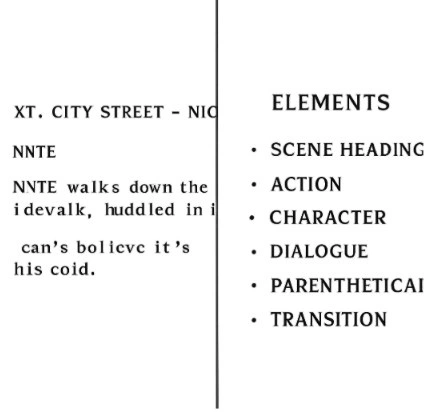
Instead of viewing plain text, modern AI script analysis understands scene context with impressive accuracy. When the system reads “James throws the keys to the Aston Martin,” it automatically creates metadata tags and transforms the story into an organized production list. Specifically, it instantly extracts four core categories:
- Characters (Cast)
- Props (Objects)
- Locations (Settings)
- Vehicles
This AI script breakdown also analyzes complex scene headings to identify specialized equipment requirements. It accurately separates indoor day shoots from outdoor night scenes. Once every item gets tagged, the software creates the foundation for digital stripboard generation, the film industry’s version of a master calendar. This process demonstrates another reason how AI Script Breakdown Improves Film Budgeting and Scheduling across modern productions.
With all production elements prepared, filmmakers can move to the next phase: building an efficient shooting schedule.
The Travel Agent Logic: Using AI to Build the Perfect Shooting Schedule
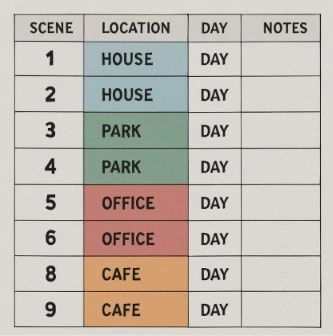
Imagine flying to London, returning to New York, and then flying back to London only for dinner. That is exactly how inefficient filming in script order would become. To solve this issue, filmmakers use a stripboard, a visual production calendar where every scene appears as a movable colored strip. Historically, Assistant Directors spent weeks rearranging these strips manually. Now, digital stripboard generation instantly organizes them through “block shooting,” a strategy that films all scenes at one location together regardless of story order.
Instead of relying on guesswork, the algorithm functions like an elite travel planner. AI-driven production schedule optimization creates a practical itinerary that avoids expensive logistical mistakes by evaluating three major constraints:
- Location Proximity: Grouping nearby sets to reduce expensive crew moves.
- Actor Availability: Tracking the “Day Out of Days” chart to minimize paid idle time.
- Time of Day: Clustering day or night scenes to simplify lighting setups.
Before these tools existed, missing an actor’s blackout date could disrupt an entire production. Today, predictive analytics for film shooting days flags those conflicts instantly and reduces unnecessary location expenses. This scheduling precision further highlights how AI Script Breakdown Improves Film Budgeting and Scheduling for productions of every size.
Real-Time Price Tags: Connecting Scene Elements Directly to Your Bank Account
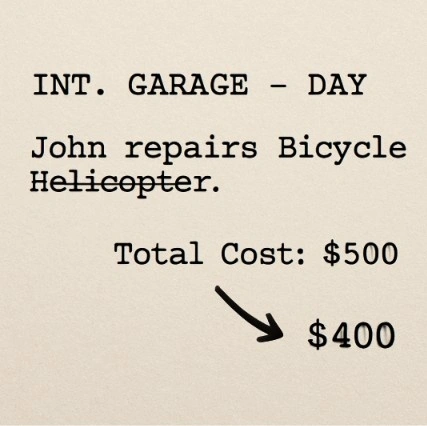
In Hollywood, adding a single word to a script can dramatically increase production costs. Traditionally, a Line Producer spent days recalculating expenses whenever directors changed a “car” into a “helicopter.” Today, artificial intelligence acts like a smart shopping cart and automatically tracks those creative changes.
When writers revise scenes, the software instantly links new elements to line items, the categories inside a production accounting ledger. If a scene changes from day to night, the system immediately adds lighting equipment costs into the running budget. This instant feedback supports cost-effective resource allocation and helps creators understand the financial impact of creative decisions before production begins.
Replacing manual calculations represents a major improvement in reducing human error in film budget forecasting. Predictive cost tracking helps producers avoid financial surprises during filming. In addition, this workflow clearly shows how AI Script Breakdown Improves Film Budgeting and Scheduling through accurate financial planning.
Reducing Human Error in the Production Pipeline: Why AI Beats the Spreadsheet
Inside the pressure-filled environment of a film set, a single oversight can delay production and increase costs. Historically, exhausted crew members working with spreadsheets and highlighters made avoidable mistakes. Today, AI-powered production tracking acts as a safety net by eliminating three common manual errors:
- Missing a character in a scene.
- Miscalculating page count for shooting time.
- Forgetting equipment required for night shoots.
Cloud-based script analysis platforms also keep production teams synchronized in real time. If a director changes a location, schedules update immediately across departments. As a result, teams avoid communication gaps and production delays.
Despite this digital precision, software cannot replace human creativity or decision-making. Human review still remains essential for verifying whether the production plan supports the artistic vision. Even so, filmmakers continue discovering how AI Script Breakdown Improves Film Budgeting and Scheduling by reducing repetitive technical work.
From Paper to Production: Embracing the Digital Transformation of Filmmaking
Filmmakers no longer need to treat pre-production like a battle with spreadsheets and highlighters. By automating script breakdowns for indie films, production teams reclaim valuable hours and improve planning accuracy. Start by running your next screenplay through an AI-powered breakdown tool to instantly generate scene elements. Once the software tags props and locations, it quickly builds the foundation for your first production budget.
Integrating AI into the production pipeline can reduce technical administrative work by nearly 80%. Instead of spending weeks counting extras or reorganizing schedules, filmmakers can focus on creative decisions that improve the final story. This digital shift perfectly demonstrates how AI Script Breakdown Improves Film Budgeting and Scheduling while allowing storytellers to focus on filmmaking instead of manual calculations.
As production technology continues evolving, AI tools will become an essential part of modern filmmaking workflows. Studios, independent creators, and production managers already rely on intelligent automation to save time, reduce costs, and improve accuracy. Ultimately, how AI Script Breakdown Improves Film Budgeting and Scheduling comes down to one simple advantage: it gives filmmakers more time and energy to create better stories.
Simplify Film Pre-Production with Studiovity
Modern filmmakers need faster and smarter ways to manage production planning, and Studiovity helps make that possible. From AI-powered script breakdowns and intelligent scheduling to budgeting, shot listing, storyboarding, and call sheets, the platform streamlines every stage of pre-production in one connected workspace. Whether you are managing an indie short film or a large-scale production, Studiovity helps production teams reduce manual work, improve collaboration, and make quicker creative decisions. By combining automation with filmmaker-focused workflows, Studiovity gives creators more time to focus on storytelling while keeping budgets and schedules under control.