
Have you ever walked onto a film set or joined a production meeting? Did you hear words that sounded like a different language? The industry relies heavily on specific Filmmaking Terminology. Every department uses these terms to communicate quickly and keep production moving. Therefore, understanding these terms helps writers, directors, producers, actors, and crew members work together more efficiently.
Whether you are writing your first screenplay, preparing for a film shoot, or planning a production, learning Filmmaking Terminology will improve your communication and confidence. Moreover, it reduces misunderstandings, saves valuable time, and helps every department stay on the same page.
In this guide, you will learn some of the most common vocabulary used in the industry. You will also understand how professionals use this essential Filmmaking Terminology during every stage of production.
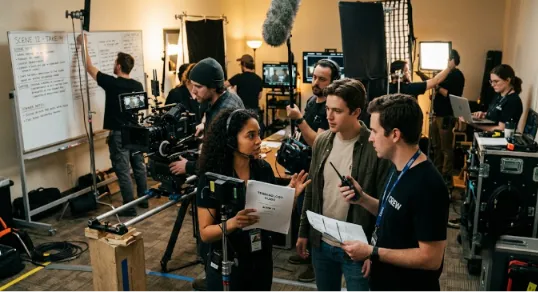
Why Filmmaking Terminology Matters
Filmmaking involves hundreds of creative and technical decisions. Every department contributes to the final project. Consequently, clear communication becomes essential throughout production.
When a director asks for a close-up or a producer requests a call sheet, everyone must understand exactly what those terms mean. Likewise, editors, cinematographers, assistant directors, and production designers rely on shared Filmmaking Terminology to complete their work efficiently.
Furthermore, many filmmaking software platforms also use these industry terms. Therefore, learning this Filmmaking Terminology makes it easier to understand production documents and collaborate with experienced professionals.
Common Screenwriting Terms
Every film begins with a script. Therefore, screenwriting introduces several important terms that every filmmaker should know.
A slugline appears at the beginning of every scene. It identifies whether the scene takes place inside or outside, specifies the location, and indicates the time of day. This information helps every department prepare for production.
An action line describes everything happening on screen. It focuses only on visible actions instead of characters’ thoughts or emotions.
A dialogue section contains the words spoken by characters. Meanwhile, a parenthetical provides brief direction about how a line should be delivered when necessary.
A beat represents a significant emotional or story moment. Writers often use beats to maintain pacing and structure throughout the screenplay.
Finally, a draft refers to a version of the screenplay. Writers usually create multiple drafts before the script reaches production.
Pre-Production Terminology
Pre-production transforms a script into a production plan. Therefore, many planning terms become essential during this stage.
A script breakdown separates every scene into production elements such as cast members, props, costumes, locations, vehicles, makeup, and special effects. As a result, every department knows what it must prepare before filming begins.
A shooting schedule organizes scenes across filming days. Instead of following the story sequence, productions usually group scenes by location, cast availability, and production efficiency.
A call sheet serves as the daily schedule for the cast and crew. It includes call times, filming locations, weather information, contact details, scene numbers, and important production notes.
A shot list outlines every camera shot planned for each scene. Consequently, the director and cinematographer can execute the visual plan more efficiently.
Meanwhile, a storyboard uses illustrations to visualize scenes before filming starts. Directors often use storyboards to communicate camera movement and shot composition.
Camera and Cinematography Terms
The cinematography department creates the visual language of a film. Therefore, understanding camera terminology helps filmmakers communicate more effectively.
A wide shot captures the entire subject and surrounding environment. In contrast, a medium shot frames a subject from the waist up, while a close-up emphasizes facial expressions or important details.
An extreme close-up highlights a very small detail, such as an eye, hand, or object. Directors often use this shot to increase emotional impact.
A tracking shot follows a moving subject using a moving camera. Similarly, a pan moves the camera horizontally from a fixed position, while a tilt moves it vertically.
A dolly shot moves the entire camera toward or away from the subject. Meanwhile, a crane shot raises or lowers the camera through space to create dramatic movement.
The term frame rate describes the number of images captured each second. Different frame rates create different visual styles. For example, filmmakers often use higher frame rates for slow-motion sequences.

Production Terms Used on Set
Once filming begins, the crew uses specific terminology throughout the day. Therefore, everyone on set becomes familiar with these expressions.
A take represents one recorded attempt at filming a shot. Directors may record several takes before selecting the best performance.
A setup includes the camera position, lighting arrangement, and actor placement before filming begins. After completing one setup, the crew prepares the next.
The phrase rolling means the camera and sound recorder have started recording. Shortly afterward, the assistant director usually calls action, signaling actors to begin performing. At the end of the scene, the director calls cut, which stops the performance.
A wrap indicates that filming has finished for the day or that an actor has completed all scheduled scenes. Therefore, hearing “That’s a wrap” often marks the end of production activities.
Editing and Post-Production Terms
After filming ends, editors transform raw footage into the finished film. Consequently, post-production introduces another set of important terms.
A rough cut represents the first edited version of the movie. Editors focus on story flow before refining smaller details.
A final cut becomes the completed version approved for release. It includes picture editing, sound design, music, visual effects, and color correction.
A timeline refers to the editing workspace where video, audio, and effects appear in sequence.
Color grading adjusts colors, brightness, and contrast to establish the desired visual style. Meanwhile, sound mixing balances dialogue, music, and sound effects to create a polished audio experience.
Editors also use transitions to connect scenes. Although cuts remain the most common transition, dissolves and fades also appear when the story requires them.
Business and Distribution Terms
Filmmaking continues after post-production. Therefore, understanding business terminology also benefits aspiring filmmakers.
The box office measures ticket sales and financial performance after a film’s release.
A distribution deal allows a distributor to release the film in theaters, television networks, or streaming platforms.
An independent film, often called an indie film, operates without major studio financing. However, many independent productions still achieve commercial and critical success.
A film festival provides filmmakers with opportunities to showcase their work, connect with industry professionals, and secure distribution. Festivals also help emerging filmmakers build credibility within the industry.
Tips for Learning Filmmaking Terminology
Learning industry vocabulary becomes easier with regular practice. Therefore, read professional screenplays whenever possible to master foundational Filmmaking Terminology. Observe how writers format scenes and use industry-standard language.
Next, watch behind-the-scenes videos to hear professionals communicate during production. Additionally, explore production documents such as shooting schedules, script breakdowns, and call sheets.
Finally, use professional filmmaking software while working on your own projects. Practical experience reinforces new Filmmaking Terminology much faster than memorization alone.
Final Thoughts
The filmmaking industry relies on clear communication from the first script draft to the final release. Therefore, understanding core Filmmaking Terminology helps every member of the production team collaborate more effectively.
Whether you are an aspiring screenwriter, filmmaker, producer, cinematographer, editor, or film student, these terms provide a strong foundation for your creative journey. Moreover, they make production meetings, film sets, and collaborative projects much easier to navigate.
As your experience grows, you will naturally learn even more specialized vocabulary. However, mastering these essential filmmaking terms is the perfect place to begin. With the right knowledge and consistent practice, you can communicate like a professional and contribute confidently to any film production.