
A strong screenplay breakdown turns a script from a creative document into a practical production plan. Consequently, it helps producers, assistant directors, line producers, and department heads understand what each scene requires. Therefore, teams can easily see how complex the shoot may be. Furthermore, they can spot where potential budget or scheduling issues may appear.
However, a breakdown is only useful when it remains accurate and consistent. In addition, it must connect to the realities of production. Unfortunately, a rushed or incomplete breakdown can lead to missing props and confused departments. As a result, you might face inefficient schedules, avoidable rewrites, and unexpected costs.
Perhaps you are preparing your first short film. Alternatively, you might be organizing an independent feature or refining your professional workflow. Regardless, the goal is not simply to mark up a script. Instead, you must understand the story deeply. Thus, you can anticipate what the production needs before problems appear on set.
This screenplay breakdown guide explores the most common mistakes people make during the process. Furthermore, it shows you how to avoid them with practical, production-minded habits.
What a Screenplay Breakdown Actually Does
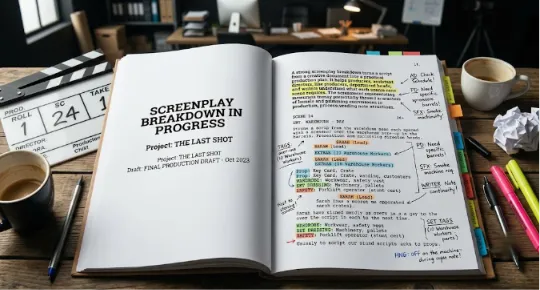
A screenplay breakdown identifies and organizes every meaningful element in a script that affects production. Specifically, this usually includes characters, extras, props, wardrobe, vehicles, animals, and stunts. Moreover, it tracks special effects, visual effects, makeup, locations, set dressing, and sound needs.
In many workflows, managers review each scene individually. Next, they separate these details into clear categories. Consequently, those details inform scheduling, budgeting, department planning, location scouting, casting, and call sheets.
Indeed, a good breakdown answers several critical questions:
Who appears in each scene?
Where does the scene take place?
Is the scene interior or exterior?
Is it day or night?
What props, costumes, vehicles, or special equipment does the crew need?
Are there stunts, intimacy, animals, children, weapons, or crowd scenes?
What elements could increase cost, time, or risk?
Are there continuity concerns across scenes?
Ultimately, a breakdown is both creative and logistical. Therefore, it respects the story while translating that story into actionable production information.
Mistake 1: Starting the Breakdown Before Reading the Full Script
One of the biggest mistakes is jumping straight into marking elements before reading the entire screenplay. Consequently, this often leads to shallow or inconsistent choices. This happens because the reader does not yet understand the story’s structure, character arcs, or recurring props.
For example, a prop that seems insignificant in scene two may become crucial in scene eighty. Likewise, a minor character may appear in enough scenes to affect scheduling. Furthermore, a location that looks simple at first may require major coordination later.
Therefore, read the script from beginning to end at least once without marking it. Focus entirely on story, tone, genre, pacing, and major production concerns. On a second pass, you can begin identifying specific elements.
Clearly, this is one of the most important screenplay breakdown tips. It prevents you from treating scenes as isolated units because a screenplay is connected. Thus, your breakdown should reflect those connections perfectly.
Mistake 2: Confusing Story Analysis With Production Breakdown
Story analysis and production breakdown are related, but they remain distinct tasks.
Specifically, story analysis asks whether the script works dramatically. It examines structure, character motivation, theme, dialogue, pacing, and emotional impact. Conversely, a production screenplay breakdown asks what the script requires to be filmed.
For example, story analysis might note that a scene lacks tension. In contrast, a production breakdown notes that the scene requires rain effects, three background actors, a vintage car, a dog, and night exterior lighting.
Writers, directors, and producers often benefit from both types of analysis. However, mixing them too casually can create confusion. If you perform a production breakdown, avoid filling your notes with vague creative opinions. If you give screenplay writing tips, separate those notes from the breakdown itself.
Therefore, a clean workflow might include:
Creative notes for story, character, and dialogue issues
Production notes for elements, locations, scheduling, and budget concerns
Continuity notes for repeated actions, wardrobe, props, and timeline issues
Risk notes for scenes involving safety, legal, or technical complexity
Consequently, keeping these categories separate makes your work more useful to every department.
Mistake 3: Ignoring Scene Headings
Scene headings serve as the backbone of a breakdown. They tell you where the scene takes place, whether it is interior or exterior, and whether it occurs during day or night. When scene headings are unclear, inconsistent, or missing, the entire breakdown becomes harder to trust.
Common scene heading problems include:
Using multiple names for the same location
Forgetting to indicate interior or exterior
Switching between time markers without clear purpose
Combining multiple locations into one scene heading
Writing transitions as if they are new scenes
Using overly poetic headings that do not help production
For example, one scene heading might say “INT. JANE’S APARTMENT – NIGHT.” Then, another says “INT. JANE’S PLACE – LATE EVENING.” Consequently, the breakdown team may wonder whether these are the same location or different sets.
Fortunately, writers can make breakdowns easier by keeping scene headings simple and consistent. Meanwhile, production teams can help by flagging unclear headings early.
Mistake 4: Missing Implied Elements
Not everything needed for a scene appears explicitly in dialogue or action lines. In fact, many important elements are implied.
If a character “answers the phone,” the scene naturally needs a phone. Similarly, if someone “gets into the car,” the scene requires a vehicle. If a couple “sits down for dinner,” the scene may need plates, glasses, food, chairs, and table dressing.
Missing implied elements is a common beginner mistake. This happens because a superficial breakdown only captures obvious nouns. Therefore, a strong breakdown requires production imagination. You need to picture the scene as you will actually film it.
Specifically, look for implied needs related to:
Food and drink
Phones, bags, books, keys, and personal items
Furniture and set dressing
Weather conditions
Screens, documents, photos, and signage
Background activity
Wardrobe changes
Character injuries or makeup continuity
Sound sources, such as radios, televisions, or crowds
Thus, a practical approach is to ask, “What must physically exist for this action to happen on camera?” That single question will reveal many hidden elements.
Mistake 5: Over-Tagging Everything
While missing elements is a problem, over-tagging can be just as damaging. If you treat every tiny object as a major production element, the breakdown becomes cluttered and difficult to use.
Clearly, not every chair, pen, wall, or generic background object needs the same level of attention. Instead, the key is to identify items that affect departments, continuity, scheduling, budget, or on-camera action.
For example, a “red envelope containing the blackmail photos” is highly important. However, a random envelope on a desk is not. Therefore, you should tag a hero prop clearly, while set dressing notes can handle generic office clutter.
Ask these questions before tagging an item:
Does a character interact with it?
Is it important to the plot?
Does it need to match across scenes?
Does it require design, purchase, clearance, safety review, or duplication?
Does it affect a specific department’s preparation?
Ultimately, a useful breakdown is detailed, not bloated. The goal is clarity.
Mistake 6: Failing to Track Continuity
Continuity issues often begin in the breakdown stage. If no one tracks repeated props, wardrobe changes, injuries, weather, or the story timeline, mistakes can multiply quickly. This is especially true once the production schedule rearranges scenes.
Scripts are rarely filmed in story order. For instance, a character may be clean in one scene and covered in mud in the next. However, the crew might shoot those scenes weeks apart. Without breakdown notes, departments may not know what state the character should look like.
Therefore, important continuity elements include:
Wardrobe condition and changes
Hair and makeup progression
Injuries, bruises, blood, or dirt
Prop placement and use
Time of day within the story
Weather across connected scenes
Food and drink levels
Character emotional state
Screen content on phones, computers, or televisions
Consequently, continuity tracking is one area where screenplay writing tips and production advice overlap. Writers can help by making timeline shifts clear on the page. Meanwhile, production teams can identify continuity chains during the breakdown.
Mistake 7: Treating Background Actors as an Afterthought
Background actors can have a major impact on cost, scheduling, wardrobe, makeup, transportation, and location logistics. Yet teams often undercount or ignore them in early breakdowns.
For example, a scene in a “busy restaurant,” “crowded courtroom,” or “packed nightclub” requires significant planning. Even a small group of background actors needs coordination, holding space, paperwork, wardrobe direction, and time.
Therefore, avoid vague assumptions when breaking down scenes with background activity. Note the exact type of background presence you need:
General pedestrians
Restaurant patrons
Office workers
Students
Police officers
Medical staff
Party guests
Drivers or passersby
Also consider whether background actors need specific actions, costumes, props, or vehicles. Remember, a crowd is not just one element. Instead, it represents a complex production requirement.
Mistake 8: Underestimating Location Complexity
A location is far more than a place listed in a scene heading. Specifically, it affects access, permits, sound, lighting, power, parking, weather, safety, company moves, and production design.
A script may contain ten scenes set in a café. However, that does not automatically mean the café is easy to shoot. For instance, is it open during business hours? Can you control the lighting? Is there street noise?
Common location-related breakdown mistakes include:
Counting locations without considering company moves
Ignoring night exterior requirements
Overlooking weather exposure
Missing scenes that require crowd control
Forgetting about sound challenges
Assuming a real location can support scripted action
During the breakdown, flag locations that may require extra scouting, permits, or set builds. Early awareness gives the production team far more options.
Mistake 9: Not Identifying Special Requirements Early
Some script elements require specialized planning, safety procedures, legal review, or additional budget. If you discover them too late, they can easily disrupt the schedule.
Special requirements may include:
Stunts or fights
Weapons
Vehicles in motion
Fire, smoke, or explosions
Water scenes
Animals or children
Intimacy scenes
Special effects makeup or visual effects
Drones or practical effects
Period costumes or sets
Music performance scenes
Even a simple-looking scene can become complicated. For example, a character driving while speaking or holding a firearm requires extra coordination.
Therefore, a reliable screenplay breakdown guide should always emphasize risk visibility. You are not solving every issue during the first pass. However, you are making sure the right people know the issue exists.
Mistake 10: Ignoring Budget Implications
A screenplay breakdown does not replace a full budget, but it directly informs one. Indeed, every element you identify may affect cost.
A common mistake is treating the breakdown as a paperwork task instead of a budget intelligence tool. If the script includes multiple locations, large cast days, night shoots, or stunts, those details matter long before production begins.
Budget-sensitive elements often include:
Number of speaking roles and background actors
Location count
Day versus night scenes
Practical and visual effects
Period details
Specialty props or wardrobe
Travel needs
Animals and handlers
Minors and required working limitations
If you are a writer trying to create a more producible script, this is where screenplay writing tips become practical. You do not have to avoid ambitious scenes. However, you should understand their production impact. For example, combining locations or simplifying crowd scenes can make a script more feasible without weakening the story.
Mistake 11: Breaking Down an Outdated Draft
Screenplays change constantly. If the breakdown is based on an old draft, departments may prepare for scenes, props, characters, or locations that no longer exist.
This mistake is especially common when revisions happen quickly. Someone updates the script, but the breakdown or schedule does not get updated at the same pace.
To avoid this problem:
Confirm the draft date before starting
Use consistent file naming conventions
Track revision colors or version numbers
Communicate changes clearly to department heads
Revisit affected scenes after every major rewrite
Ultimately, a breakdown should always be tied to a specific script version. If the script changes, the breakdown must change with it.
Mistake 12: Forgetting Character Appearances and Cast Days
Every character appearance affects scheduling and cast availability. Missing a character in a scene can create serious problems later, especially when actor contracts, travel, or limited availability are involved.
Do not rely only on dialogue to identify who appears. For instance, a character may be present silently, seen in the background, shown in a photo, or represented by a body double.
Track appearances such as:
Speaking roles
Non-speaking character presence
Voiceover or phone voices
Photo or video appearance
Stunt double or body double needs
Child versions or older versions of characters
Insert shots involving hands or body parts
A character who appears for one silent moment still matters. Therefore, the breakdown should make that clear.
Mistake 13: Not Thinking About Time of Day
Day and night are not just visual labels. In fact, they heavily affect lighting, scheduling, crew hours, location availability, and production cost.
Night shoots are generally more complex. Exterior night scenes require additional lighting, safety planning, permits, and neighborhood considerations. Meanwhile, interior night scenes still require controlling windows and practical lights.
Mistakes often happen when scripts use vague time labels like “later,” “continuous,” or “magic hour” without production clarity. Therefore, you should flag these during the breakdown.
For example, “magic hour” gives the production a very limited shooting window. Similarly, “continuous” implies no time jump, which affects wardrobe, makeup, and props. Always note time-of-day details to identify scenes that may create scheduling pressure.
Mistake 14: Overlooking Sound Needs
Because screenplays are visual documents, sound requirements are often overlooked in breakdowns. However, sound can create real production needs.
Look for elements such as:
Live music or playback
Crowds chanting or cheering
Public announcements
Phones ringing or alarms
Sirens or off-screen voices
Animal sounds or machinery
Environmental noise
Some sound elements may be added in post-production, while others require playback or on-set coordination. Music performance scenes are especially important because they involve instruments, playback systems, synchronization, and extra rehearsal. Therefore, if sound is important to the action, include it in your notes.
Mistake 15: Assuming Visual Effects Can Be “Fixed Later”
Visual effects are sometimes treated as a post-production problem. However, many VFX needs must be planned before shooting. If the breakdown misses them, the production may fail to capture plates, tracking markers, or necessary coverage.
Common VFX-related elements include:
Screen replacements
Digital backgrounds or set extensions
Object removal
Muzzle flashes
Digital wounds or enhancements
Weather additions
Crowd duplication
Creature or character effects
Even simple effects should be flagged. The earlier the VFX team knows what is required, the better they can advise the shoot.
Mistake 16: Not Collaborating With Department Heads
A breakdown should never live in isolation. The assistant director, production designer, costume designer, makeup department, and stunt coordinator may all see different needs in the same scene.
One person may identify the obvious elements, but specialists catch the details. For instance, costume may notice a wardrobe continuity issue. Meanwhile, makeup may flag injury progression. Furthermore, stunts may recognize that a simple action line requires safety planning.
Collaboration improves accuracy and reduces surprises. Therefore, you should review major breakdowns with the key people responsible for executing the work.
Mistake 17: Using Software Without Understanding the Process
Breakdown software can be extremely useful, but it does not replace human judgment. A tool can organize categories and generate reports, but it cannot always understand context, implication, or production risk.
If you rely entirely on software tagging, you may miss subtle elements or over-tag irrelevant ones. Therefore, the strongest users combine software efficiency with careful reading and production experience.
Before using any tool, understand the fundamentals:
What each breakdown category means
Why elements are tagged
How reports will be used
Which departments need which information
How changes are tracked
Technology should support the process, not define it.
Mistake 18: Skipping a Final Review Pass
After the first breakdown pass, it is tempting to move on. However, a final review often catches missed characters, inconsistent location names, untagged props, and continuity issues.
A useful final review includes several passes:
Character pass: Confirm every character appearance.
Location pass: Check location names for consistency.
Props pass: Identify hero props and continuity items.
Wardrobe and makeup pass: Track changes, injuries, and special looks.
Special requirements pass: Flag stunts, VFX, animals, children, and weapons.
Budget pressure pass: Look for expensive or logistically difficult scenes.
Draft version pass: Confirm the breakdown matches the current script.
This step may feel repetitive. Nevertheless, it is much easier to fix errors during prep than on set.
Practical Workflow for a Cleaner Breakdown
A reliable screenplay breakdown does not need to be complicated. What matters most is consistency.
Use this workflow as a starting point:
Read the full script once without tagging to understand the story first.
Confirm the correct draft version so everyone stays aligned.
Review scene headings to flag unclear locations or time labels.
Break down scene by scene, identifying cast, props, wardrobe, and locations.
Look for implied elements that must exist physically on screen.
Track continuity across scenes for items, looks, and conditions.
Flag risk and complexity, highlighting anything that requires special planning.
Review with department heads so specialists can refine the notes.
Update after revisions to keep the breakdown aligned with the script.
Generate useful reports to support scheduling, budgeting, and prep.
These screenplay breakdown tips apply to productions of almost any size. The scale may change, but the core principles remain the same.
How Writers Can Make Breakdowns Easier
Even if you are not producing the script yourself, understanding breakdown basics can improve your writing. Production-aware writing is not about limiting creativity. Instead, it is about making intentional choices.
Here are a few screenplay writing tips that help both the story and the eventual production:
Use clear, consistent scene headings.
Avoid unnecessary location changes when scenes could be combined.
Be intentional with crowds, stunts, animals, vehicles, and effects.
Make important props clear on the page.
Track character injuries, wardrobe changes, and time jumps.
Avoid adding expensive elements that do not serve the story.
Clarify whether off-screen voices or media clips require specific treatment.
Keep action lines visual and specific enough to be filmed.
A producible script can still be highly ambitious. The key is making sure every complex element earns its place on the page.
Final Thoughts
A screenplay breakdown is where creative vision meets practical execution. When done well, it protects the story by helping the production prepare properly. Conversely, when done poorly, it creates confusion, missed details, scheduling problems, and budget surprises.
The most common mistakes usually come from rushing, assuming, or reading too literally. Therefore, a strong breakdown requires patience, imagination, and collaboration. You need to understand what is written, what is implied, and what each department will need to bring the scene to life.
Ultimately, use the breakdown process as more than an administrative step. Treat it as a creative planning tool, a communication system, and an early warning system for production challenges. The more carefully you break down the script, the more confidently you can move from page to screen.