What Is a Development Producer? Roles & Responsibilities

Every successful film or television project starts with a strong idea. However, great ideas rarely reach production without careful planning and creative guidance. That is where a development producer becomes essential. This professional shapes concepts, evaluates scripts, works with writers, and prepares projects before cameras start rolling.


Whether you plan to work in filmmaking or simply want to understand the production process, learning about this role provides valuable insight into how stories evolve from an idea into a production-ready project.

A group of people around a wooden desk, collaborating on a project with a woman pointing at a paper, and a white board in the background.

What Is a Development Producer?

A development producer oversees the earliest stage of film, television, or digital content creation. Instead of managing production on set, they focus on developing stories that have creative and commercial potential.


Their work begins long before filming starts. First, they discover promising ideas from writers, books, articles, or original concepts. Next, they refine those ideas through multiple script revisions. Finally, they prepare projects for financing, pitching, and production. Because of this, these professionals play a major role in determining whether a project moves forward.

Why Is Development So Important?

Many projects fail before production because the story lacks structure, market appeal, or financial viability. Development solves these problems early.


A professional in this role helps identify weaknesses before they become expensive mistakes. They improve scripts, strengthen characters, clarify themes, and ensure the story matches audience expectations. Moreover, they balance creativity with business goals. As a result, producers, investors, and studios gain greater confidence in the project.

Key Responsibilities of a Development Producer

Although every production company works differently, most individuals in this position handle similar responsibilities.

Finding New Story Ideas

Development begins with discovering strong concepts. A development producer reads scripts, books, articles, and treatments while searching for stories with production potential. Sometimes they work directly with writers. Other times they secure adaptation rights for existing material. Consequently, they constantly evaluate originality, audience demand, and production feasibility.

Working With Screenwriters

Script development forms the core of the job. Rather than rewriting every screenplay themselves, they guide writers through several drafts. They provide detailed notes on pacing, dialogue, character arcs, structure, and emotional impact. Throughout the process, they encourage collaboration while protecting the project’s creative vision.

Evaluating Commercial Potential

Creative quality alone does not guarantee success. These specialists also analyze budgets, target audiences, streaming trends, competing projects, and distribution opportunities. Therefore, they consider whether the story can attract investors, studios, or production partners. This balance between creativity and business makes the role especially valuable.

Preparing Pitch Materials

Before producers seek financing, projects need professional presentation materials. They often help create treatments, pitch decks, loglines, synopses, character descriptions, and presentation documents. These materials communicate the project’s vision quickly and clearly. As a result, investors and production companies can evaluate opportunities more efficiently.

Coordinating Early Development

They regularly communicate with writers, directors, executives, legal teams, and production companies. They schedule meetings, organize feedback, track script revisions, and ensure development stays on schedule. Consequently, everyone involved remains aligned throughout the early stages.

Skills Every Development Producer Needs

Successful story developers combine creative storytelling with strong organizational skills.


Excellent communication helps them provide constructive feedback. Story analysis allows them to recognize weak plot points before production begins. In addition, negotiation skills support rights acquisition and partnership discussions.


Furthermore, they understand budgeting, audience preferences, production workflows, and industry trends. Since development often involves multiple revisions, patience and adaptability also become essential qualities.

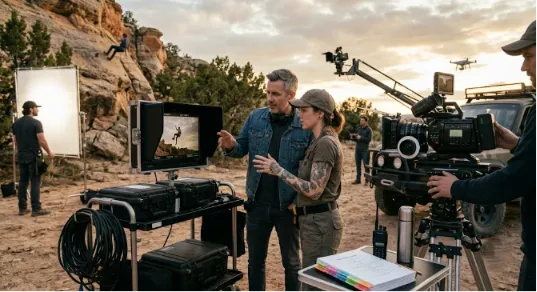
Two crew members on a movie set look at a video monitor showing a stuntman on a cliff face, with filming equipment, other people, and a four-wheeler in the background in a desert.

Development Producer vs. Producer

Although the titles sound similar, their responsibilities differ.


A development producer focuses on creating and refining projects before production begins. They spend most of their time improving scripts, evaluating concepts, and preparing presentations.


A production producer, on the other hand, manages financing, scheduling, hiring, logistics, and overall production after the project receives approval. In many independent productions, one person may perform both roles. However, larger studios usually separate these responsibilities.

Modern Tools for Development Producers

Today’s development process relies heavily on digital collaboration. Instead of exchanging countless document versions by email, production teams now use cloud-based platforms for script management, breakdowns, scheduling, and creative collaboration.


Solutions like Studiovity allow creative teams to write screenplays, organize revisions, collaborate with writers, generate AI-assisted script breakdowns, build storyboards, create shot lists, and prepare projects for pre-production within a single workspace. Consequently, teams move from development to production with fewer delays and better organization.

How to Become a Development Producer

Most professionals in this field begin their careers as script readers, production assistants, screenwriters, assistant producers, or development coordinators.


Reading hundreds of scripts builds strong story instincts. Likewise, networking with writers, directors, and production companies creates valuable opportunities. Many professionals also study film production, screenwriting, or media management to strengthen their industry knowledge.


Most importantly, successful talent in this field never stop learning. They continuously analyze films, study audience trends, and refine their storytelling skills.

Final Thoughts

A development producer serves as the creative architect of a film or television project. From discovering ideas to refining scripts and preparing investor pitches, they help transform concepts into production-ready stories.


Although audiences rarely see their work, their influence appears in every successful screenplay that reaches the screen. As filmmaking becomes more collaborative and technology-driven, they continue to play a vital role in shaping projects from the very beginning.

Advanced Screenwriting Software and
Film pre-production tool

Studiovity is a new standard for Screenwriting, Storyboard, Ai breakdown and Scheduling. 

More to explore​
A view through a vintage movie camera viewfinder showing a split image: a man passively watching an action film vs. the same man actively analyzing film techniques at a desk.
Film Production, Screenwriting and Film Making Blog

How to Write a Film Analysis in 5 Steps (+ Examples)

Watching a great movie is exciting. However, understanding why it works takes a different skill. That is where learning how to write a film analysis

A close-up of a person holding a tablet showing a film budget template spreadsheet on an active movie set with a blurred background of crew and cameras.
Film Production, Screenwriting and Film Making Blog

Film Budget Template: The Essential Guide for 2026

Every successful film starts with a creative vision. However, that vision can only reach the screen when a solid financial plan supports it. A film

Subscribe To Our Newsletter

Get updates and learn from the best

Story Writing Competition Registration

Get important information like submission link, registration and submission details and more on WhatsApp!