
You’ve got the script, the camera, and your actors ready to go. However, three hours into your very first shoot day, the sun is rapidly setting. You have only finished half a page. Common industry knowledge dictates that these first few hours on set are the most critical for staying on track. Yet, this is exactly where unprepared shoots fall apart. While everyone understands that movies are filmed in individual scenes, the actual process of assembling them in the real world is a mathematical puzzle. Therefore, without a solid plan, you are completely at the mercy of unpredictable sunlight, draining batteries, and shrinking actor availability.
To tackle these production logistics, a comprehensive Film Scheduling Guide is required to be utilized by creators so that they can effectively navigate these chaotic variables. Tackling these production logistics is exactly like planning a multi-stop road trip across the country. Nobody would dream of driving coast-to-coast without a mapped route and a clear gas budget. Yet, many new creators try to direct relying entirely on good vibes. A proper Film Scheduling Guide turns your creative vision into a practical, living document. Consequently, it constantly balances both time and money. By grouping your scenes together based on location, you immediately transform the terrifying prospect of a fourteen-hour nightmare into an efficient, predictable filmmaking timeline.
Ultimately, your primary goal is simply getting the brilliant shots you need without completely exhausting your crew. Experienced producers achieve this by building “buffer time”—extra padded minutes throughout the day. This acts as an insurance policy against the inevitable moment a prop goes missing. As a result, relying on these safety nets allows you to minimize overtime and keep morale high. Instead of racing against the clock in a panic, you can finally focus your energy on directing a great story with this Film Scheduling Guide.

The Script Breakdown: Identifying Every Prop, Actor, and Location Before You Hit Record
Reading your screenplay as an emotional story is great. However, preparing it for the camera requires a highly analytical mindset. You have to perform a script breakdown for production scheduling. This means dissecting every single scene to measure its exact length and physical requirements. Instead of counting whole pages, filmmakers measure scene length in “eighths of a page” ($1/8$). Because standard script format assigns roughly one minute of screen time to one page, dividing that page into eight one-inch sections gives you a precise, bite-sized snapshot of how long a scene will actually take to film. For example, a quick $1/8$ page reaction shot will fly by. Meanwhile, a dense $7/8$ page dialogue scene between two friends in a kitchen will easily dominate your morning.
Once you understand the length, you must mine the text for its ingredients. This is one of the classic first assistant director duties. It involves combing through the script to spot exactly what must physically exist in front of the lens. You will highlight and categorize everything into a master checklist for each scene. This Film Scheduling Guide section recommends paying special attention to:
Cast: Which specific actors (including background extras) are needed?
Props: Is a character holding a coffee mug or a specific book?
Wardrobe: Does a shirt get muddy and require a backup?
Special Effects: Do you need practical rain or stage blood?
Vehicles: Is a specific car parked in the driveway?
Spotting these details early prevents the nightmare of stalling a 12-person crew while someone rushes to the store for a forgotten item. Therefore, identifying “long-lead” items—like a specialized costume or a custom-printed sign—weeks in advance guarantees your gear is ready before your camera rolls. With every ingredient finally extracted and categorized, you are ready to combine them efficiently.
The Grocery Store Method: Why Shooting Out of Order Saves 30% of Your Production Time
Grabbing milk, running across the store for bread, and sprinting back for butter is an exhausting zig-zag. That is exactly what happens if you try to film your script from page one to the end. Instead, smart filmmakers rely on batching. This means grouping scenes that happen in the same place together, regardless of story order. By scheduling by location vs chronology, you can shoot the ending and the opening scene on the exact same Tuesday just because both happen in “Kitchen A.”
Indeed, this out-of-order approach specifically targets the heavy lifting. Moving cameras and lights takes precious hours. By keeping your gear planted in one room, you easily reduce setup time by 50% by maintaining consistent lighting rigs across multiple scenes. Optimizing scene order means your team spends less time hauling stands and more time actually capturing great performances.
Smart grouping also protects you from the ultimate time-waster: a Company Move (the dreaded process of packing up the entire set, driving to a new address, and unpacking again). To prevent losing hours to traffic, stay at one address per day while carefully separating your “Interior” and “Exterior” shooting windows. Since sunlight is unpredictable, you should always capture your exteriors first before retreating safely inside for interior shots.
Mastering this location puzzle is crucial for minimizing overtime and protecting your wallet. Yet, perfectly grouping your kitchen scenes together is only half the battle. You still need to know how much footage fits into a single shift to set realistic goals.
The 'Page Count' Rule: Setting Realistic Daily Goals to Prevent Crew Burnout
Figuring out how many pages to shoot daily is a balancing act between ambition and reality. While a Hollywood blockbuster might spend days filming one explosion, indie crews generally aim for three to five pages. Pushing beyond this limit causes rushed performances and exhausted teams. Therefore, understanding what is a standard shooting day means viewing those pages as the actual physical hours required to block, light, and record action.
Not all script pages are created equal. In fact, treating them identically inevitably triggers expensive film production overtime. Balancing “heavy” and “light” scenes across your week prevents burnout. When estimating pace, your speed depends on three elements:
Dialogue-heavy scenes vs. Action: Simple conversations film much faster than physical movement.
Number of actors: Every additional person requires distinct lighting adjustments and camera angles.
Technical complexity: Tricky camera moves or practical effects instantly slow your momentum.
Even with a perfectly balanced load, human stamina has limits. This requires enforcing a “Turnaround”—the mandatory 12-hour rest period between wrapping one shoot day and starting the next. Skimping on this vital buffer to cram in extra pages destroys morale and safety. Once you know how much your team can accomplish daily, the next puzzle is organizing who needs to be there.
Mastering the Day-Out-of-Days (DOOD): Visual Logic for Managing Cast Availability
Securing your cast is often the trickiest puzzle in film production scheduling. You might have the perfect lead actor, but they only have weekend availability while your supporting players juggle day jobs. To solve this, producers use a Day-Out-of-Days (DOOD) report—a simple visual grid tracking exactly when each actor is needed. Think of it like a weekly shift roster at a coffee shop, but with specialized shorthand. Instead of writing “working,” you use “SWF” notation: ‘S’ means their first day (Start), ‘W’ indicates a middle working day (Work), and ‘F’ marks their final day (Finish).
A quick glance at this chart provides a bird’s-eye view of your overall budget. The primary benefits of DOOD reports lie in spotting inefficiencies before spending a dime. If an actor has a “Start” on Monday, no work until Thursday, and a “Finish” on Friday, you risk losing their commitment or paying unnecessary daily rates for their idle time. By tweaking your plan to group all their scenes on Monday and Tuesday, you consolidate their workdays, drastically saving money.
Early conflict detection is the ultimate hack for managing actor availability without stress. If your lead’s final day overlaps with an unbooked location, the DOOD highlights that collision instantly so you can pivot weeks in advance. For this reason, a comprehensive Film Scheduling Guide always emphasizes visual tracking. Once your cast is locked into a tight, affordable grid, you can prepare for the external forces that threaten every shoot.

Building the Safety Net: Planning for Weather, Travel, and the Inevitable Technical Glitch
Locking down your cast is a massive victory, but your filmmaking timeline will quickly unravel if you assume every minute on set is spent shooting. Think of moving a crew like packing up a family camping trip: you can’t start roasting marshmallows the second you park the car. When planning location scouting logistics, always account for the reality of travel and loading gear. Do not schedule a scene to start the minute the crew arrives. Instead, to survive the inevitable dead camera battery or missing prop, pad your daily schedule with a 15% time buffer.
Mother Nature, unfortunately, never reads your call sheet. When handling film production weather delays, you need a backup plan so you don’t burn through your budget waiting out a rainstorm. Schedulers keep the camera rolling by relying on a few vital contingency options:
- Cover Sets (indoor backups): Always select an indoor backup location for every outdoor shoot so you can immediately pivot inside if it pours.
- Weather-Hold Days: Pencil in a flexible makeup day at the end of your schedule specifically reserved for rained-out scenes.
- Tech-Prep Buffers: Add extra setup time for moving equipment safely when conditions unexpectedly shift.
Building these safety nets prevents a minor hiccup from collapsing your entire production. A smart schedule acknowledges that things will go wrong and provides a stress-free pivot point when they do.
Digital Stripboards vs. Simple Templates: Choosing Tools That Match Your Budget
Organizing your logistics visually is where the magic happens. In the film world, this is done using a stripboard. Imagine slicing your script into ribbons, where each individual “strip” holds a single scene’s data—such as cast members needed, location, and page length. By creating a digital production stripboard, you turn these modular building blocks into a color-coded puzzle. This step allows you to see exactly how your shoot day flows before anyone steps foot on set.
A massive budget isn’t required to build this foundational document. For a weekend short film in a single house, a well-organized shooting schedule template in free tools like Google Sheets is perfectly fine for keeping a small crew on track. However, static spreadsheets struggle the moment your lead actor gets stuck in traffic. Dedicated scheduling software unlocks the ability to grab and drag and drop those scene strips to reorder your day instantly, automatically calculating your new timeline without requiring panicked on-set math. This is a key technique taught in any modern Film Scheduling Guide.
Upgrading to these paid applications depends entirely on your production scale. When weighing options like Movie Magic vs StudioBinder scheduling, carefully consider your project’s complexity. The former is a complex, legacy powerhouse designed for massive Hollywood features. On the other hand, the latter offers a modern, cloud-based interface highly popular with indie creators and YouTubers. Whichever tool fits your current budget, the end goal remains identical. Therefore, let this Film Scheduling Guide serve as your roadmap.
From Plan to Action: Turning Your Schedule into Daily Call Sheets Your Crew Will Actually Use
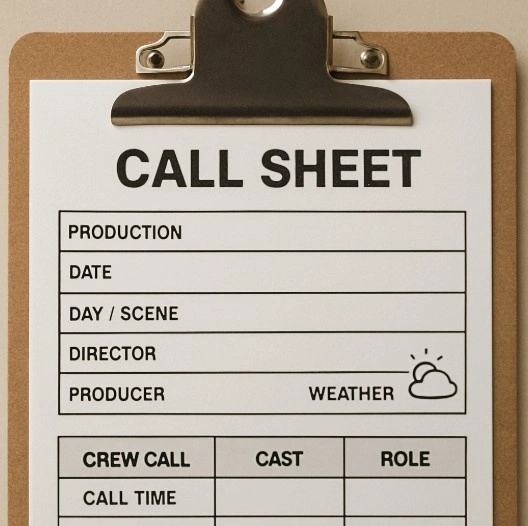
You can break scenes down logically and protect your crew from burnout, but a master schedule is useless if nobody sees it. To guarantee everyone arrives ready, you must translate that big picture into a daily instruction page called a Call Sheet.
When formatting daily film call sheets, clarity is your best friend. Distribute this document at least 24 hours in advance so nobody is left guessing. It acts as your crew’s daily roadmap—working right alongside your script supervisor continuity log—to keep the shoot moving efficiently. Always include these critical elements:
Call time
Parking info
Nearest hospital
The Day’s Schedule
Understanding production logistics allows you to turn on-set chaos into a predictable, manageable process. Consequently, you can confidently finish every project. Start by building your first stripboard, communicating clearly through daily call sheets, and executing your schedule one organized day at a time with this ultimate Film Scheduling Guide.
Elevate Your Production: Why Studiovity is the Ultimate Film Scheduling Guide in Action
You can have the perfect strategy on paper, but executing it flawlessly requires a modern tool built for the speed of a live set. This is where Studiovity transforms the theory of this Film Scheduling Guide into seamless, real-time production management. Instead of wrestling with rigid spreadsheets or juggling disconnected documents, Studiovity serves as your all-in-one digital command center. The platform automatically extracts your script breakdown elements, generates color-coded digital stripboards, and tracks actor availability with intuitive DOOD reporting. Furthermore, when unexpected weather delays strike or call times shift, Studiovity lets you reorder your entire day via drag-and-drop mechanics, instantly updates your timeline, and distributes beautifully formatted daily call sheets to your crew in seconds. By bringing your logistics, creative assets, and team communication under one cloud-based roof, Studiovity eliminates on-set panic so you can finally stop managing chaos and start focusing on your vision.