
Think of the most famous sequence in movie history—the terrifying, iconic shower scene. According to cinema historians, director Alfred Hitchcock famously considered his movies finished before he ever arrived on set. How was that possible? Long before a single camera rolled, those moments existed as rough, hand-drawn sketches. This practice, known as Storyboarding in Film, creates the very first physical version of a movie.
Building a cinematic world requires pre-visualization. This process functions perfectly as the architectural analogy of storyboarding. A construction crew wouldn’t pour concrete without consulting a blueprint. Similarly, filmmakers need a guide to know exactly where actors stand and where the lens focuses. Moving a wall is much easier on paper than after the foundation is laid. This makes the process the ultimate tool for movie scene planning.
Have you ever tried to shoot a quick video on your phone, only to realize later that you missed a crucial angle? Professional directors avoid this frustrating “oops” moment. They map out their visual storytelling well in advance. Fortunately, industry practice shows that artistic skill is entirely secondary to clear communication. Whether you draw beautiful illustrations or basic stick figures, sketching your shots ensures your entire crew understands the vision before anyone yells “Action!”
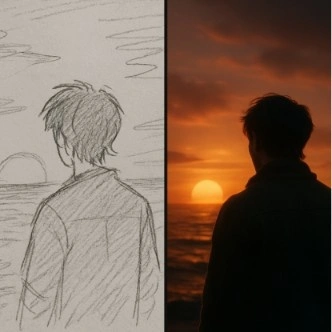
The Blueprint Strategy: Why Visual Planning Saves Thousands in Production Costs
Describing a vivid dream often reveals that words alone are not enough to capture an exact image. When people ask why directors use storyboards, the answer comes down to solving this exact problem. This problem must be solved on a massive, expensive scale. Making a movie is like building a house. It is infinitely easier to move a wall on a paper blueprint than to tear down poured concrete. On a film set, every minute of confusion costs money in equipment rentals and crew wages. This reality makes pure improvisation a dangerous financial game.
To avoid that chaos, successful filmmakers rely on visual outlines. These outlines get everyone on the exact same page. Imagine trying to explain a complex car chase to a hundred crew members just by pointing and waving your arms. By collaborating with a storyboard artist—or simply drawing stick figures yourself—you create a universal language. This language easily bypasses confusing technical jargon. The lighting team instantly sees where the shadows fall. The actors know exactly where to run. Meanwhile, the camera operator understands precisely where to look.
This shared visual communication transforms a stressful set into a highly focused machine. Directors have long sworn by the power of reducing production costs with pre-production sketches. They know that a few hours of drawing saves countless dollars in wasted filming time. Once you grasp the immense value of this preparation, the next step is capturing your own vision on paper. You can do this by building the perfect panel. This introduces the 3 core components of a professional film storyboard.
Building the Perfect Panel: The 3 Core Components of a Professional Film Storyboard
Staring at a blank piece of paper can feel intimidating, especially if your drawing skills peak at stick figures. However, if you are wondering what a professional film storyboard includes, the answer relies entirely on simple organization rather than museum-quality art. Think of a single panel as a tiny window into your movie’s world. It is simply a practical container designed to hold specific pieces of information that keep your crew moving smoothly without confusion.
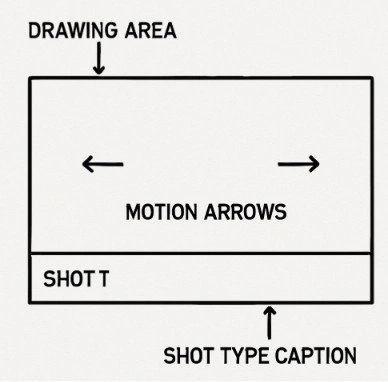
To construct this window correctly, you need a reliable blueprint. Every great director relies on these three essential components of a storyboard panel:
The Frame (Aspect Ratio): This dictates the literal shape of your screen and determines exactly how much of the world fits inside your box. Choosing the correct storyboard aspect ratio for cinematic formats ensures you aren’t drawing a tall rectangle for a smartphone when your movie will actually play on a wide theater screen.
The Sketch (The Action): This serves as your visual note-taking area where simple shapes show who is in the scene and what they are doing.
The Description (The Shot Details): A short caption lives beneath the box to explain camera lenses, lighting cues, or dialogue that a drawing alone cannot convey.
When you combine a properly shaped box with a quick sketch and a descriptive caption, you instantly eliminate guesswork on set. Mastering basic film storyboard techniques for beginners often starts by just drawing a stick figure running, adding an arrow to show direction, and scribbling “camera follows closely” in the caption area. You do not need to worry about complex shading or perfect perspective; your only goal is absolute clarity.
Once your panels are correctly set up, the real magic of directing begins. The boxes are drawn and the captions are ready, but deciding how close that camera should be to your actors makes the biggest impact. Simply changing the size of your sketch can completely transform how a viewer feels.
Mastering the Visual Language: How to Use Wide and Close-Up Shots to Guide Your Audience’s Emotions
Watching a tense movie scene where two people are simply sitting at a table can make your heart pound. That invisible suspense is not an accident. Professional directors create it by carefully selecting camera angles and framing terminology to dictate psychological space. When you are improving shot composition through visualization, you are not just trying to create a pretty picture; you are actively deciding how the audience should feel.
The secret to this visual language lies in the “Emotional Distance” rule: the closer the camera, the deeper the emotion. Think of it like a real-life conversation. If a stranger is crying across a busy street, you might feel a vague sense of pity, but if a friend is crying inches from your face, you feel their heartbreak instantly. Directors replicate this exact human instinct on screen. A camera placed far away makes a character look isolated against the world, while a camera shoved into their personal space demands that the viewer share their immediate feelings.
To start communicating this way when practicing Storyboarding in Film, you only need to master the 3 fundamental shots:
Wide Shot (The World/Context): Establishes the geography, like a tiny spaceship against a massive, starry horizon.
Medium Shot (The Relationship/Action): Frames characters from the waist up, serving as the perfect blueprint for capturing two people arguing or working together.
Close-Up (The Emotion/Detail): Focuses purely on a face or specific object, stripping away the background to highlight a crucial reaction.
Alternating between these distances transforms your simple sketches from a boring, static security camera feed into a rhythmic, engaging movie. However, static frames only tell half the story. Once you know exactly how close you want to be, you need to map out how your characters and camera will move through that space.
Arrows Over Artistry: Simple Techniques for Mapping Action and Camera Movement
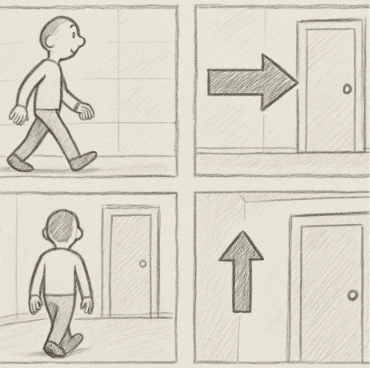
Capturing a fast-paced sprint on paper often results in a sketch that looks completely frozen in time. The magic of Storyboarding in Film is not about perfectly rendering anatomy; it is about clearly communicating action. Professional directors solve this static problem by drawing character movement and blocking—the industry term for where actors stand and travel—using bold, simple arrows. Instead of worrying about sketching a realistic run, you just draw a stick figure and add a thick arrow pointing where they need to go. This simple shorthand turns a motionless box into a dynamic plan.
Just as your actors need to move, your camera often needs to move with them, which requires a completely different type of visual instruction. To avoid confusing the crew, artists use specific directional symbols to separate the actor’s path from the lens’s path. For instance, a solid arrow inside the frame tells the actor to walk forward, while smaller, outlined arrows on the outside edge of the box tell the cameraman to physically move the lens. When reviewing classic storyboard examples, you will notice these basic symbols are the true secret to directing cinematic motion on a two-dimensional page.
Imagining how these directional instructions connect from one sketch to the next is where your movie finally comes alive through “The Flipbook Effect.” If you flip through your sequence of panels and the movement feels jarring, your audience will experience that exact same confusion on screen. Mastering this visual flow is crucial when visualizing complex action sequences, ensuring every step or camera tilt logically connects to the next shot. With characters and the camera moving in perfect harmony, the next phase is translating written dialogue into a cohesive sequence.
The Script-to-Screen Workflow: A 5-Step Process for Translating Dialogue into Images
Staring at a page full of dialogue can feel overwhelming when it is time to actually grab a camera. How do you decide exactly what the audience should see? Figuring out how to translate script to storyboard requires treating the written page like an architectural blueprint. Before pouring the concrete of your final panels, you must break those thick paragraphs of text down into a clear, actionable visual map.
Beginners often confuse the written plan with the visual one, but grasping shot list vs storyboard differences is crucial for step-by-step movie scene planning. A shot list is just a grocery list of camera setups—noting that you need a wide shot or a close-up—while the storyboard is the sketched recipe showing how those ingredients combine. To build that recipe, professional directors follow a reliable sequence rather than drawing randomly.
To bridge this gap efficiently, use this translation workflow:
Identify the ‘Beats’: Highlight the crucial emotional shifts, or narrative beats, where the camera must capture a specific reaction.
List the required shots: Write down the basic angles needed to cover those highlighted moments.
Create a rough thumbnail: Quickly sketch a tiny, messy box—called thumbnailing—to test your layout before drawing the real thing.
Finalize the panel details: Add your directional arrows and framing notes into the full-sized storyboard box.
Review for continuity: Flip through the sequence to check continuity, ensuring the visual logic flows smoothly without jarring errors.
Catching mistakes during that final review phase saves countless hours on set. Once your story flows logically from sketch to sketch, you have successfully transformed typed text into a shootable movie. With the mental workflow mastered, you just need the right gear to sketch it out.
Choosing Your Tools: When to Use Traditional Paper vs. Digital Pre-visualization Software
Grabbing a pen and sticky notes remains the fastest way to get ideas out of your head. Famous directors often rely on simple stick figures to map out blockbusters. This proves you do not need expensive gear to plan a masterpiece.
Yet, as projects grow, the debate between digital storyboarding software vs traditional sketching matters. Paper is unbeatable for quick, messy brainstorming. However, it falls short when you need to instantly rearrange scenes or share your visual blueprints online.
Stepping into the digital realm does not require complex Hollywood programs. Today, accessible cinematography pre-visualization tools are widely available. Basic tablet apps act as virtual movie sets. They let you easily place characters and change angles without an art degree. Whether you choose a trusty sketchbook or an iPad, pick the method that builds your confidence. With your ideal tools selected, you are ready to take action on your next creative project.
Taking the First Shot: A Simple Action Plan for Your Next Creative Project
You no longer need to wave your arms to explain your creative vision. Whether you are shooting a quick social media video or a short film, you now have the tools to plan your shots purposefully. Start with a simple 3-panel storyboard for your next personal project. You don’t need to be a professional artist. Stick figures on a blank piece of paper are absolutely perfect. Sketching these sequences gives you the immediate confidence to share visual ideas clearly with others.
Cinematic confidence comes from clarity. Looking at famous storyboard examples, you quickly realize that iconic movie moments didn’t happen by accident. They were built one messy sketch at a time. The true secret to effective Storyboarding in Film is realizing that the first step to a great movie is simply grabbing a piece of paper. Your blueprint is ready; start drawing.