
Every minute on a film set matters. Therefore, producers, assistant directors, production managers, and line producers constantly look for ways to estimate time, budget, and resources accurately. However, before cameras roll, they need one important measurement that helps organize the entire production schedule. This essential measurement is known as script eighths.
Although the term may sound technical, these units provide one of the simplest ways to estimate the workload for every shooting day. Instead of counting pages alone, filmmakers divide each screenplay page into eight equal sections. As a result, the production team can quickly estimate how much content they can realistically film in a day. Therefore, whether you produce a short film, commercial, television episode, or feature film, understanding this system can improve your planning process and reduce scheduling mistakes.
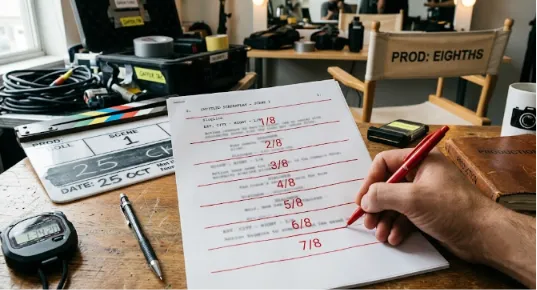
What Are Script Eighths?
These units represent a standard tool used during script breakdown and production scheduling. Specifically, each screenplay page gets divided into eight equal horizontal sections, or eighths. Consequently, instead of saying a scene takes one full page, the production team measures it more precisely.
For example:
A short dialogue scene may equal 2/8 of a page.
Alternatively, a medium-length scene may equal 5/8.
Furthermore, a longer scene may equal 1 3/8 pages.
Finally, a complex action sequence may span 4 6/8 pages.
Clearly, this measurement gives assistant directors and production managers a more accurate way to estimate daily shooting goals. Because screenplay pages follow standard formatting, these fractions create a universal measurement across the film industry.
Why Do Filmmakers Use Eighths?
Simply counting scenes rarely helps during production planning. For instance, one scene could last only two lines, while another could stretch across several pages. Likewise, page counts alone fail to represent actual shooting complexity.
Therefore, page eighths solve this problem by creating a consistent measurement system. Consequently, the production office can compare scenes more effectively when preparing schedules.
For example, a production team may plan to shoot five scenes in one day. However, those scenes could total only 3 3/8 pages. On another day, they might schedule two scenes that equal 6 5/8 pages. Without these fractional measurements, those differences become difficult to estimate. Therefore, eighths create realistic expectations for every shooting day.
How Are Script Eighths Calculated?
Calculating these fractions requires very little math. First, print the screenplay using standard industry formatting. Alternatively, view it inside professional screenwriting software. Next, divide every page into eight equal horizontal sections. Then, estimate where each scene begins and ends.
For example:
Scene A occupies three sections of a page = 3/8
Scene B fills one complete page = 8/8
Scene C begins halfway down one page and ends halfway through the next = 1 4/8
The fractions may seem unusual at first. Nevertheless, they become second nature after working through several script breakdowns. Fortunately, most scheduling software automatically calculates these values, which saves time and reduces manual errors.
How Script Eighths Improve Production Planning
These measurements affect almost every department during pre-production. Instead of serving only as page measurements, they help teams make smarter production decisions.
Better Shooting Schedules
Assistant directors build shooting schedules around estimated page counts. Rather than assigning random scenes, they balance each day’s workload using these segments.
For instance, a dialogue-heavy scene worth 5/8 may require fewer hours than an action scene of the same length. Even so, eighths provide the starting point for organizing each production day. As a result, schedules become more realistic.
More Accurate Budgeting
Budget estimates depend heavily on production days. If a production underestimates daily page counts, additional shooting days may become necessary. Consequently, labor, equipment rentals, locations, catering, transportation, and accommodation costs increase. Therefore, these measurements help producers estimate shooting days more accurately before creating the final budget.
Easier Script Breakdown
During script breakdown, every scene receives tags for cast members, props, costumes, makeup, vehicles, visual effects, stunts, and locations. Knowing each scene’s page length helps departments estimate preparation time.
Generally, longer scenes require additional planning. Meanwhile, shorter scenes usually need fewer resources. Therefore, departments can allocate manpower more efficiently.
Improved Crew Coordination
Every production department depends on the shooting schedule. For example, camera crews, lighting teams, costume designers, makeup artists, transportation coordinators, and production assistants all prepare according to daily workloads. Therefore, these precise measurements create a common standard everyone understands. Consequently, communication becomes faster across departments.

Do Page Fractions Determine Shooting Time?
Not entirely. Page eighths estimate script length, but they do not predict exact filming hours. In fact, many other factors influence production speed, including:
Camera setups
Special effects
Stunts
Weather
Actor availability
Location changes
Crowd scenes
Complex dialogue
For example, a 2/8 action scene with explosions could require an entire day to film. Meanwhile, a 2-page conversation inside one room might finish within a few hours. Therefore, experienced assistant directors combine page measurements with production experience before creating the final schedule.
How Modern Production Software Calculates Script Eighths
Years ago, assistant directors measured script pages using printed copies and rulers. Today, production software automates much of the process.
Specifically, modern pre-production platforms allow filmmakers to:
Import screenplays
Perform AI-powered script breakdowns
Measure page eighths
Build shooting schedules
Create production calendars
Generate call sheets
Track revisions
Consequently, automation reduces calculation errors while keeping every department synchronized throughout production. Instead of updating multiple spreadsheets manually, teams can manage scheduling from a single workspace.
Common Mistakes When Using Script Eighths
Although these units simplify scheduling, beginners often make several mistakes. For example, one common mistake involves assuming every page requires the same filming time. In reality, scene complexity matters just as much as page length.
Another mistake occurs when screenplay formatting changes during revisions. If page lengths shift, the calculations also change. Therefore, production teams should always work from the latest locked script.
Furthermore, some productions ignore scene logistics. For instance, a short exterior night scene with rain effects may demand far more preparation than a full-page office conversation. Finally, teams sometimes rely only on page counts while ignoring actor availability and location efficiency. Therefore, successful schedules always combine multiple production factors.
How Studiovity Simplifies Script Eighths Planning
Managing these measurements manually becomes challenging as productions grow larger. Fortunately, digital production management software streamlines the process.
Studiovity combines screenwriting, AI script breakdown, scheduling, budgeting, storyboarding, shot lists, production calendars, and call sheets within one platform. Therefore, instead of switching between different applications, filmmakers can manage the entire pre-production workflow from a single workspace.
Once a screenplay enters the system, teams can organize scenes, prepare breakdowns, estimate production workloads, and build shooting schedules much faster. Consequently, producers spend less time on manual calculations and more time preparing for production. Whether you manage an independent short film or a large feature production, integrated planning tools help every department stay aligned from development through principal photography.
Final Thoughts
These fractional units may appear to be a small detail, yet they play a major role in successful film production. By dividing screenplay pages into eight equal sections, production teams gain a practical way to estimate daily workloads, organize schedules, prepare budgets, and coordinate departments.
Although page eighths cannot predict every production challenge, they provide the foundation for realistic planning. When combined with script breakdowns, scheduling experience, and modern production software, they help filmmakers reduce delays, control costs, and keep projects on track. Therefore, for anyone involved in film or television production, mastering this system remains an essential pre-production skill that improves efficiency from the first planning meeting to the final shooting day.