Mastering Screenplay Breakdown: Essential Tips for Film Production

A screenplay breakdown is completed by the production team as one of the most important steps in film pre-production. Before creating a shooting schedule, estimating a budget, or assigning crew members, every script must be analyzed scene by scene to identify the production requirements. Consequently, this process transforms a screenplay into a practical production plan. Therefore, it helps filmmakers stay organized, save time, and avoid costly mistakes. Whether you’re producing a short film, feature, commercial, or web series, understanding how to analyze your script makes the entire production process more efficient.

What Is a Screenplay Breakdown?

A screenplay breakdown is the process of reviewing every scene and identifying all the production elements needed for filming. These include cast, locations, props, wardrobe, vehicles, makeup, visual effects, sound requirements, and special equipment.


However, the goal is not simply to list items mentioned in the script. Instead, you need to understand everything required to bring each scene to life. Even a simple action sequence can involve multiple departments, so a detailed analysis is essential for smooth production.

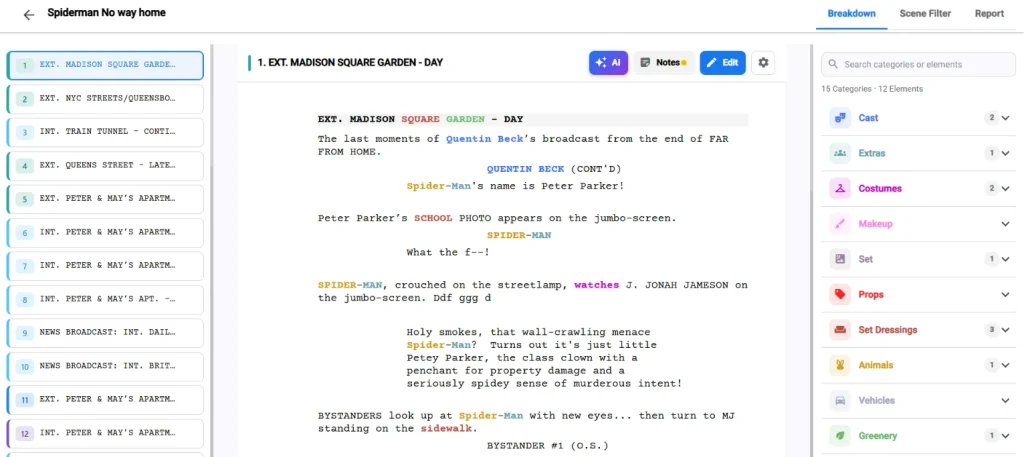
Studiovity script breakdown software interface showing a Spiderman screenplay with color-coded production categories like cast, costumes, and props on the right panel.

Why Screenplay Breakdowns Matter

A proper screenplay breakdown serves as the foundation for successful film production. Specifically, it helps production teams:


  • Build accurate budgets

  • Create realistic shooting schedules

  • Identify expensive scenes early

  • Improve communication between departments

  • Prevent missing props, costumes, or cast members

  • Reduce production delays and unnecessary costs


Without a detailed breakdown, productions often face scheduling conflicts, budget overruns, and continuity problems.

Start With a Locked Script

Whenever possible, begin with the latest approved version of the screenplay. A locked script keeps scene numbers consistent. Furthermore, it prevents confusion when scheduling or budgeting.


Before starting your screenplay breakdown, verify that the script contains:


  • Clear scene headings

  • Proper formatting

  • Numbered scenes

  • Complete pages

  • Accurate character names


Consequently, a well-formatted script creates a much cleaner production workflow.

Read the Script Before Marking Anything

One of the most valuable screenplay breakdown tips is to read the script once without making notes. Indeed, the first reading should focus on the story, characters, pacing, and emotional tone. Understanding the creative vision allows you to make better production decisions later.


Therefore, ask yourself:


  • Which scenes are most important?

  • Which locations repeat?

  • What scenes may be expensive?

  • Are there recurring props or costumes?


Only after understanding the story should you begin identifying production elements.

Break Down Every Scene

After the first read, examine each scene individually. Then, record essential production information, including:


  • Scene number and location

  • Interior or exterior / Day or night

  • Cast members and background actors

  • Props, wardrobe, and makeup

  • Vehicles and animals

  • Special effects and visual effects

  • Sound requirements and production risks


Remember that page length does not determine production difficulty. For example, a short action scene involving rain, vehicles, and stunt performers may require much more preparation than several pages of dialogue.

Use Consistent Breakdown Categories

Consistency makes your screenplay breakdown easier for every department to understand. Standard categories include:


  • Cast and Extras

  • Props and Set Dressing

  • Wardrobe and Makeup

  • Vehicles and Locations

  • Stunts and Sound

  • Visual Effects and Special Effects

  • Production Notes


Using the same categories throughout the script improves communication. Thus, it reduces the chance of missing important production elements.

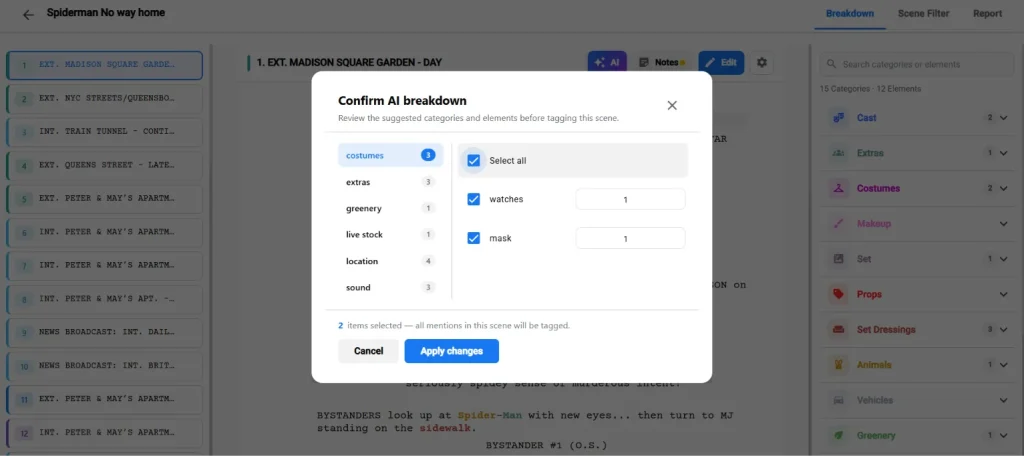
AI screenplay breakdown tool popup window confirming tagged elements like costumes, watches, and masks for automated scene analysis.

Track Cast and Background Actors

Every scene should clearly identify which characters appear. Additionally, you must note whether background performers are needed. Accurate cast tracking helps schedule actors efficiently and prevents costly mistakes on set.


For each scene, note speaking characters, background actors, child actors, stunt doubles, and stand-ins. Moreover, flag special makeup or costume requirements. Crowded locations like restaurants, hospitals, or city streets may require additional extras, so identifying them early helps improve scheduling and budgeting.

Pay Attention to Props and Continuity

Props often play a bigger role than expected. Items such as phones, letters, weapons, food, or personal belongings may appear across multiple scenes. Therefore, they need duplicates for continuity.


When identifying props, ask:


  • Who uses the prop?

  • Does it appear in multiple scenes?

  • Does it break or change during filming?

  • Are duplicate versions required?


Good prop tracking prevents continuity errors. As a result, it reduces production delays.

Watch Wardrobe and Makeup Changes

Wardrobe and makeup directly affect continuity, especially when scenes are filmed out of order. During your screenplay breakdown, identify costume changes, hero costumes, and period clothing. Similarly, track injuries, bruises, dirt, rain, or blood effects. You should also note hair changes, prosthetics, or tattoos. Tracking character appearance throughout the story ensures every department stays aligned.

Flag Safety, Stunts, and Visual Effects

Scenes involving action or physical risk should always receive extra attention. Specifically, flag production elements such as fight scenes, driving sequences, firearms, water scenes, animals, children, fire, or smoke. Identifying these requirements early allows producers to allocate additional time, equipment, and safety personnel where needed.

Organize Locations for Efficient Scheduling

One of the biggest advantages of a thorough analysis is efficient location planning. Group scenes filmed at the same location whenever possible. Consequently, this reduces company moves and saves production time.

Also identify day versus night shoots, permit requirements, parking access, weather concerns, noise restrictions, and lighting requirements. Smart location planning significantly reduces production costs.

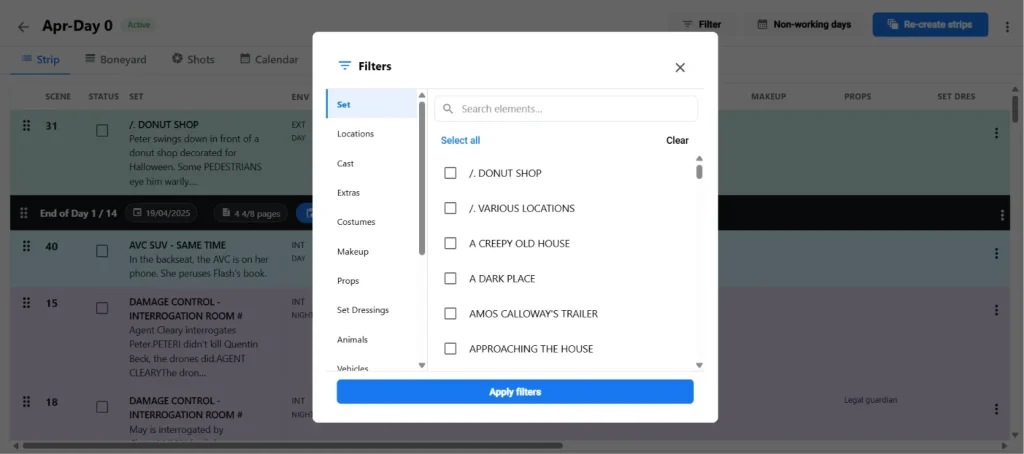
Script breakdown filter menu displaying production categories like Set, Locations, Cast, and Costumes to organize shooting strips.

Identify Budget Risks Early

Your notes provide valuable information for building an accurate production budget. Pay special attention to scenes involving multiple locations, large casts, night shoots, stunts, vehicles, period settings, complex wardrobe, special effects, visual effects, animals, or children. Recognizing these costs during pre-production allows filmmakers to adjust the script or allocate resources before filming begins.

Common Screenplay Breakdown Mistakes

Even experienced filmmakers overlook important details. Some common mistakes include:


  • Missing recurring props and ignoring continuity

  • Forgetting background actors

  • Underestimating action scenes

  • Missing wardrobe changes

  • Confusing props with set dressing

  • Ignoring safety concerns

  • Failing to update the paperwork after script revisions


Reviewing the script multiple times often reveals production requirements missed during the first pass.

Best Practices for Better Breakdowns

Follow these best practices for a smoother production process:


  • Read the script for story before analyzing logistics.

  • Break down every scene individually.

  • Use consistent production categories.

  • Track both obvious and implied production elements.

  • Prioritize continuity throughout the script.

  • Collaborate with department heads.

  • Update the files whenever the script changes.

  • Use production software to improve organization and reporting.


A detailed analysis becomes the foundation for scheduling, budgeting, and resource planning.

Final Thoughts

A screenplay breakdown bridges the gap between the written script and a successful film production. By carefully identifying cast, locations, props, wardrobe, equipment, and production challenges, filmmakers gain a complete understanding of what each scene requires before cameras begin rolling.


Ultimately, a well-prepared breakdown reduces production risks, improves collaboration, and creates more accurate schedules and budgets. Whether you’re producing an independent short film or a large-scale feature, investing time in this process helps your entire production run more smoothly from pre-production through the final shoot.


Ready to simplify your screenplay breakdown? Use Studiovity AI to automatically analyze scripts, organize production elements, generate script breakdowns, and streamline your entire pre-production workflow with one collaborative platform.
Advanced Screenwriting Software and
Film pre-production tool

Studiovity is a new standard for Screenwriting, Storyboard, Ai breakdown and Scheduling. 

More to explore​

Subscribe To Our Newsletter

Get updates and learn from the best

Story Writing Competition Registration

Get important information like submission link, registration and submission details and more on WhatsApp!