
We’ve all had that moment: you’re watching a movie and suddenly think, “I have a better idea than this.” Moving from idea to script, however, requires more than just a vivid imagination—it demands learning a completely new visual language. Therefore, discovering how to write a professional screenplay is the essential first step for any aspiring filmmaker.
Unlike a novel, effective screenplay writing relies heavily on the blueprint analogy. In practice, your script operates as a technical construction document for a film crew rather than a book for a casual reader. Consequently, you must only write what the camera can physically see and what the microphone can actually hear.
According to established Hollywood standards, this strict formatting also serves a vital mechanical purpose known as the one-minute rule. Because professional scripts are uniformly spaced, one correctly formatted page equals roughly one minute of screen time. This built-in clock ensures your story flows at the perfect pace before anyone ever yells “Action!”
Why a 30-Second Elevator Pitch is Your Script’s True North
Imagine you have thirty seconds to tell a busy producer what your movie is about before the elevator doors open. This scenario is where the “elevator pitch” shines, forcing you to condense your grand idea into one punchy sentence called a logline. Indeed, mastering how to write a professional screenplay begins with this precise focus, letting you test your story’s viability before you write a single scene.
Mastering the art of developing a compelling movie logline requires a specific recipe rather than a vague summary. Every professional blueprint needs four vital pieces:
A protagonist we can easily root for.
An inciting incident that suddenly disrupts their normal life.
A specific goal they must achieve to fix things.
A massive obstacle standing directly in their way.
Combining these elements—like a police chief finding a shark victim and needing to kill the beast despite a greedy town mayor—establishes a clear core conflict. This single sentence acts as your true north, guiding your focus whenever the writing process gets tough. With your central stakes firmly defined, you are ready to expand your blueprint into a complete narrative framework.
How the Three-Act Structure Saves You from the 'Mushy Middle'
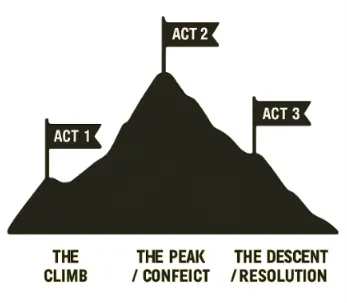
When an audience starts checking their phones halfway through a movie, the writer has likely lost them in the “mushy middle” of the script. To keep your story moving, you need the three-act structure for beginners: Setup, Confrontation, and Resolution. Think of this framework as a mountain climb where every section has a specific, load-bearing job. Furthermore, understanding this structural balance is a core pillar of how to write a professional screenplay.
The journey begins in Act One by showing the hero’s normal world before immediately turning it upside down. This disruption is the inciting incident, and placing it early in your script is critical for establishing a fast, engaging pace. If you wait too long to introduce this spark—like Luke Skywalker finding the hidden hologram message in Star Wars—the audience will lose interest before the real adventure even starts.
Once the hero accepts their challenge, they enter Act Two’s Confrontation, which requires constantly rising tension to prevent second-act sagging. You manage this escalating danger by creating a detailed story beat sheet, which is essentially a chronological outline of your movie’s major emotional and action shifts. Plotting these “beats” ahead of time guarantees your hero faces enough hardship before finally reaching Act Three’s epic Resolution.
Even with a perfect map, a cinematic journey is only as interesting as the person taking it. Mapping out the rhythm of your narrative guarantees a solid skeleton, but your protagonist needs internal struggles to make those story beats hit hard.
Why Every Hero Needs a Flaw and a Formidable Foe
The secret to why we care deeply about certain heroes while others feel flat lies in the battle between what a character wants and what they truly need. The “want” is an external, visible goal—like Woody trying to stay Andy’s favorite toy in Toy Story. The “need” is their internal emotional growth, forcing them to overcome a personal flaw, like Woody learning to share love. This transformation is the core of the character arc development process, which is a major element in learning how to write a professional screenplay.
To force this change, your hero requires obstacles perfectly designed to test their weaknesses, making protagonist vs antagonist conflict the true engine of your script. A great villain acts as a dark mirror reflecting the hero’s flaws rather than just being “evil.” Here are the essential questions to ask your character to ensure they are well-developed:
What is your external, visible goal?
What internal fear secretly holds you back?
How does the antagonist exploit that exact fear?
Mapping this emotional journey from the first page to the last guarantees your story has a soul, ensuring that the characters populating your precise technical document actually resonate with the audience.
Why Industry Formatting Isn't Just for Show
Staring at a blank document can feel intimidating, but learning how to format a screenplay correctly is simply about mastering a highly organized blueprint. Industry pros judge your script within seconds based on the “eye test”—if it looks like a dense novel, they won’t read it. Thus, figuring out how to write a professional screenplay means strictly adhering to these presentation rules. This layout isn’t just aesthetic; it serves as the vital timing tool discussed earlier, tracking your pacing page by page.
To pass this visual test without losing your mind hitting the spacebar, you need the right tools. Using the best screenwriting software for professionals, like Final Draft or free alternatives like Celtx, is non-negotiable because it automatically handles the complex margins and spacing for you as you type.
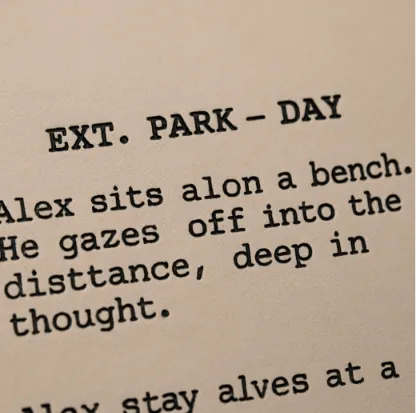
Once your software is ready, mastering the page means understanding sluglines and scene headings alongside a few other visual building blocks. The hierarchy of a screenplay page flows like this:
Slugline: Tells the film crew exactly where and when we are (e.g., INT. COFFEE SHOP – DAY).
Action Line: The present-tense description of what the camera physically sees happening.
Character Name: Who is speaking, centered clearly on the page.
Parenthetical: A brief emotional tone or micro-action placed immediately under the name (e.g., whispering).
With this structural framework firmly established, you are completely free to focus on the people living inside these locations and ensuring their voices ring true.
How to Write Dialogue That Doesn't Sound Like a Robot
When a movie character dramatically announces, “I am so angry at you!” it immediately breaks the immersion. The secret to writing natural sounding dialogue actually lies in what goes unsaid. Screenwriting is fundamentally a visual medium where actions must do the heavy lifting. Think of classic show don’t tell examples for film: rather than a wife telling her husband their marriage is over, she simply leaves her wedding ring on the kitchen counter. Clearly, learning how to write a professional screenplay requires mastering these visual cues over text.
Mastering this unspoken layer introduces you to subtext, which professionals often compare to an iceberg. The dialogue your characters speak is just the visible tip, while their true desires and secrets make up the massive ice hidden below. When characters say exactly what they feel without a filter, writers call this “on-the-nose” dialogue. Relying on this crutch instantly makes human interactions feel robotic and flat.
To ensure your characters sound like complex people, run your scenes through these quick checks for “on-the-nose” dialogue:
Are they stating obvious backstory facts just for the audience’s benefit?
Are they announcing their emotions directly instead of acting on them?
Could a physical action replace their spoken line entirely?
Once your characters stop over-explaining and start behaving naturally, your script will begin to feel like a living, breathing world.
Why Your First Draft Is Only the Beginning of the Professional Process
Typing “FADE OUT” on a first draft is an incredible milestone, but professional writers know this document is merely a rough blueprint. Your next crucial step is the rewrite, where you hunt down the most common script writing mistakes to avoid, like dragging out the second act or leaving plot holes unresolved. Therefore, an essential phase of how to write a professional screenplay involves meticulous editing. Think of this phase as tightening the bolts on a freshly built roller coaster so the ride actually feels safe and thrilling.
To fix structural issues without getting lost in screenwriting software, step away from the computer and try organizing story structure with index cards. Write one major scene per card and lay them sequentially across your living room floor. This bird’s-eye view lets you instantly see if action sequences are clumped together or if a vital plot twist arrives too late. By physically shuffling these beats around, you can easily audit your pacing and ensure the story moves with the relentless momentum of a Star Wars movie.
When those cards are perfectly ordered and your latest draft shines, you might wonder how the blueprint measures up against Hollywood standards. This is the ideal time for getting professional script coverage, which is a detailed, objective report card from an industry reader evaluating your concept, characters, and overall marketability. Receiving this external feedback helps you polish the final edges of your work and prepares it for an industry audience.
Your Script Action Plan: From Final Fade Out to the Industry
You no longer have to stare at a blank screen wondering how to capture the movie in your head. You now understand that a script is a precise blueprint for a production crew. With this foundation, you are ready to transform an abstract idea into a polished 90-120 page document, having fully mastered how to write a professional screenplay.
Your concrete action plan starts today. First, finish your core logline. Next, flesh out the story by writing a professional script treatment to thoroughly beat out your three acts. Finally, establish a sustainable daily habit of writing just two pages a day. Many critically acclaimed films were built using this disciplined, block-by-block progression.
This is a disciplined craft, but you are absolutely capable of mastering it. You now speak the secret language of the script. Commit to the professional blueprint mindset, trust your vision, and start typing today.
Elevate Your Script with Studiovity
Ready to put this blueprint into action? Studiovity is the ultimate all-in-one screenwriting and production platform designed to take you from initial logline to final draft seamlessly. With intuitive, industry-standard formatting software, integrated index cards for act structuring, and built-in character development tools, Studiovity eliminates technical friction. Don’t let your story stay stuck in your head—bring your vision to life with the professional tools you deserve today.