
You’ve got a great script and a camera, but once you arrive on set, everything suddenly feels like a blur of creative chaos. Have you ever wrapped a stressful shoot only to realize you forgot to film the most important close-up of the day? Transforming a creative idea into a physical video requires more than just a good lens and the instinct to hit record. Fortunately, the entire pre-production process can be streamlined when a professional shot list software is utilized by your team.
In practice, relying strictly on your memory during a busy production is a fast track to missed opportunities. Think of a shot list like a grocery list for your camera; it guarantees you never return to the editing room missing a vital ingredient. This organizational step introduces basic production management, acting as the ultimate script-to-screen bridge that translates your written dialogue into actionable logistics. While your script provides the emotion, proper visual storytelling tools help your entire crew actually see the director’s intended vision before filming begins.
Fortunately, stepping away from messy paper binders instantly elevates your creative process. By streamlining the film pre-production workflow, Studiovity fundamentally changes how you plan. Instead of guessing what to shoot next, you walk onto set holding a crystal-clear digital roadmap built inside an intuitive shot list software.
Why Most 'Great Ideas' Fail Without a Shot List
Standing on set while everyone waits, guessing what to film next, drains creative energy. Without a solid plan, creators waste valuable hours just figuring out angles and setups.
Relying on memory shatters your narrative consistency. When rushing, it is incredibly easy to skip the foundational pieces that stitch your story together during editing. Without a visual checklist, you risk forgetting:
B-roll: The environmental details establishing your scene.
Cutaways: Crucial close-ups of vital objects.
Reaction shots: The silent, emotional responses of your actors.
Stepping onto your location with a clear roadmap instantly transforms you into a technically prepared, confident director. Utilizing digital storyboarding and dedicated shot list software is the modern secret to managing complex camera setups efficiently. Instead of deciphering messy handwriting, your entire team sees exactly what to do.
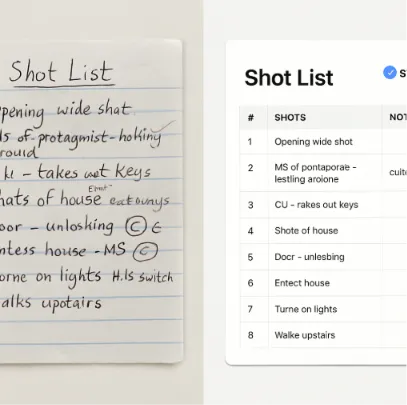
From Script to Shot List in Seconds: The Power of Automation
Manually highlighting every prop, location, and character in a script used to take hours of tedious reading. Studiovity transforms this exhausting chore into a seamless ‘Import to Insight’ workflow through automated script to shot list conversion. Instead of combing through pages with a marker, you simply upload your document and let the platform operate as a smart shot list software assistant.
The platform’s artificial intelligence instantly reads your formatting to do the heavy lifting for you. When creating a shot list from a screenplay, the AI automatically tags critical elements like your main actors or a coffee shop setting. It recognizes when characters are speaking or interacting, immediately suggesting the exact moments where you might need a close-up to capture a subtle emotional shift.
This massive reduction in repetitive data entry allows you to reclaim up to 70% of your pre-production time for purely creative work. With foundational shot lists instantly generated by this advanced shot list software, you can stop organizing like an accountant and start thinking like a true director.
Visualizing the Narrative Without Being an Artist
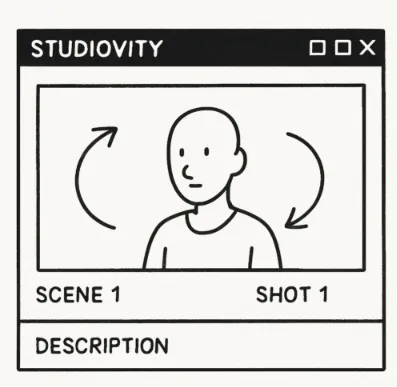
Great directors don’t just see a story in their heads—they see it on paper first, even if they can only draw stick figures. When tackling high-stakes scenes, “pre-visualization” (the process of planning your shots visually before you reach the set) becomes absolutely essential. Studiovity provides one of the best alternatives to manual storyboard drawing, letting you effortlessly drop elements into place to build your frame composition without picking up a pencil.
As one of the top visual storytelling tools for independent filmmakers, this approach prevents expensive on-set misunderstandings. A quick visual reference tells your crew exactly what you need to capture “the vibe.” Specifically, a storyboard instantly communicates four vital details that words often miss:
Frame size: Choosing between a tight Close-Up or an expansive Wide Shot.
Camera blocking: How the characters and the lens will move.
Lens height: Whether the camera is positioned high or low.
Lighting mood: Where the shadows fall to create emotion.
Translating abstract ideas into these clear visuals is surprisingly seamless. By following a basic step-by-step storyboard creation guide within the app, you empower your team to execute your exact vision.
Your 5-Step Workflow for a Professional Shot List
Transitioning from visual sketches to a logistical plan is where true organization begins. Learning how to make a professional shot list feels daunting, but it streamlines your entire production day. You use Studiovity’s dashboard to systematically log every required angle so no time is wasted.
The advantage emerges when linking these text details directly to your images. When comparing Studiovity vs traditional storyboarding methods, the key difference is intelligent connectivity. Rather than managing isolated paper notebooks, you attach specific gear requirements and director notes directly to your frames inside the shot list software, ensuring no critical element gets lost in the creative shuffle.
Assigning physical action is the next step, utilizing basic cinematic camera movement terminology so your crew understands the mechanics. You can tag shots as a “Pan” (turning the lens left or right), a “Tilt” (looking up or down), or a “Dolly” (physically pushing the camera forward). These functional terms instantly clarify whether your operator needs a basic stationary tripod or rolling tracks.
Everything culminates in a seamless export workflow before you head to your location. With one click, your logged data helps generate a “Call Sheet“—the official daily schedule telling your cast and crew exactly when to arrive and what to prep.
Managing Complex Camera Setups with Ease
Stepping onto a set with intricate lighting plans can overwhelm passionate creators. Yet, managing complex camera setups efficiently becomes simple when you start centralizing creative assets for film directors within Studiovity. Your digital shot list acts as the master logistical record, pairing specific tools directly with your visual scenes.
To guarantee your vision translates perfectly, every frame should detail three technical specifications alongside your cinematic camera movement terminology:
Lens Focal Length: Choosing a wide 24mm lens to establish a room or a tight 85mm for an emotional reaction.
Aspect Ratio: Deciding the video’s physical dimensions—like a widescreen 2.35:1 format—which dramatically alters the cinematic mood.
Lighting Setup: Documenting the exact placement and intensity of your main “key” light.
Pinning down this lighting continuity prevents disastrous, mismatched shadows if you ever have to reshoot a scene days later. Locking these details into your digital blueprint ensures everyone knows exactly what gear to grab.
Real-Time Collaboration: Keeping Your Crew on the Same Page
Nothing stalls a shoot faster than realizing your camera operator is holding yesterday’s plan. By embracing cloud-based collaboration for film crews, Studiovity eliminates the version control nightmare of outdated, printed documents floating around. When you tweak a camera angle or scene order on your laptop, that update syncs instantly to every device.
Rather than shouting instructions across a noisy location, you can assign specific tasks directly within your digital planner. Tagging a lighting assistant right in the shot list software is vital for streamlining your film pre-production workflow because it guarantees everyone knows their exact responsibility before the camera even rolls.
When creators ask about the benefits of integrated production management, the primary answer is reducing expensive wait time. Instant, clear communication keeps your team moving smoothly from one setup to the next without pausing for directions.
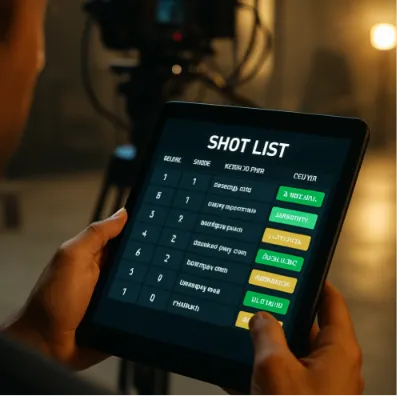
Studiovity vs. Spreadsheets: Why Modern Filmmakers are Switching
You likely planned your first video using a basic spreadsheet. While grids work perfectly for accounting, they struggle to capture a creative vision. The core difference between specialized software and manual tracking is speed. Spreadsheets force you to describe visual mediums using text alone, significantly slowing down your time-to-output.
Relying on generic documents creates unnecessary friction on set. When rushing on location, standard spreadsheets frequently fail because:
They lack visual links to your actual camera references.
They are frustratingly hard to read on mobile phone screens.
They invite manual data entry errors that quickly derail your production scheduling and visual planning.
Upgrading to specialized shot list software solves these headaches instantly. Visual-first tools let you actually see your shots, helping you make smarter creative decisions before anyone yells “action.” As a modern alternative to manual storyboard drawing, Studiovity translates tedious typing into a clear, shared roadmap.
Start Your Production with Confidence
You no longer need scattered notes when filming. By embracing professional visual storytelling tools, you transform creative chaos into a clear, actionable roadmap. Imagine the confidence of walking onto your set, handing your crew a perfectly organized plan, and knowing exactly what to film next. This level of preparation saves hours of wasted production time and eliminates shoot-day anxiety, giving independent creators the logistical power of major studio directors.
Mastering this workflow requires just a few simple steps. First, import a short script into the platform to see exactly how to make a professional shot list without the technical stress. Next, let the system auto-generate your visual plan directly from your narrative beats. Finally, share this setup with a collaborator. You now possess the framework needed to turn any creative vision into a stress-free reality.