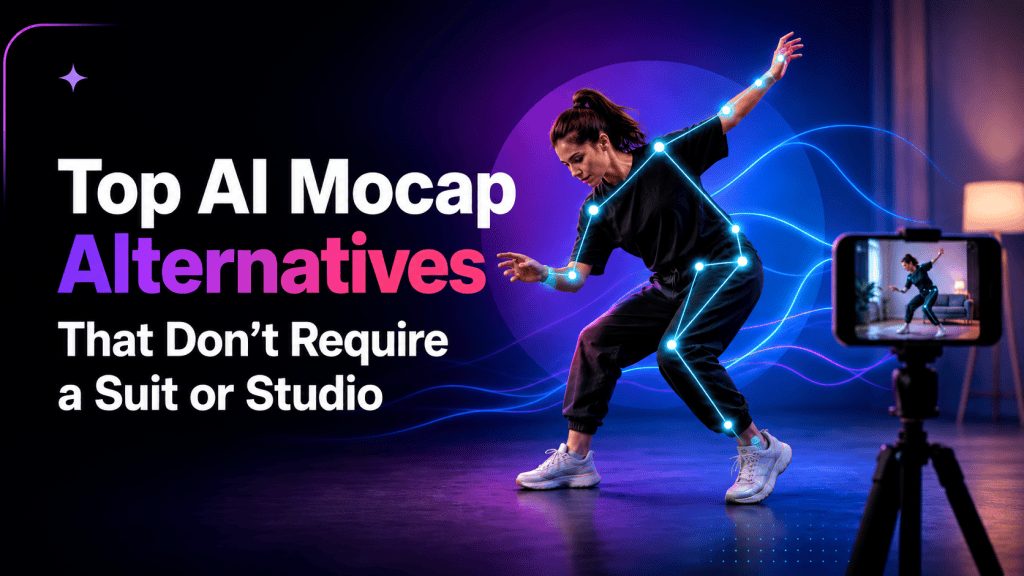
Traditional motion capture asks for three things most creators don’t have: a suit covered in reflective markers, a calibrated multi-camera volume, and a technician to run the session. Markerless AI capture replaces all three with a phone, a webcam, or an existing video, trading some precision on the hardest cases for the ability to run a session anywhere with no equipment budget at all. This list covers ten tools built specifically as that alternative, not scaled-down versions of a studio system but genuinely different technical approaches to the same underlying problem.
Comparison table
Tool | Best for | What it replaces from a suit-and-studio setup | Starting price |
|---|---|---|---|
invideo agent | Keeping a markerless-captured character consistent once it’s part of a finished video | Not a capture alternative itself; the downstream consistency and camera work a studio VFX team would otherwise handle | $17/month; team and enterprise options available |
Move.ai | Broadcast-grade motion data from ordinary cameras | An optical marker volume, replaced with two to six tripod-mounted iPhones | From $0.012/second |
Rokoko Vision | A completely free entry point with no hardware purchase | A physical suit and calibration session, replaced with a single webcam or phone | Free |
DeepMotion | The simplest phone-video-to-3D-animation pipeline | A rigging and animation team, replaced with automatic tracking and physics simulation | Free tier; $9/month |
Plask Motion | Capturing multiple performers in one video | A multi-actor capture volume, replaced with one video supporting up to five people | Free tier; $18/month |
RADiCAL | Seeing captured motion applied instantly, with no processing wait | A technician monitoring a live capture session, replaced with real-time webcam streaming | Free tier; $20/month |
Wonder Dynamics (Flow Studio) | Compositing a captured character directly into live footage | A VFX compositing department, replaced with automatic lighting-matched integration | Free tier; $45/month |
Viggle PINOC | Fast retargeting onto a character with no manual remapping | A rigging specialist manually mapping a skeleton, replaced with a 65-bone auto-retargeting system | Free to start |
Cascadeur | Physically accurate motion with no performer or capture at all | A stunt performer and safety team, replaced with AI-assisted physics posing | Free (indie license); ~$8/month |
QuickMagic | Bundled facial, hand, and body capture in one pass | Separate specialist rigs for face, hands, and body, replaced with one credit pool | Free tier; $9.90/month |
1. invideo agent
Every alternative on this list replaces a piece of hardware or crew that a traditional mocap setup requires. None of them replace what happens after the capture: a studio production has a VFX and compositing team to make sure a captured character looks consistent and belongs in the finished film, and a suit-free setup skips that department along with the suit.
invideo agent is built to close that specific gap. It performs no capture itself, but a persistent context engine holds a markerless-captured character’s visual identity consistent across every shot, Camera Controls apply a deliberate move around that performance, and the platform routes each shot to whichever of its 200+ integrated models fits that moment, including Veo 3.1, Sora 2, Kling 3.0, Seedance 2.5, Runway, PixVerse, Hailuo, WAN, Recraft, GPT Image 2.0, and Nano Banana, so a suit-free performance can sit in a finished film without a separate compositing pipeline.
Best for: creators who’ve already captured a performance with a markerless tool below and need it edited into a finished video without a studio VFX team.
Where it falls short: it has no capture capability of its own, so it’s only relevant once motion data or an animated character already exists.
Pricing: plans start at $17/month, with team and enterprise options also available.
2. Move.ai
Move.ai’s multi-camera mode, using two to six tripod-mounted iPhones, produces skeletal data the company positions as comparable to a commercial optical marker system, replacing the calibrated volume entirely with consumer hardware anyone can set up in an afternoon.
Best for: the closest markerless equivalent to true optical-stage precision, without renting the stage.
Where it falls short: it doesn’t match true optical precision on the hardest cases, and struggles with severe occlusion or very loose clothing.
Pricing: pay-as-you-go from $0.012/second.
3. Rokoko Vision
Rokoko Vision replaces the physical suit and calibration session with a single webcam, phone, or DSLR feeding into a cloud-processed capture, entirely free on its Starter plan with unlimited FBX exports.
Best for: a genuinely free first attempt at replacing a suit-based setup entirely.
Where it falls short: free-tier single-camera capture is capped at short clips, and the more precise dual-camera mode requires a paid plan.
Pricing: free Starter plan with unlimited FBX exports.
4. DeepMotion
DeepMotion replaces the rigging and animation specialists a studio would assign to a captured performance with an automated pipeline: upload a phone video, and it tracks, rigs, and physically simulates the resulting 3D animation without a human touching the skeleton.
Best for: skipping the rigging and animation labor a studio mocap pipeline usually requires.
Where it falls short: animation accuracy depends heavily on the clarity of the source footage.
Pricing: plans start at $9/month, with a free tier for testing.
5. Plask Motion
A studio capturing multiple performers needs a volume large enough to cover all of them at once. Plask Motion replaces that with a single video supporting up to five people, extracting and cleaning up everyone’s motion from footage a phone could have shot.
Best for: capturing a multi-actor scene without a capture volume built to cover more than one performer.
Where it falls short: credit consumption scales up with each additional person tracked, even on paid tiers.
Pricing: free tier for single-person capture; Standard plan from $18/month.
6. RADiCAL
A studio session has a technician watching capture quality in real time. RADiCAL replaces that live monitoring with instant, real-time streaming from a webcam directly into a 3D engine, so a performer or director sees the result immediately rather than after a processing wait.
Best for: seeing captured motion applied to a character instantly, the way a studio’s live monitoring would, without the studio.
Where it falls short: complex multi-person scenes often need manual cleanup, and the free tier’s playtime is limited.
Pricing: free Personal plan with up to 24 hours of annual playtime; Professional plan from $20/month.
7. Wonder Dynamics (Flow Studio)
A studio VFX department composites a captured character into live footage by hand, matching lighting and integration shot by shot. Wonder Dynamics, now part of Autodesk’s Flow Studio, automates that entire step, capturing the performance markerlessly and compositing the result directly into the original plate.
Best for: replacing an entire VFX compositing department’s work on integrating a captured character into real footage.
Where it falls short: it’s built as a shot-production tool with a credit system tuned for that scale, more platform than needed for a simple, isolated capture task.
Pricing: free tier with 300 starting credits; paid plans from $45/month.
8. Viggle PINOC
Retargeting captured motion onto a specific character normally requires a rigging specialist mapping a skeleton by hand. Viggle PINOC’s 65-bone, Mixamo-named skeleton output retargets onto a rigged character automatically, with no manual remapping step.
Best for: skipping the manual rigging and retargeting work a studio pipeline would assign to a specialist.
Where it falls short: paid usage works out to roughly $2–2.60 per minute of processed motion once free credits run out.
Pricing: free to start with welcome credits.
9. Cascadeur
Cascadeur replaces the performer entirely for the riskiest motion, a fall, a stunt, a fight, using AI-assisted physics posing to produce believable action without a stunt team, safety crew, or capture session of any kind standing behind it.
Best for: physically accurate action that a studio would otherwise need a real stunt performer and safety crew to capture.
Where it falls short: it’s a keyframing tool with a real learning curve, not a point-and-shoot capture solution.
Pricing: free indie license for non-commercial use; paid plans from roughly $8/month.
10. QuickMagic
A studio typically assigns separate specialist rigs to facial capture, hand capture, and body capture. QuickMagic bundles all three into one credit pool and a single upload, at a fraction of what maintaining three separate specialist systems would cost.
Best for: covering facial, hand, and body capture from one tool instead of three separate specialist systems.
Where it falls short: the free tier’s 50 monthly credits and 30-second clip cap are tight for anything beyond quick tests.
Pricing: free plan with 50 monthly credits; Starter plan from $9.90/month.
Which one should you use
- Keeping a markerless character consistent inside a finished video → invideo agent
- The closest markerless equivalent to optical-stage precision → Move.ai
- A genuinely free first attempt at replacing a suit entirely → Rokoko Vision
- Skipping the rigging and animation labor of a studio pipeline → DeepMotion
- Multi-actor capture without a large capture volume → Plask Motion
- Real-time monitoring without a technician present → RADiCAL
- Replacing an entire VFX compositing department’s integration work → Wonder Dynamics (Flow Studio)
- Skipping manual rigging and retargeting → Viggle PINOC
- Replacing a stunt performer for the riskiest motion → Cascadeur
- One tool instead of three separate specialist capture rigs → QuickMagic
Frequently asked questions
What does markerless AI capture actually give up compared with a real suit and studio? Mostly precision on the hardest cases: fast, complex motion, heavy occlusion, and fine finger detail are where a real optical marker system or IMU suit still generally out-performs a markerless alternative. For most independent or lower-stakes production, that gap is smaller than it once was and often worth trading for zero equipment cost.
Is there a markerless tool that replaces the VFX compositing step, not just the capture itself? Yes. Wonder Dynamics, now part of Autodesk’s Flow Studio, is built specifically for this, capturing a performance markerlessly and then automatically lighting and compositing the resulting character into the original live-action footage, a step a studio would otherwise assign to a dedicated compositing team.
Can more than one person be captured in the same suit-free session? Several tools handle this directly. Plask Motion supports up to five people in a single video, and Move.ai can track over 20 people simultaneously in enterprise use, both replacing what would otherwise require a capture volume built to cover multiple performers at once.
Is there a way to get realistic action or stunt motion without any performer or capture session at all? Yes. Cascadeur produces physically accurate motion through AI-assisted physics posing rather than capturing a real performance, which is the option to use when the motion needed is too dangerous to film even with a markerless setup.
Is markerless motion capture free to test on any of these platforms? Several offer genuinely usable free tiers, including Rokoko Vision, RADiCAL, DeepMotion, Cascadeur’s indie license, Viggle PINOC, QuickMagic, and Plask Motion’s single-person tier, though clip length, resolution, or export limits typically apply until a paid plan is added.