
Production scheduling sits at the center of every successful shoot. Whether you are creating a feature film, a television series, or a streaming production, the schedule determines how efficiently your crew works. Additionally, it dictates how well your budget stays under control, and whether your project finishes on time. However, many first-time producers assume that television and film scheduling follow the same process. In reality, completely different strategies are required by TV vs Film Scheduling.
A feature film often focuses on completing one self-contained story within a fixed production timeline. Television, on the other hand, demands continuous planning across multiple episodes, recurring locations, changing cast availability, and tight delivery deadlines. As a result, production teams must build schedules that match the unique workflow of each format. Therefore, mastering the dynamics of TV vs Film Scheduling helps directors, assistant directors, production managers, and line producers avoid delays while making smarter production decisions. Let’s explore how TV and film scheduling differ and why choosing the right scheduling approach matters.
Understanding Production Scheduling
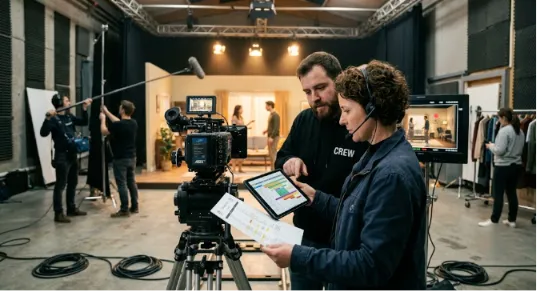
Production scheduling transforms a screenplay into a practical shooting plan. After script breakdown, the production team organizes scenes according to locations, cast availability, equipment needs, weather conditions, and production priorities.
Consequently, the schedule answers several important questions:
Which scenes should be filmed each day?
Which departments need preparation?
How long will each shooting day last?
When should actors report to set?
Which locations require permits or travel?
Every scheduling decision affects the production budget. Consequently, efficient scheduling reduces overtime, minimizes unnecessary company moves, and keeps departments working together. Although these goals remain consistent across television and film, the underlying mechanics of TV vs Film Scheduling differ significantly.
How Film Scheduling Works
Feature films usually follow a straightforward production structure. The screenplay reaches its final version before pre-production begins. Once producers approve the budget, the assistant director creates a shooting schedule that covers the entire project.
Instead of filming scenes chronologically, productions group scenes by practical factors. For example, every scene inside one house may be scheduled together, even if those moments appear throughout the story.
Furthermore, this approach helps productions:
Reduce location costs
Limit equipment transportation
Maximize actor availability
Save valuable production days
Most feature films shoot within a defined production window. Independent films may finish in two to four weeks, while larger productions can continue for several months. Nevertheless, the schedule usually remains relatively stable once principal photography starts. If unexpected problems arise, the production team adjusts individual shooting days instead of redesigning the entire schedule.
How Television Scheduling Works
Television scheduling operates under far greater pressure. Instead of producing one complete story, TV productions create multiple episodes that often overlap during development, shooting, editing, and post-production.
For instance, a single production week may involve:
Filming Episode 5
Editing Episode 3
Writing Episode 8
Preparing Episode 6
Because several departments work simultaneously, scheduling becomes much more dynamic. Television productions must also meet strict broadcast or streaming deadlines. Missing even one delivery date can disrupt an entire release calendar. Therefore, production managers continuously revise schedules as scripts evolve or production requirements change. Daily communication becomes essential since every department depends on accurate scheduling updates.
Episode-Based Planning Changes Everything
One of the biggest differences in TV vs Film Scheduling involves episode management. A feature film contains one production timeline. Television requires separate production plans for every episode while maintaining consistency across the entire season.
For example, if Episode 2 and Episode 7 both use the same hospital location, the production may schedule those scenes together. This strategy saves money while reducing location rentals and transportation costs. Similarly, productions often group scenes featuring recurring actors across multiple episodes. Instead of bringing performers back several times, the schedule maximizes their available shooting days. As a result, television scheduling demands much greater flexibility than film scheduling.
Cast Availability Plays a Larger Role in Television
Feature films generally secure the primary cast before production begins. Once shooting starts, most actors remain committed until principal photography ends. Television productions face different challenges.
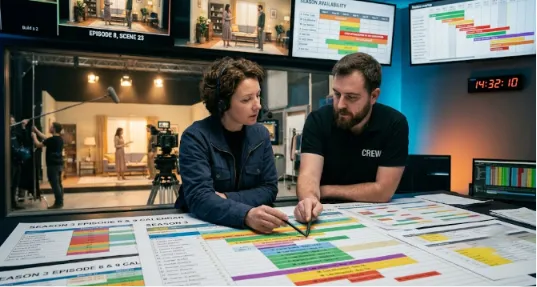
Indeed, series regulars appear throughout the season, while guest actors may only work for one or two episodes. Some performers also balance multiple projects simultaneously. Because of these variables, production coordinators constantly adjust shooting schedules around actor availability. This balancing act becomes even more challenging for anthology series, episodic dramas, and long-running television shows where new cast members join almost every episode. Therefore, managing cast logs highlights another core friction point in TV vs Film Scheduling.
Location Scheduling Differs Significantly
Location planning also separates television from feature film production. Films often travel extensively if the story requires multiple settings. Since the project has one production timeline, producers can dedicate several days or weeks to specific locations.
In contrast, television productions usually prioritize efficiency. Many TV shows rely on standing sets that remain available throughout the season. Permanent courtroom sets, police stations, apartments, hospitals, and office interiors reduce setup time and simplify scheduling. When productions leave studio facilities, they often maximize each location by filming scenes from several episodes during the same visit. This strategy lowers transportation costs while reducing schedule disruptions.
Budget Pressure Shapes Television Scheduling
Every production schedule reflects financial decisions. Feature films receive a production budget that supports the complete project. While producers still monitor costs carefully, the schedule typically focuses on finishing the film as efficiently as possible.
However, television scheduling places even greater emphasis on speed. Every additional shooting day affects multiple future episodes. Delays create a chain reaction that impacts editors, visual effects teams, marketing departments, and broadcasters. Therefore, television productions frequently use tighter daily schedules with carefully calculated page counts. Production managers continuously monitor progress to prevent delays from spreading across the season. Consequently, budget pressure alters the fundamental timeline of TV vs Film Scheduling.
Flexibility Matters More in TV Production
Feature film schedules often remain relatively stable after production begins. Conversely, television schedules change frequently. Script revisions, actor availability, weather conditions, production notes, and network feedback can force immediate adjustments.
Instead of rebuilding the entire schedule, production teams update specific episodes while protecting future shooting days. Modern scheduling software helps crews reorganize scenes quickly without losing track of cast, locations, or production resources. This flexibility has become increasingly important as streaming platforms demand faster production cycles.
Technology Has Changed Both Workflows
Digital production tools have transformed scheduling for both television and film. Instead of manually updating spreadsheets, production teams now generate schedules directly from screenplay breakdowns. Changes automatically update shooting days, call sheets, production calendars, and crew notifications.
For television productions, automation saves even more time because multiple episodes share locations, cast members, and production assets. AI-powered scheduling software can also identify conflicts before production begins. Teams can test alternative shooting orders, optimize company moves, and reduce scheduling risks long before cameras roll. As productions become larger and more complex, intelligent software completely redefines the technical workflow of TV vs Film Scheduling.
Choosing the Right Scheduling Strategy
Neither television nor film scheduling is inherently more difficult. Each format simply demands a different planning mindset.
Feature film scheduling focuses on completing one story within a defined production timeline. Stability, location efficiency, and resource optimization drive most scheduling decisions. Television scheduling emphasizes flexibility, continuous coordination, and episode management. Every decision affects multiple production stages, making communication and adaptability essential throughout the season. Production managers who understand these differences can build stronger schedules, reduce unnecessary costs, and keep crews working efficiently under changing production conditions.
Conclusion
Scheduling remains one of the most important responsibilities in film and television production. Although both formats rely on script breakdowns, shooting schedules, and production calendars, their workflows differ considerably.
Feature films benefit from stable, project-based scheduling that optimizes locations and production resources. Television productions require agile planning that balances multiple episodes, recurring cast members, changing scripts, and strict delivery deadlines.
Ultimately, analyzing TV vs Film Scheduling proves that proper framework alignment dictates project health. As productions continue embracing AI-powered planning tools, scheduling becomes faster, smarter, and more accurate. Whether you are producing an independent feature or a multi-season television series, the right scheduling system allows your team to stay organized, avoid costly delays, and keep every department moving toward a successful production.