
You have a brilliant movie idea. However, your notes are currently scattered across three notebooks, a dozen Google Docs, and a pile of napkins. In practice, seasoned directors know that cinema magic relies entirely on the invisible pre-production lifecycle. Therefore, mastering Filmmaking for Students requires transitioning those scattered concepts into an industry-standard workflow immediately. You need to stop planning like an amateur and start organizing like a professional.
Think of your film like building a house. Specialized architectural software forms your foundation. By mastering professional scriptwriting and integrated filmmaking workflow tools, you instantly automate complex logistics. Consequently, modern Filmmaking for Students bridges the gap between amateur ideas and professional results. Applying these methods ensures your next project remains visually and structurally indistinguishable from a professional studio production.
Why Industry-Standard Script Formatting is Your Film's Creative DNA
Typing a brilliant script in a standard word processor instantly screams amateur to your cast and crew. Learning how to format movie scripts according to industry standards is not just about looking professional. Actually, it establishes your pacing. Because Hollywood relies on the “one page equals one minute” rule, proper layout acts as the very DNA of your project.
Instead of manually hitting the tab key fifty times, using industry standard screenwriting software for Filmmaking for Students automates this heavy lifting. Therefore, your script will effortlessly follow three professional rules:
Font: 12-point Courier gives every letter equal spacing so timing remains strictly consistent.
Sluglines: Bold headings (like EXT. PARK – DAY) tell your crew exactly where and when you shoot.
Spacing: Precise margins visually separate dialogue from your action descriptions.
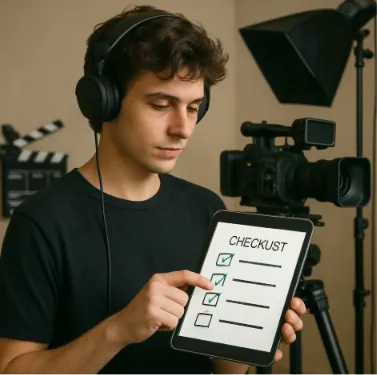
Filmmaking is a team sport. Therefore, your crew needs to access your script easily. By leveraging collaborative scriptwriting tools, multiple people can edit the exact same document in real-time. Consequently, you will avoid creating confusing “Version_7_FINAL” files on your desktop. Once you lock in your polished draft, the focus shifts from writing to logistics. This allows you to turn those words into an actionable blueprint.
Turning Words into a Blueprint with Automated Script Breakdowns
Finishing your final page of dialogue feels amazing. However, now you must shift from a writer’s creative mindset to a producer’s logistical focus. Figuring out how to manage student film pre-production digitally used to mean grabbing five different colored highlighters. Then, you manually marked every prop, costume, and character on printed pages. This is a tedious chore that quickly drains your creative energy.
What if your software could instantly identify those assets for you? Learning professional script breakdown techniques for Filmmaking for Students transforms your script into a highly organized plan of attack. Leveraging Studiovity filmmaking tools, you can automate element tagging. This means the system seamlessly scans your text and flags your cast, locations, and crucial items instantly. As a result, you significantly reduce manual labor.
This digital blueprint completely eliminates the dreaded risk of missing critical elements on shoot day. Therefore, you will never again arrive at your set only to realize someone forgot the main character’s signature jacket. With your production assets neatly cataloged and organized, you are perfectly positioned to begin visual planning.
How Storyboarding and Shot Listing Bridge the Gap Between Paper and Camera
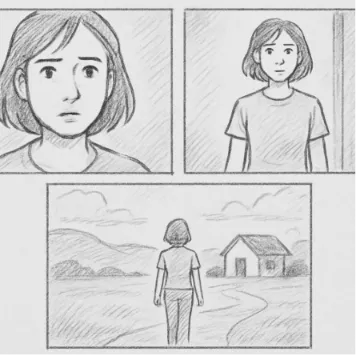
Staring at a script while trying to explain a visual idea to your crew quickly causes chaos. To translate abstract ideas into concrete visual instructions, you must bridge the gap between words and pictures. Think of storyboarding as a comic book version of your film. By leveraging integrated storyboarding and shot listing software, you easily sketch or upload reference photos. Thus, you show everyone exactly what you want to capture. As one of the best workflow tools for Filmmaking for Students, Studiovity keeps these essential visuals instantly accessible.
While the storyboard provides visual inspiration, a shot list serves as the technical roadmap for your cinematographer. It organizes every close-up and wide shot into an efficient shooting order. Because of this, you never waste time moving camera gear unnecessarily. Combining this visual planning with mobile-friendly script editing ensures your crew always stays synced directly from their phones. Consequently, you dramatically optimize time on set when following this pre-planned guide, setting the stage for flawless daily scheduling.
Master the 'Command Center' with Automated Call Sheets and Scheduling
Since crews screenplay and film movies out of chronological order, organizing a shoot can easily feel like solving a massive puzzle. Using budget-friendly alternatives like Studiovity revolutionizes Filmmaking for Students by transforming this chaos into a streamlined command center. By syncing script changes directly to your production schedule, you save hours of tedious re-typing and effortlessly group scenes by location.
Getting everyone to set on time requires a Call Sheet—the daily schedule detailing exactly where to go and what to expect. Automating film production call sheets for beginners keeps your small team punctual. Furthermore, it makes your project look instantly legitimate. A professional sheet always includes four essential items:
Call time
Location addresses
Weather forecasts
- Nearest hospital
Collaboration becomes completely seamless when your logistics live securely online. Utilizing cloud-based production management guarantees every single cast member can access the latest scheduling updates straight from their phones. With your command center fully operational, you possess a comprehensive action plan for principal photography.
Your Action Plan to Finish Your First 'Hollywood-Grade' Student Film
You no longer have to rely on scattered notebooks. By mastering digital screenwriting and project organization, you can confidently execute a linear transition from script to set. Simply format your screenplay, visually map your storyboards, and automatically generate your schedules. Therefore, adopting structured workflows for Filmmaking for Students ensures your creative blueprint is rock-solid before you ever touch a lens.
Think of the massive amount of time saved. You can now spend those hours directing instead of fighting spreadsheets. Ultimately, streamlining creative collaboration in Filmmaking for Students elevates the quality of student portfolios, making your project look undeniably professional. Commit to this workflow on your next short film, trust your new system, and focus entirely on capturing cinema magic.