
You probably never noticed the low ceiling in your favorite thriller, but a Set Designer in Film spent weeks obsessing over those exact dimensions. Actors get the glory, yet the physical environment silently dictates the scene’s emotion. According to Hollywood production archives, every fake wall and window is deliberately engineered for storytelling rather than mere aesthetics. The designer did their job perfectly if you never realized that claustrophobic room was actually built from plywood on a soundstage.
This artist acts as a translator, and their work bridges a director’s vague dream with a highly precise mathematical blueprint. Decorators simply furnish the space with furniture, but designers architect the room’s structural “bones.” Industry data reveals they map out these physical realities using precise pre-production visualization techniques, and this crucial structural planning makes them the first crew members hired. Empty stages are meticulously transformed into living worlds through this foundational planning.
Architects of the Unreal: Why a Set Designer in Film is Not Just an Interior Decorator
When you picture a breathtaking movie room, it is easy to assume one person built the grand staircase and placed the antique rug. In reality, creating cinematic worlds requires a highly specialized team. To understand the hierarchy of an art department, think of film construction like building a custom home.
This collaborative engine operates on a strict tier system. While audiences often confuse production design and art direction, the actual workflow follows a very distinct path:
- Production Designer: The visionary architect who dreams up the overarching aesthetic.
- Set Designer: The structural draftsman engineering those dreams into safe, physical realities.
- Set Decorator: The interior expert adding the furniture, art, and life.
Ensuring a staircase won’t collapse matters more to the Set Designer in Film than choosing paint colors. While the production designer dictates that a space feels like a Victorian mansion, the Set Designer engineers the room’s “bones,” calculating where walls must split apart to fit heavy camera equipment. This architectural math truly shines when designers deconstruct a script for action requirements.
Translating Paper to Plywood: How a Set Designer in Film Deconstructs Action Requirements
Set designers read scripts with a unique approach: they ignore dialogue and hunt for verbs. If a scene notes a character “slams the bedroom door,” the designer cannot draft a standard doorway. They must engineer a reinforced frame capable of surviving fifty consecutive takes of aggressive slamming. This technical script breakdown launches the step-by-step design process, ensuring every physical structure safely supports the narrative action.
Translating character emotion into “psychological architecture” is another essential skill for a Set Designer in Film. A designer might intentionally draft a lowered, heavy ceiling to make a struggling protagonist’s apartment feel intensely claustrophobic. However, once this emotionally resonant, action-ready room is fully drafted, a massive practical problem emerges. How does a bulky camera crew actually fit inside a tiny room to film it? The solution involves engineering architectural illusions that can literally pull apart on command.
The 'Wild Wall' Secret Every Set Designer in Film Uses for Camera Movement
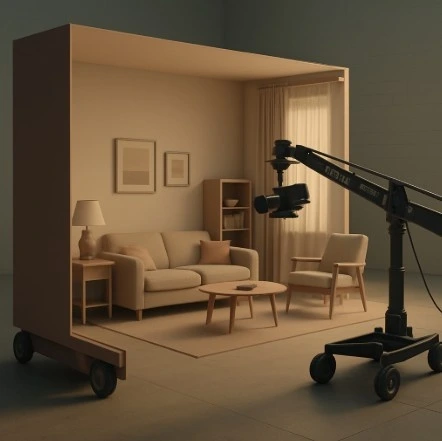
When a film shows an intimate dinner scene in a small kitchen, the actors are never alone; a massive crew and a 500-pound camera rig are hovering just out of frame. To accommodate this reality, a Set Designer in Film engineers “Wild Walls”—fully decorated walls mounted on heavy-duty wheels that can be quietly pulled away in minutes. Instead of standard blueprints, they draft technical architectural drawings for movies that map out exactly how a solid room will seamlessly split apart.
Orchestrating these spatial magic tricks requires sophisticated software like AutoCAD. Designers build exact mathematical models so directors can virtually “walk through” a 3D set before construction begins, ensuring the camera crane can glide right through where a solid wall used to be.
This hidden engineering even extends below ground, as floors are deliberately raised to conceal tangles of lighting cables and fake plumbing. Every inch prioritizes cinematic utility. However, once these temporary, wheel-mounted structures are built, the challenge immediately shifts to making them look like permanent, expensive architecture without bankrupting the production budget.
The Art of the 'Faux': How a Set Designer in Film Saves Production Budgets
How does an indie film afford a medieval castle? The secret is the “Touch Rule”—if actors don’t physically interact with an object, it doesn’t need to be real. While creating cinematic mood boards, a Set Designer in Film determines exactly when to invest in sourcing authentic props and furniture versus faking the architecture entirely using a few budget-saving tricks:
- Painted Foam: High-density foam is carved and textured to perfectly mimic heavy stone.
- MDF: Cheap fiberboard is painted by scenic artists to resemble luxurious hardwood.
- Forced Perspective: Shrinking background objects creates infinite vistas on tiny soundstages.
Mastering these optical illusions is the absolute core of movie set construction budget management. A designer might build a hallway where the farthest doors are actually miniature, tricking your brain into seeing endless depth. However, faux finishes and distorted dimensions only look convincing if shadows fall perfectly, requiring tight coordination with the cinematography team.
Light, Camera, Construction: Why a Set Designer in Film Works Closely with Cinematographers
A beautifully crafted room is useless if it cannot be lit. Therefore, daily responsibilities prioritize collaborating with the director of photography. To accommodate heavy equipment, designers often eliminate ceilings entirely, engineering hidden “lighting pockets”—strategic architectural gaps allowing overhead rigs to cast dramatic shadows without exposing the machinery.
This logistical dance continues with creating “camera-ready textures.” A vibrant wall might look perfect in person but could cause “color muddying” on a digital sensor. Every Set Designer in Film tests paint swatches under specific lenses to guarantee visual harmony between the construction and electric departments. Recognizing this structural foresight allows audiences to spot the set designer’s invisible genius.
The New Movie Lens: Spotting the Invisible Genius of a Set Designer in Film
Next movie night, look closely at the environments on screen: is that peeling wallpaper driving the mood? By noticing these deliberate structural choices and faux finishes, you can actively appreciate the rigorous architectural math behind the movie magic created by a Set Designer in Film.
Simplify Film Production Design with Studiovity
From script breakdowns to shot planning, modern filmmaking depends on organized collaboration between creative and technical teams. Studiovity helps filmmakers streamline pre-production with tools for screenwriting, scheduling, shot lists, storyboards, call sheets, and production planning. Whether you are managing an indie short film or a large-scale production, Studiovity gives every department a centralized workspace to stay aligned and production-ready.