
Creating the Perfect Film Production Call Sheet
Imagine standing in a dim parking lot at 6:00 AM with twenty crew members staring at you, all asking the same terrifying question: “What are we doing first?” When creating the perfect film production call sheet, a film set transforms from chaos into a precision machine. Without a plan, it becomes an expensive, chaotic meeting; however, with the right document, it becomes structured and efficient. This guide builds the heartbeat of your shoot and transforms scattered energy into a unified workflow.
Think of a professional call sheet less like a boring form and more like a high-stakes travel itinerary or a wedding day schedule. It serves as the “production pulse,” coordinating every movement from the sound department’s arrival to the lead actor’s lunch break. As a result, a clear and accurate schedule builds crew trust because it proves you respect their time and safety.
In practice, this document acts as an insurance policy for your shooting day. It proactively solves three massive problems before the sun even comes up: it establishes exactly where the team meets, defines the timeline for each department, and clarifies safety protocols. Because of this, you remove administrative anxiety and allow your team to focus entirely on creativity.
Creating the perfect film production call sheet once required late nights with complex spreadsheets, but technology has evolved. Today, platforms like Studiovity act as a production assistant in your pocket, automating tedious data entry so you never miss a detail. Therefore, mastering this document becomes the defining step that takes you from an aspiring enthusiast to a structured production leader.
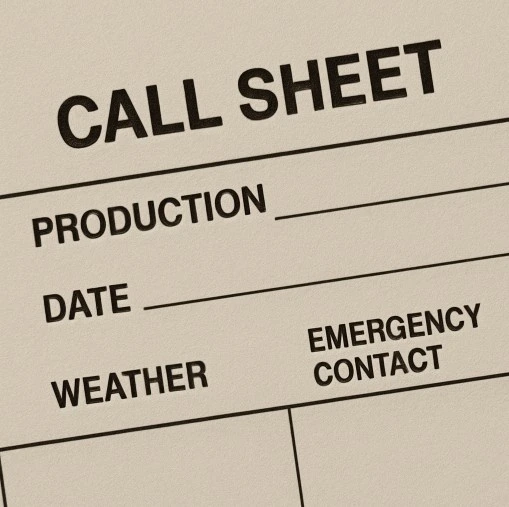
The Anatomy of a Professional Header: 5 Critical Details Every Crew Member Scans First
Think of the top section of your document as the dashboard of a car; it provides vital stats before the engine starts. While the script tells the story, the header establishes the reality of the day. As a result, it instantly signals to your cast that this is a safe and organized environment. By organizing essential elements here, you prevent the most common amateur mistake: confusion before coffee.
Nothing kills morale faster than a crew circling the block looking for parking. Therefore, clearly defining “Basecamp” is non-negotiable. In film terms, Basecamp is the primary hub where the day begins—where actors get dressed and crew members park. Instead of sending vague text messages, use a template in Studiovity to pin precise GPS coordinates. This way, you separate crew parking from the shooting location and eliminate the “Where do I go?” panic.
Lighting and logistics depend heavily on the sun. Because of this, your header must function as a weather station. Listing Sunrise and Sunset times tells the camera department exactly how much natural light is available. At the same time, this sits next to the “General Call”—the start time for the main crew. For example, if General Call is 7:00 AM but sunrise is 7:15 AM, that window becomes crucial for safe unloading.
The Top 5 Essentials to Verify:
- Production Title: The project’s identity
- Date/Day of Shoot: Context for the timeline (e.g., “Day 2 of 4”)
- Weather/Sunrise/Sunset: Environmental constraints
- Nearest Hospital: The safety net
- Basecamp Address: The starting point
Finally, safety defines strong leadership. Including set safety notes and nearest hospital information acts as a safeguard, proving you value the crew over the shot. In an emergency, nobody has time to search for help. Therefore, with these pillars secured, your team is ready to move forward confidently.
Decoding the Shooting Schedule: How to Read the Grid Like a Professional
Once the header is secured, attention shifts to the center of the page: the shooting schedule. This grid is not just a list; instead, it acts as a battle plan that dictates the flow of your entire day. It tells the crew exactly what the story requires.
Think of this section as your production’s travel itinerary. It groups scenes by logistical logic rather than story order. For instance, you shoot all “Kitchen” scenes together to save hours of setup time. As a result, efficiency improves dramatically.
Understanding a professional call sheet requires learning industry shorthand. Instead of full pages, workload is measured in “eighths.” A short exchange may be 2/8ths, while a monologue could be 7/8ths. This precision helps estimate the speed of the day. Similarly, “Cast IDs” replace full names to keep the grid clean.
The Grid Breakdown:
- Scene #: Script reference
- Description: Scene summary
- Cast IDs: Required actors
- Pages: Scene length in eighths
- Location: Filming address
Managing this manually often leads to errors. However, Studiovity eliminates these risks by automatically parsing scripts and syncing data. Therefore, you can focus on strategy rather than calculations.

Managing the 'Who' and 'When': Setting Precise Call Times for Cast and Crew
The difference between chaos and professionalism often comes down to time management. If everyone arrives at once, delays begin immediately. Instead, you should stagger arrivals to maintain flow and efficiency.
Actors must go through Hair, Makeup, and Wardrobe before filming. Because of this, their call times must be earlier than the shooting call. For example, if makeup takes 45 minutes, their arrival must reflect that buffer.
Precision matters equally for the crew. A 7:00 AM call means “ready to work,” not just arrival. Therefore, clear expectations prevent delays and confusion.
Creating the perfect film production call sheet requires managing these timelines accurately. Fortunately, Studiovity automates staggered scheduling, turning complexity into simplicity.
Stop the Spreadsheet Struggle: Optimizing Pre-Production Workflows Using Studiovity
Most first-time directors face the same challenge before production. They sit in front of fragile spreadsheets, copying data and hoping nothing breaks. However, Studiovity changes this completely.
Instead of isolated files, it connects your entire production into one system. When you break down your script, every detail syncs automatically. As a result, you reduce hours of work into minutes.
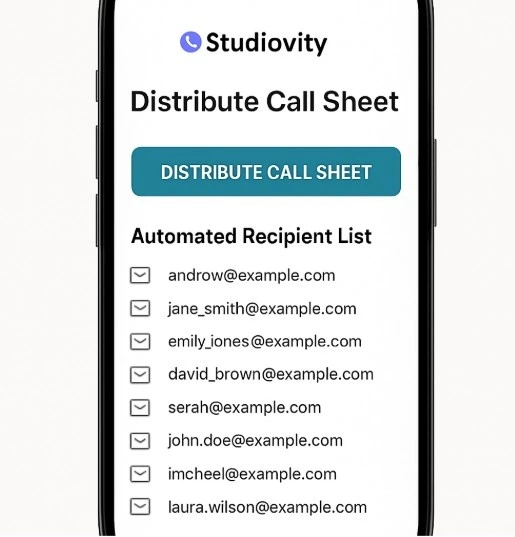
Creating the perfect film production call sheet becomes faster, more accurate, and far less stressful. Furthermore, distribution becomes seamless. You can send updates instantly via mobile, ensuring everyone stays informed.
Avoiding the 3 Most Common Scheduling Errors That Ruin Production Days
Even with great tools, poor planning can still cause problems. Therefore, you must avoid these common mistakes:
- Underestimating Company Moves: Always add buffer time
- Ignoring the 6-Hour Meal Rule: Prevent fatigue and penalties
- Shortchanging Turnaround: Ensure proper rest
These rules protect both efficiency and safety. As a result, your production remains sustainable and professional.
Automating the Hand-Off: Efficiently Distributing Your Call Sheet to the Crew
A perfect schedule means nothing if it is not shared on time. Industry standards suggest sending it by early evening. This allows your team to prepare properly.
Instead of messy group chats, use structured distribution. Studiovity simplifies this by sending real-time updates directly to crew members. Therefore, everyone stays aligned with the latest version.
From Spreadsheet to Set: Your 5-Step Action Plan for a Flawless Production Day
You are no longer just operating a camera—you are leading a production. Creating the perfect film production call sheet builds trust and ensures smooth execution.
Follow this workflow:
- Finalize script and scenes
- Set call times in Studiovity
- Add safety and location details
- Review with department heads
- Distribute before evening
Creating the perfect film production call sheet no longer requires stress or late nights. With Studiovity handling the heavy lifting, you eliminate errors and focus on creativity. A perfect call sheet defines a serious director—and now, you have the tools to build one effortlessly.
Create the Perfect Call Sheet with Studiovity
Creating the perfect film production call sheet becomes effortless when your tools work as intelligently as your vision. Studiovity brings your entire pre-production workflow into one connected system—from script breakdown to scheduling and instant call sheet generation. Instead of juggling spreadsheets, emails, and last-minute edits, you get a streamlined platform that ensures accuracy, saves hours, and keeps your entire crew aligned. When every detail is automated and every update is synced in real time, you can focus on what truly matters: executing your shoot with confidence and creative control.