
Call Sheet Explained: Shooting Schedule & Production Details
Imagine trying to coordinate a high-stakes wedding where the caterer, the band, and the guests all arrive without a clear itinerary. In film production, this chaos is avoided through what is known as a Call Sheet Explained & Schedule, which serves as the central nervous system of every production. This essential document acts as a daily blueprint, transforming a chaotic location into a synchronized workspace where safety, timing, and creativity align perfectly.
Orchestrating this logistical feat falls to the 1st Assistant Director (AD). Acting as the set’s lead project manager, the 1st AD builds the schedule based on exactly which scenes need to be filmed, balancing the director’s creative vision with the practical realities of available daylight and budget. As a result, experienced producers often note that a well-crafted call sheet is the primary defense against expensive on-set delays.
Navigating this document begins with the General Call, which lists the official start time for the crew to report to Basecamp—the main headquarters where equipment trucks and actor trailers are parked. While the main crew arrives then to prepare the lights and cameras, actors often have different “individual call” times for hair and makeup. Therefore, by mastering this schedule, you gain the ability to understand the complex, hidden flow of a professional film set.
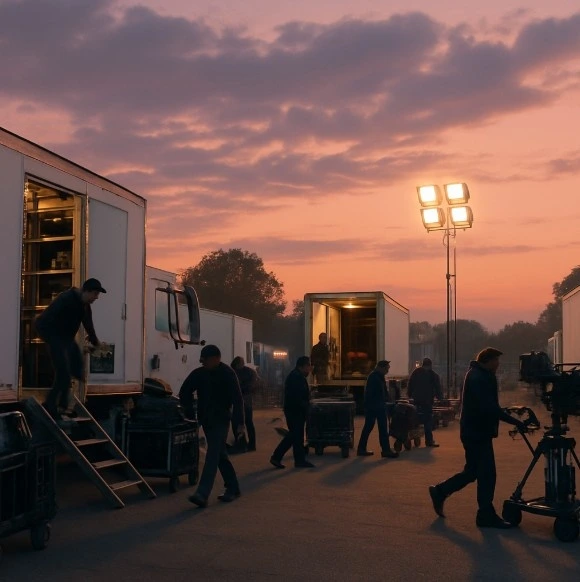
The Header: Navigating the Vitals of Set Location, Weather, and Emergency Safety
Scanning the very top of the page reveals the production’s geographic heartbeat: the locations. You will often see two distinct addresses listed here: “Basecamp” and “Set.” Think of Basecamp as the headquarters where the day begins—this is where cast trailers, catering trucks, and crew parking live. Meanwhile, “Set” is where the cameras are actually rolling. Distinguishing between these two ensures you don’t drive your car into a delicate lighting setup when you were actually supposed to report to the makeup trailer five miles away.
Below the address lines, the weather box acts as a strategic forecast rather than simple small talk. Filmmakers obsess over the “Golden Hour”—that brief window of soft, warm light just before sunset—and the call sheet explicitly lists these times so the camera team knows exactly when they must be ready to capture the magic. Additionally, if the forecast predicts a storm, this section will identify a “Cover Set,” which is an indoor backup location prepared in advance so the production doesn’t lose money standing in the rain.
Beyond logistics, the header serves as a critical safety net for the entire crew. Consequently, safety compliance is non-negotiable. This section provides immediate access to:
- Date and Day of Production: Tracks progress (e.g., “Day 4 of 20”) to keep the budget aligned.
- Weather & Golden Hour: Vital data for lighting continuity and crew gear preparation.
- Nearest Hospital: A legal requirement listing emergency medical facilities with maps and phone numbers.
- Producer Contact: The direct line to the decision-maker in charge of the set.
Decoding the Grid: Why We Shoot Out of Order to Maximize Your Budget
The massive grid taking up the center of the page is the day’s strategic roadmap, and its contents often surprise newcomers. Unlike the finished film, this schedule rarely flows in chronological order. Instead, productions are organized by logistics to maximize the budget. For instance, if the movie’s opening scene and the grand finale both take place in the “Hero’s Kitchen,” they will be filmed on the same day to avoid the expensive process of setting up lights and cameras twice. Therefore, this highlights the Call Sheet Explained & Schedule as a tool that alerts the crew to exactly which emotional beats they need to prepare for, regardless of script order.
To measure exactly how much work fits into these twelve-hour days, the industry uses a unique unit of time: the “eighth” of a page. Scripts are conceptually divided into eight one-inch strips, with one full page representing roughly one minute of screen time. Consequently, a scene listed as “4/8” is half a page of dialogue, while a “1/8” might be a single silent reaction shot. This granularity allows the Assistant Director to balance the schedule with precision.
Reading a single row across this grid provides a snapshot of the resources required for that specific moment. Moreover, every column serves as a specialized instruction for a different department, ensuring that props, actors, and lighting are synchronized. A standard entry breakdown includes:
- Scene Number & Setting
- Description
- Cast IDs
- Page Count
The Talent Timeline: Syncing Hair, Makeup, and Wardrobe Without Losing the Lead Actor
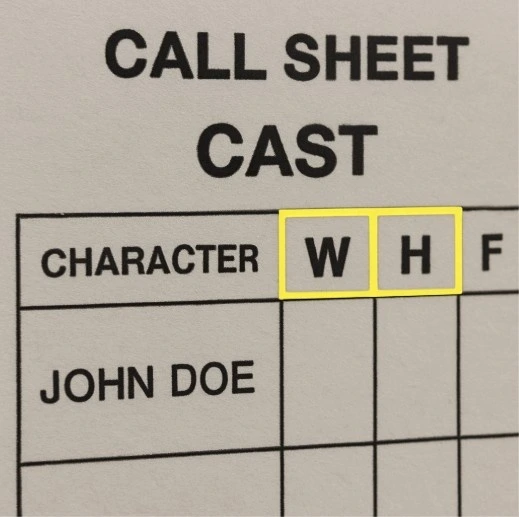
Just because the crew starts unloading trucks at 7:00 AM doesn’t mean the lead actor walks onto the set at the same time. The “Cast” box breaks down the precise choreography required to transform a person into a character. Initially, this timeline begins with “Pickup,” followed by “H/M/W” (Hair, Makeup, and Wardrobe). As a result, this staggered approach ensures everyone is “Set Ready” exactly when the cameras roll.
Beyond daily timing, the call sheet also tracks an actor’s contract status using abbreviations such as S, W, and F. Therefore, these codes help monitor payroll and logistics efficiently. Ultimately, all timelines converge on the “Set Call,” which is the deadline for the talent to step in front of the lens.
Crew Logistics and Department Notes: Managing 100+ Roles Through Specific Instructions
While actors prepare, the production team mobilizes based on department-specific instructions. For example, technicians may receive “pre-calls” to set up equipment early. To navigate this hierarchy, it helps to identify key department heads such as the DP, Gaffer, and Key Grip.
Energy management is also strictly regulated through the “6-Hour Rule.” Consequently, missing meal deadlines results in penalties, making scheduling crucial.
Finally, the “Advance” section forecasts the next day’s plan. Therefore, departments can prepare in advance instead of reacting under pressure.
Modern Production Management: Why Digital Software is Replacing the Paper Clipboard
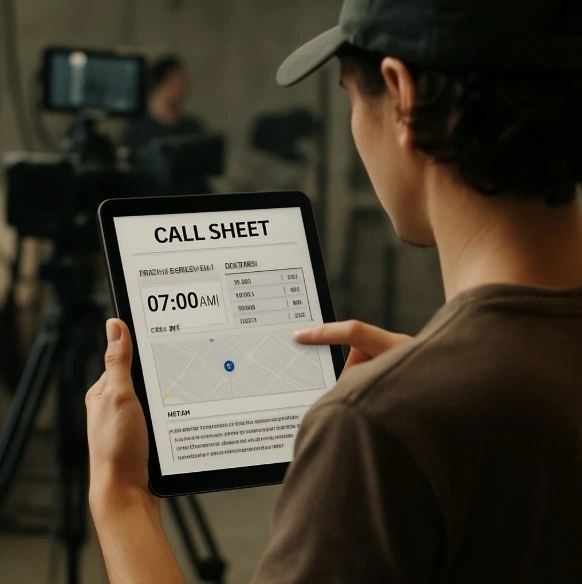
Static PDFs become outdated the moment a schedule shifts. However, modern tools now replace them with real-time updates. This evolution makes the Call Sheet Explained & Schedule far more dynamic and reliable than traditional methods.
Digital platforms provide features such as:
- Instant GPS Links
- Digital RSVPs
- Live Weather Syncing
Additionally, automation connects planning with reporting, ensuring accuracy across production workflows.
Your First Day on Set: A 5-Step Action Plan for Reading Any Call Sheet Like a Pro
You have moved past confusion to understanding the operational heartbeat of a movie set. In fact, the Call Sheet Explained & Schedule is now your daily roadmap.
Start by confirming your call time and parking instructions. Then, locate the nearest hospital for safety awareness. Next, review the scenes and check the advance schedule. As a result, you stay prepared and efficient.
Mastering this system allows you to walk onto set with confidence. Ultimately, the Call Sheet Explained & Schedule ensures that creativity thrives without logistical chaos.
Simplify Your Call Sheets with Studiovity
While understanding a call sheet is essential, managing it manually can still slow down your production. This is where Studiovity transforms the entire workflow. Instead of juggling static PDFs and last-minute updates, you can create, update, and share dynamic call sheets in real time. From automated scheduling and script breakdowns to instant crew notifications and mobile-friendly access, everything stays perfectly aligned. As a result, your Call Sheet Explained & Schedule process becomes faster, smarter, and far more reliable—allowing you to focus on filmmaking rather than fixing logistics.