As a production accountant or line producer, the close of the calendar year represents a critical window of opportunity. It is the perfect time to ensure that your active productions, ledgers, and vendor details are accurate, up to date, and fully prepared for year-end reporting and tax season. Therefore, utilizing a comprehensive End-of-Year Production Accounting Checklist (Free Template Download) is essential to streamline your review process and start the new year on a solid financial footing.
[DOWNLOAD YOUR FREE END-OF-YEAR ACCOUNTING CHECKLIST TEMPLATE FROM THE LINK GIVEN BELOW]
Managing a complex production involves more than just balancing books; it requires synchronizing your pre production software with your financial reality. Whether you are finalizing a screenplay budget or wrapping a shoot, accuracy is paramount. In this guide, we will break down the essential steps to close your books effectively using our End-of-Year Production Accounting Checklist (Free Template Download), ensuring you remain audit-ready and compliant.
Reconcile Year-End Financials
First and foremost, you must establish a baseline of truth for your accounts. Financial reconciliation is the bedrock of production accounting. Consequently, you should begin by reconciling all active and recently wrapped project bank accounts. This step ensures that the cash on hand matches your records perfectly.
Additionally, you must ensure that all petty cash, credit cards, and P-cards are fully reconciled through December 31. Often, small transactions on set slip through the cracks; however, catching them now prevents headaches later. Furthermore, verify that all vendor and crew payments are recorded in the General Ledger. If you are managing multiple units, reconcile any inter-company or cross-project transfers immediately. This level of scrutiny guarantees that your financial data is reliable.
Review General Ledger and Cost Reports
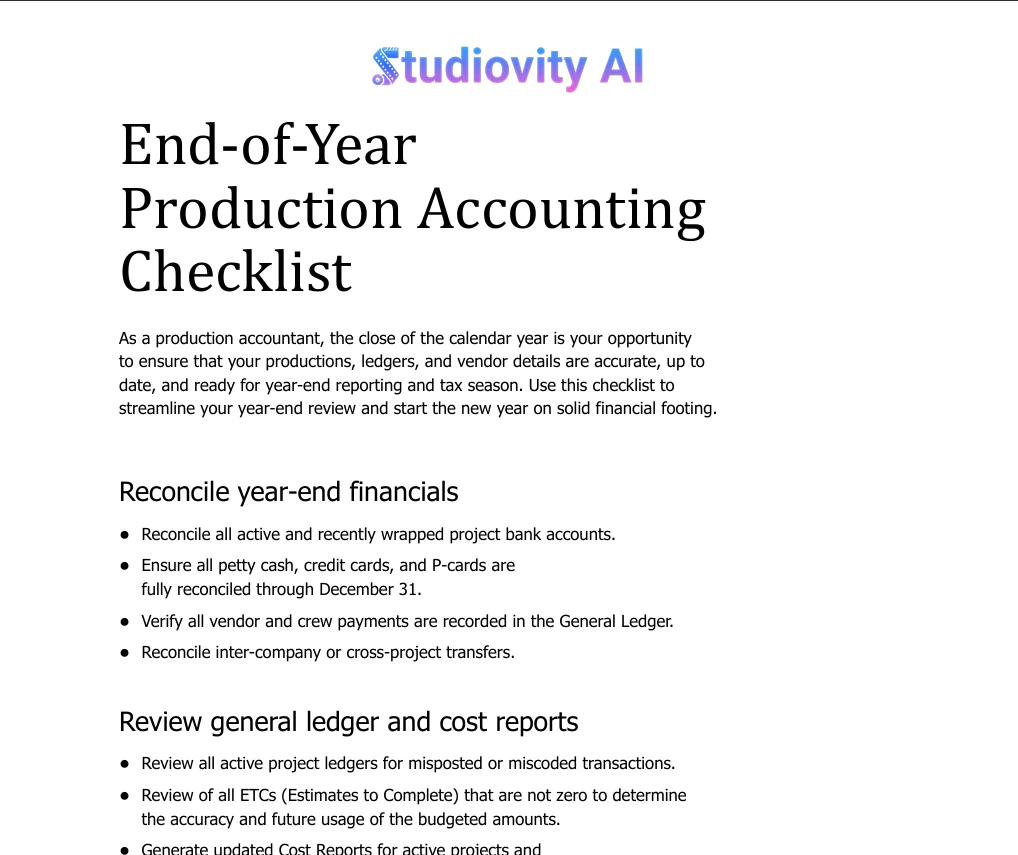
Once your accounts are reconciled, you must dive deep into the data. Reviewing your general ledger and cost reports is crucial for spotting errors before they become permanent. Start by reviewing all active project ledgers for any misposted or miscoded transactions. Even a minor coding error can skew your film scheduling budget reports significantly.
Next, review all Estimates to Complete (ETCs) that are not zero to determine the accuracy and future usage of the budgeted amounts. This analysis helps you forecast accurately. Moreover, generate updated Cost Reports for active projects and confirm they align with your current budgets. For example, if your script breakdown indicated heavy VFX spend, your cost report should reflect that trajectory.
Analyze any significant variances or overages and document explanations for audit trail purposes. Finally, confirm that final Cost Reports for completed projects have been submitted to production executives or studios. This ensures transparency with your stakeholders.
Prepare for Tax and Compliance Requirements
Compliance is non-negotiable in film production. As you approach the year-end, verify that all vendor W-9s are on file and current. Missing tax forms can delay critical filings. Therefore, audit 1099-eligible vendors and contractors to ensure accuracy before issuing forms in January.
In addition, review workers’ compensation and other insurance classifications for accuracy. Errors here can lead to costly premiums or uncovered claims. For productions filming in tax incentive jurisdictions, ensure that year-end financial data aligns with local reporting requirements. Accuracy here directly impacts your rebate potential. Using a reliable End-of-Year Production Accounting Checklist (Free Template Download) helps keep these compliance tasks organized.
Finalize Payroll and Fringe Reporting
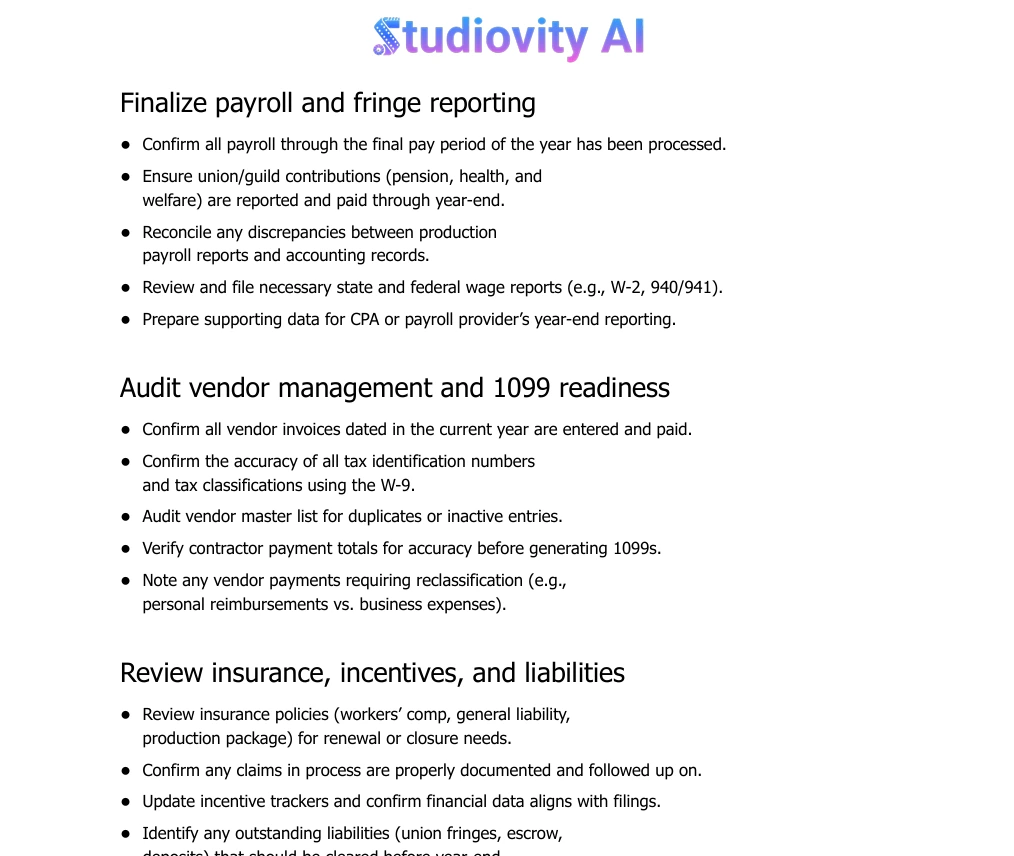
Payroll is often the largest line item on a budget. Consequently, you must confirm that all payroll through the final pay period of the year has been processed. Ensure that union and guild contributions—such as pension, health, and welfare—are reported and paid through year-end.
Reconcile any discrepancies between production payroll reports and your accounting records immediately. Furthermore, review and file necessary state and federal wage reports, such as W-2s and 940/941 forms. Preparing supporting data for your CPA or payroll provider’s year-end reporting now will save you time later. Proper management of your cast and crew financial data is vital for maintaining good relationships and compliance.
Audit Vendor Management and 1099 Readiness
Vendor relationships rely on timely and accurate payments. Confirm that all vendor invoices dated in the current year are entered and paid. Additionally, confirm the accuracy of all tax identification numbers and tax classifications using the W-9.
Audit your vendor master list for duplicates or inactive entries to keep your database clean. Before generating 1099s, verify contractor payment totals for accuracy. Also, note any vendor payments requiring reclassification, such as personal reimbursements versus business expenses. Efficient vendor management ensures your call sheet requirements are always met by happy suppliers.
Review Insurance, Incentives, and Liabilities
Protecting the production’s assets is a continuous duty. Review insurance policies, including workers’ comp and general liability, for renewal or closure needs. Confirm that any claims in process are properly documented and followed up on.
Update your incentive trackers and confirm that financial data aligns with your filings. Furthermore, identify any outstanding liabilities, such as union fringes or escrow deposits, that should be cleared before year-end. This step ensures your balance sheet is clean.
Organize Audit and Record Retention
A well-organized office is the sign of a professional production. Ensure all project accounting files, both digital and physical, are organized and archived according to studio or company policy. Verify that backup copies exist for key records like payroll, vendor contracts, cost reports, and tax filings.
Prepare supporting documentation for year-end financial reviews or CPA audits. Retain tax and payroll documents for required durations per jurisdictional rules. Proper archiving supports your team even after the shot list is completed and the cameras stop rolling.
Plan and Report for Next Year
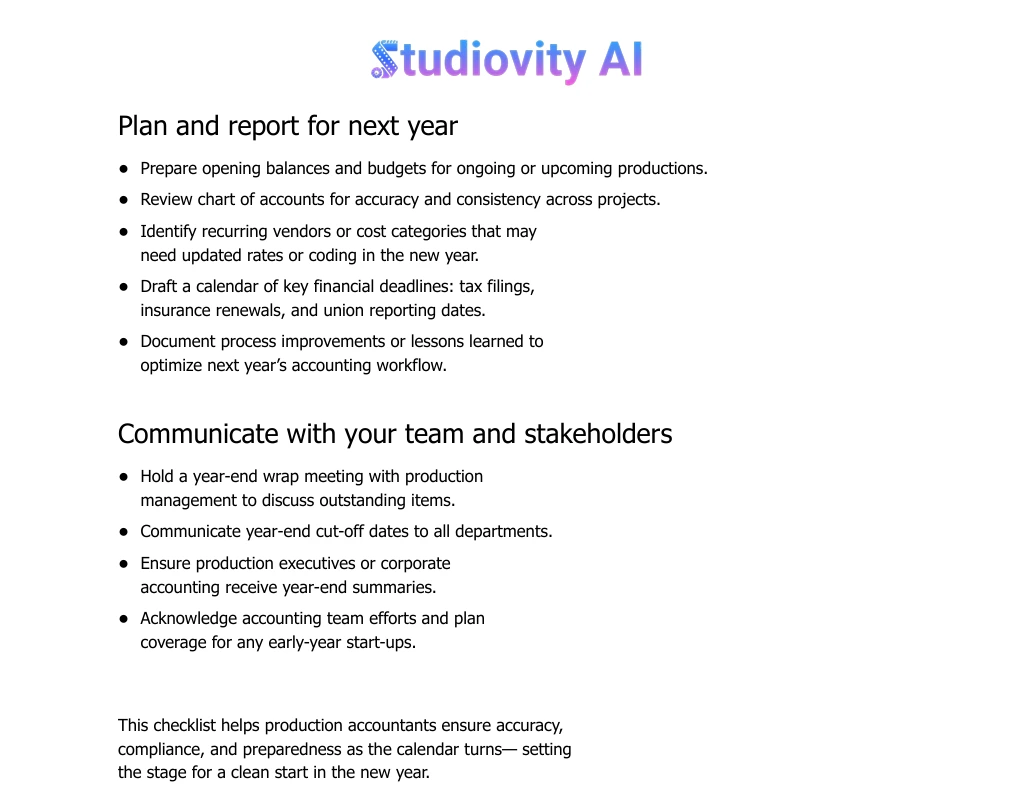
Finally, look ahead. Prepare opening balances and budgets for ongoing or upcoming productions. Review your chart of accounts for accuracy and consistency across projects. Identify recurring vendors or cost categories that may need updated rates or coding in the new year.
Draft a calendar of key financial deadlines, including tax filings and insurance renewals. Integrating this into your film production calendar ensures you never miss a date. Document process improvements or lessons learned to optimize next year’s accounting workflow.
Communication is key. Hold a year-end wrap meeting with production management to discuss outstanding items. Communicate year-end cut-off dates to all departments and ensure production executives receive year-end summaries. Acknowledge your accounting team’s efforts and plan coverage for early-year start-ups.
Using this End-of-Year Production Accounting Checklist (Free Template Download) ensures accuracy, compliance, and preparedness as the calendar turns, setting the stage for a clean start in the new year.