
Imagine it’s Friday night with a looming script deadline. In 2023, you’d be battling a blinking cursor. Today, AI Scriptwriting Tools for Filmmakers in 2026 act as a tireless digital assistant. Industry data reveals modern AI writing tools cure writer’s block through prompt engineering, managing tedious formatting so you can focus entirely on cinematic storytelling.
Moving beyond basic text generation, the shift toward procedural AI changes how scripts get developed. Now, software understands structural story beats instead of simply guessing the next word. Additionally, recent indie case studies show that AI Scriptwriting Tools for Filmmakers in 2026 can help a $5,000 shoot feel like a $50,000 blockbuster. Your screenwriting program isn’t just a digital typewriter anymore; it’s a collaborative creative partner.
Keeping Your Hero in Character with AI Consistency Engines
We’ve all faced the frustration of “dialogue bleed,” where your grizzled space smuggler and naive scientist sound identical by page 40. Although you may know how to map out a compelling character arc, holding that unique voice steady through a full feature still feels exhausting. Enter the Consistency Engine—essentially Method Acting for software. Instead of treating scenes in isolation, modern AI writing tools analyze your protagonist carefully. As a result, they prevent a cynical hero from suddenly sounding cheerful.
To achieve true character consistency, these systems rely on Narrative Memory, acting as the script’s long-term memory. You can quickly train AI-assisted character development software on a specific voice profile using three simple steps:
- Input the character’s core motivations and hidden flaws.
- Provide short sample lines establishing their unique conversational cadence.
- Flag specific quirks or forbidden phrases they would never use.
Once locked in, this digital partner safeguards your hero’s integrity. Consequently, it saves dozens of hours during character-specific polishing. With the voices perfected, AI Scriptwriting Tools for Filmmakers in 2026 also help you manage visual flow, automated formatting, and real-time pacing.
Automated Formatting and Real-Time Pacing: The End of Tedious Polish
Wrestling with margins to fix a basic slugline is now a frustration of the past. Today, you no longer need to memorize tab spaces. Instead, automated script formatting handles industry standards instantly. As a result, your software acts like an invisible script supervisor while you focus on the emotional truth of the scene.
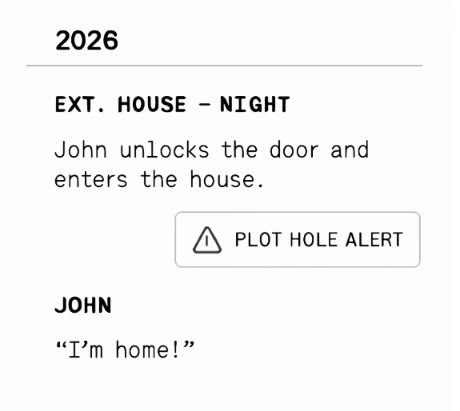
What if your script could flag a missing prop before the cameras even roll? Modern tools now feature real-time plot hole detection algorithms. In other words, they act as a safety net for narrative logic. For example, if your noir detective loses a revolver in Scene 3 but fires it again in Scene 12, the system catches the error immediately. Therefore, you avoid costly on-set reshoots.
Beyond tracking props, this technology actually feels the rhythm of your story. When you apply Natural Language Processing for screenplay pacing—the engine’s ability to “read” scene speed—it visually maps out dragging dialogue or rushed climaxes. AI Scriptwriting Tools for Filmmakers in 2026 now help creators fine-tune every emotional beat with greater precision.
With your story’s momentum perfectly tuned and errors eliminated, you are ready to visualize those words and make the leap from page to pixels using multi-modal AI.
From Page to Pixels: Using Multi-modal AI for Instant Storyboarding
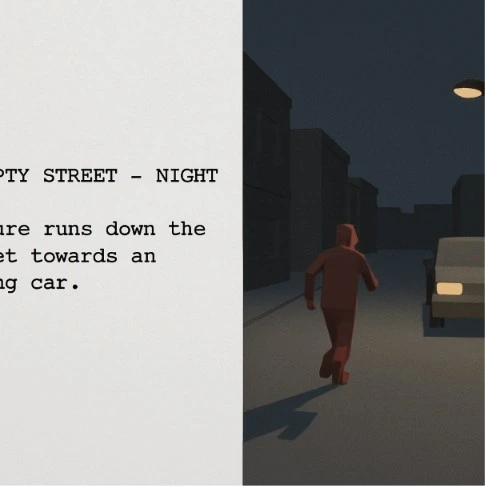
The biggest hurdle for indie filmmakers isn’t writing a brilliant car chase; it’s proving they can shoot it. By integrating Generative AI for storyboard visualization, your software becomes a digital director of photography. It seamlessly reads your scene-setting descriptions and camera cues, instantly generating practical visual frames.
Once you establish those static frames, the technology pushes your vision directly into motion. Furthermore, multimodal AI for scene-to-video prototyping translates written text into moving video drafts. Because of this, you can test a tricky tracking shot before hiring a crew. This evolution in AI content creation means you can bring animated pre-visualizations to your next investor pitch, turning a shoestring concept into a premium prototype.
Visualizing complex shots early slashes pre-production costs. At the same time, it prevents wasted hours on set. Additionally, AI Scriptwriting Tools for Filmmakers in 2026 help directors present cinematic ideas faster during investor meetings and production planning.
However, as your script rapidly evolves into tangible video assets generated by software, protecting your ownership and career becomes a vital consideration.
Ownership in the Age of AI: Protecting Your Script and Your Career
Turning your vision into a pre-visualization feels thrilling, but ownership questions still remain. Meanwhile, productions increasingly rely on collaborative AI screenplay editors for remote teams. Because of this, the line between writer and software can easily blur. To maintain true authorship, you must provide “Transformative Input”—where the software acts as a digital assistant shaping your specific ideas, rather than inventing the core plot.
Securing intellectual property rights for AI-generated scripts requires adopting modern AI disclosure standards. Protect your commercial viability by following this 4-point creator standard checklist:
- Log prompts: Document your foundational story beats.
- Rewrite dialogue: Ensure character voices remain distinctly human.
- Claim human edits: Copyright strictly covers your manual modifications.
- Detail tools: Transparently disclose the procedural software utilized.
With your screenplay legally secure, AI Scriptwriting Tools for Filmmakers in 2026 can support a smoother transition from draft development to production planning.
Your 2026 Filmmaking Roadmap: Moving from Draft to Production Faster Than Ever
You no longer need to let the blank page fuel procrastination. Instead, build a personalized integration plan with these AI writing tools. Then, you can move from simply typing words to actively directing your narrative. Moreover, AI removes mundane formatting and tedious structural heavy-lifting. Applying these intelligent systems to your next indie project drastically accelerates your time-to-screen metrics, turning months of solitary struggle into weeks of dynamic collaboration.
This technological shift completely redefines creative control. As you treat these systems as digital scene partners, the barriers between your imagination and a finished draft dissolve, leaving you to focus entirely on your unique story choices. Rather than waiting for inspiration to strike, you can actively direct your digital partner, auditioning multiple narrative paths and script variations in minutes.
AI Scriptwriting Tools for Filmmakers in 2026 continue to reshape modern storytelling workflows, helping filmmakers write, visualize, refine, and prepare productions with unprecedented speed.
For independent creators and production teams, AI Scriptwriting Tools for Filmmakers in 2026 are no longer optional creative assistants. They now serve as essential filmmaking partners that streamline scriptwriting, storyboarding, scheduling, and production collaboration across every stage of pre-production.
Why Studiovity Is the Smart Choice for Modern Filmmakers
As AI-powered filmmaking continues to evolve, platforms like Studiovity help creators move beyond traditional scriptwriting workflows. From screenplay writing and AI-assisted script breakdowns to shot lists, scheduling, budgeting, call sheets, and AI storyboarding, Studiovity gives filmmakers a complete pre-production ecosystem in one place. Moreover, filmmakers can collaborate with teams, visualize scenes faster, and streamline production planning without switching between multiple tools. For creators exploring AI Scriptwriting Tools for Filmmakers in 2026, Studiovity delivers a practical way to turn ideas into production-ready projects with greater speed, organization, and creative control.
https://blog.studiovity.com/ai-scriptwriting-in-2026-the-future-of-writing-screenplays-faster/