
Every production has to answer the same question before prep gets serious: who reads the script and tags every element, and how? The debate around manual vs AI script breakdown is really about where human judgment matters most and where automation simply saves hours. This guide compares both methods honestly, shows when each one wins, and lays out the hybrid workflow most teams end up using.
It is written for producers, assistant directors, line producers, production managers and student filmmakers who want a breakdown they can trust for scheduling and budgeting, not just a faster list of nouns.
What a script breakdown has to deliver
Whatever the method, the output must be the same: a scene-by-scene map of everything the shoot needs, including cast, background, props, set dressing, wardrobe, makeup, vehicles, animals, stunts, special effects, VFX, sound and department notes. That map feeds stripboards, shooting schedules, cost estimates and call sheets.
Quality matters more than speed. If a quiet scene mentions rain, that one word can trigger effects, safety planning, wardrobe duplicates, sound concerns and extra setup time. A fast breakdown is only useful if it is accurate enough for the decisions that depend on it.
How manual script breakdown works
In a manual breakdown, a trained person, usually the first AD, a producer or a script supervisor, reads the screenplay several times and marks each element by category. It can happen with colored pencils on paper, in a spreadsheet, or inside a breakdown app where the human does every tag. The key point is that a person decides what matters and why.
A typical manual pass looks like this: read once for story, read again to tag, transfer the tags to a breakdown sheet for each scene, measure each scene in eighths, then review the sheets with department heads.
Pros of manual breakdown
- Creative interpretation: a reader understands tone, subtext, symbolism and implied action.
- Production judgment: experienced crew spot logistics that are not obvious from the words alone.
- Flexible categories: teams can add custom labels and priorities for their project.
- Deep script familiarity: the person doing the work learns the rhythm, locations and pressure points of the film.
- Department-ready notes: a human can explain why an item matters, not just that it exists.
Cons of manual breakdown
- Time: a feature or a series with many locations can take days to tag and format.
- Fatigue errors: props mentioned only in dialogue, silent characters and repeated items get missed.
- Inconsistent naming: one person tags “cell phone”, another “mobile”, a third “phone”.
- Painful revisions: every new draft means re-reading and re-tagging changed pages by hand.
How AI-assisted breakdown works
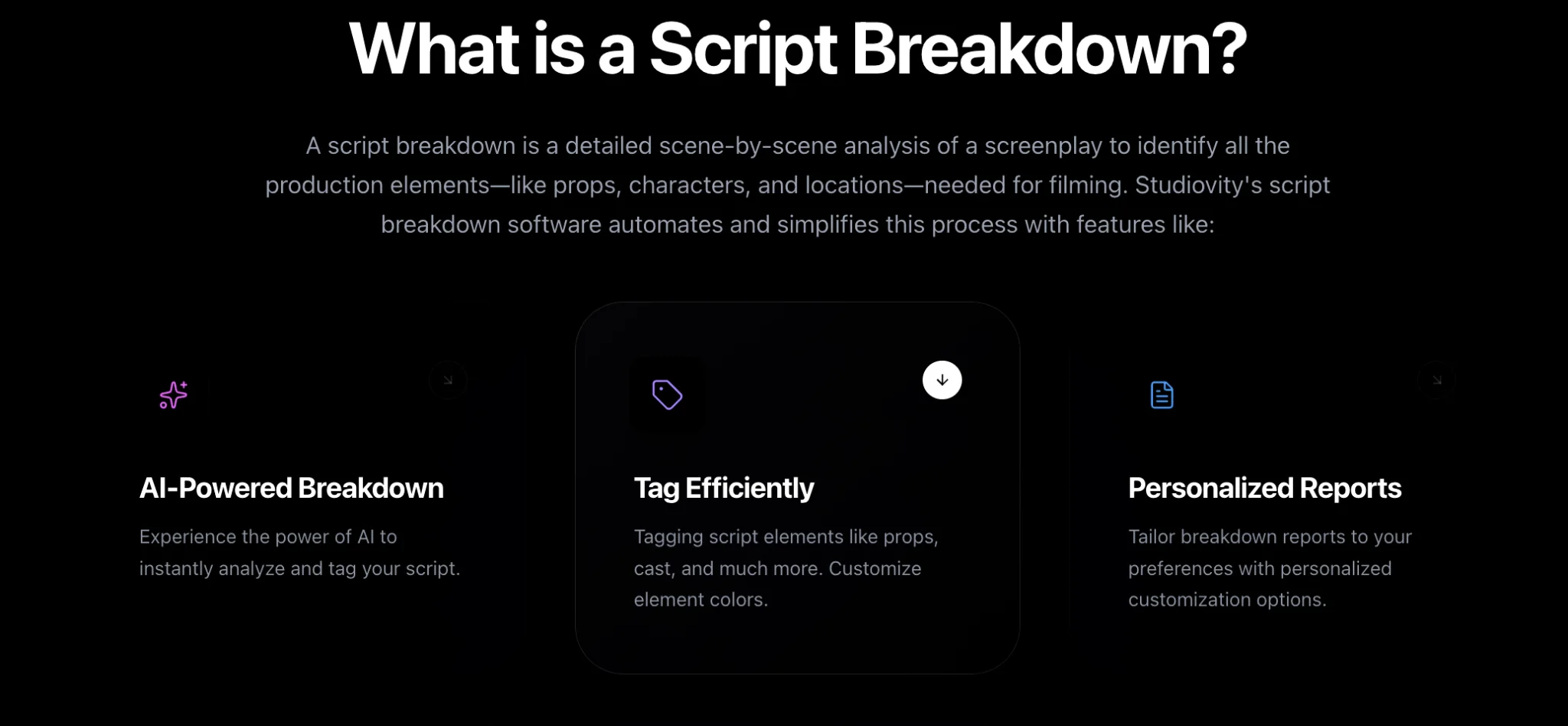
An AI-assisted breakdown uses language processing to scan an imported screenplay and propose tags for characters, locations, props, wardrobe and other categories in minutes. Instead of starting from a blank sheet, the team starts from a structured draft and spends its time reviewing.
That draft is the important word. The software recognizes patterns; it does not carry production responsibility. A person still decides what is truly required, what is a hero prop, and what the scene really costs.
Pros of AI breakdown
- Speed: a first pass arrives in minutes rather than hours or days.
- Consistency: the same element gets the same name across every scene.
- Early visibility: producers can see cast counts, recurring locations and heavy scenes during development.
- Less admin: repetitive tagging shrinks, so people focus on decisions.
- Revision support: updated drafts can be reprocessed and compared faster.
- Learning aid: new filmmakers see how a script maps to production categories.
Cons of AI breakdown
- Missing context: it may tag a car without knowing whether it is a hero, background or stunt vehicle.
- False positives: a character mentioned in dialogue may be tagged even if they never appear on screen.
- Formatting sensitivity: montages, intercuts, dual dialogue and non-standard headings reduce accuracy.
- Overconfidence: a clean-looking report can hide gaps if nobody checks it against the script.
Manual vs AI script breakdown at a glance
| Factor | Manual breakdown | AI breakdown |
|---|---|---|
| Best for | Final review, complex scenes, nuanced interpretation | First pass, early planning, fast organization |
| Main strength | Human judgment and production context | Speed and repeatable structure |
| Main weakness | Time-consuming, prone to fatigue | Needs review, can miss context |
| Accuracy depends on | Reviewer experience and attention | Script formatting, tool quality and the review process |
| Revision handling | Reliable but labor-heavy | Fast, but changes still need verification |
| Typical user | ADs, producers, script supervisors, department heads | Producers, coordinators, AD teams, students, indie filmmakers |
The short version: manual work is stronger for decisions, AI is stronger for acceleration. Manual review confirms what the production truly needs; automation gets you to that review faster.
Watch: an AI scene breakdown, then human review
When manual breakdown is the right call
- The script is close to production and final numbers need a responsible human sign-off.
- The material is complex: action, period, fantasy, VFX, weapons, minors, animals or large crowds.
- Details are subtle or implied, such as a prop that changes condition or a costume that needs duplicates.
- Budget risk is high and one missed element could change the plan.
- The director and departments need to talk it through, because discussion reveals priorities the text does not.
If you are doing it by hand, our step-by-step guide on how to break down a film script covers the full manual method, from categories to breakdown sheets and eighths.
When AI breakdown is the right call
- Early development and budgeting, when producers need the scale of a script before committing resources.
- Lean teams on tight deadlines, such as agencies, indie producers and film schools.
- Frequent rewrites, where reprocessing a draft beats re-tagging every page.
- Long scripts or series, where recurring elements make consistent naming valuable.
The hybrid workflow most productions use
For most teams the answer is not manual versus AI but manual plus AI: automation drafts, people decide. A practical sequence:
- Import the screenplay and generate an automated first pass.
- Review scene by scene against the actual script; add what is missing, remove what is not needed.
- Standardize names for recurring props, characters and locations.
- Add production notes on stunts, safety, continuity, weather, sound and special equipment.
- Share department views with key collaborators for their review.
- Re-check changed pages after every revision.
- Do a final human pass before the breakdown drives the schedule, budget or call sheets.
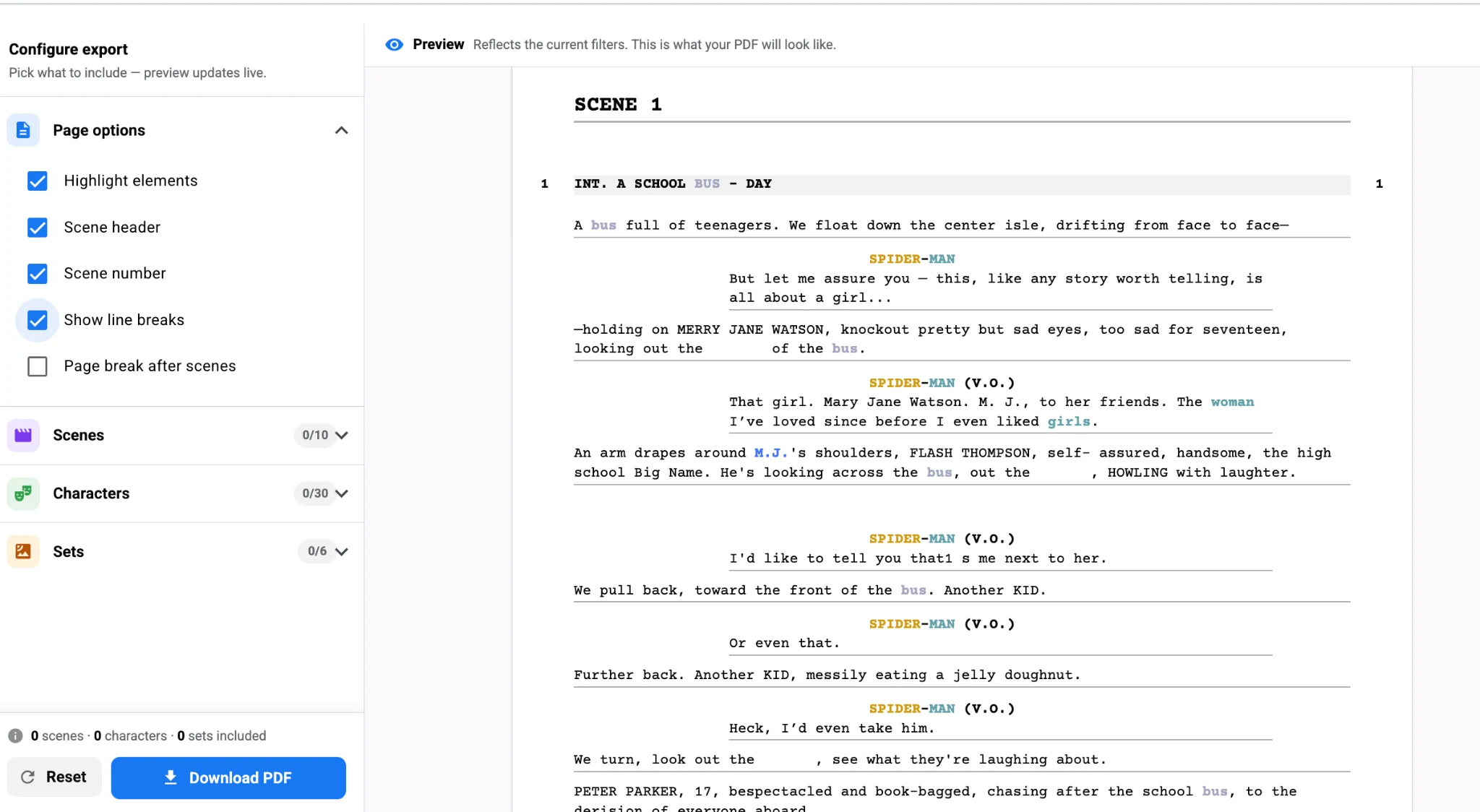
Tools that let you correct AI tags inline, add custom categories and export filtered reports make this loop much shorter; you can review AI-tagged scenes and refine them in Studiovity without retyping lists across spreadsheets.
How to choose the right approach for your project
- Script length: longer scripts benefit most from automation.
- Scene complexity: stunts, VFX, crowds, vehicles and period detail need human judgment.
- Rewrite frequency: constant revisions make automation more valuable.
- Who uses it: department heads need clear notes, not just tags.
- What depends on it: budgets and schedules require stronger verification.
- Team experience: newer teams gain structure from AI but still need to learn the craft.
Match the method to the stakes: AI when speed and structure matter most, manual review when interpretation and accountability matter most, both when you need efficiency without losing confidence.
Common mistakes to avoid
- Treating the breakdown as data entry instead of production thinking.
- Using categories so vague that departments cannot find their items.
- Not updating the breakdown after revisions or losing track of which draft it reflects.
- Relying on only one method: manual-only gets slow under pressure, AI-only misses meaning.
Final takeaway
Manual breakdown brings judgment, nuance and responsibility. AI breakdown brings speed, consistency and a faster starting point. On early drafts, let automation show you the shape of the project; as you approach the shoot, human review becomes essential. If you want to try the hybrid approach on your next script, start a free breakdown with Studiovity and keep the final call with your team.