
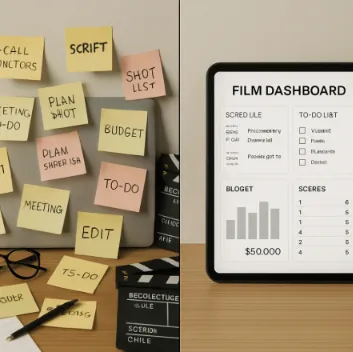
You’ve gathered your cast. However, you are suddenly flipping through messy notebooks while the precious sunlight slips away. According to veteran creators, this chaotic shift from creative excitement to logistical panic routinely ruins great projects. Relying on scattered spreadsheets makes it incredibly easy to forget crucial close-ups. Therefore, implementing a dedicated film production scheduling software is essential so you do not run entirely out of time.
This reactive nightmare highlights why professionals rely on modern systems. Think of pre-production like grocery shopping. Consequently, you wouldn’t attempt cooking a massive meal without a list guaranteeing you have every ingredient. Modern film production scheduling software provides that master plan, transforming a raw script into an actionable roadmap.
In practice, upgrading to Studiovity for filmmakers feels like hiring a tireless digital assistant. Instead of drowning in paperwork, you rely on three proactive pillars: visual shot lists, accurate schedules, and instant syncing. This automated workflow handles the stressful logistics. Thus, it frees you to focus completely on your story.
The Shopping List Strategy: How Digital Shot Lists Ensure You Get Every Angle
Have you ever sat down to edit a video only to realize you completely missed a crucial reaction shot? That missing piece is a failure of “coverage.” This is the industry term for capturing enough angles to make your final edit seamless. Creators avoid this panic by first filming a wide “master shot” from start to finish. After that, they move the camera in for closer details.
Translating that visual vision to the set requires a clear plan. This plan is known as “camera blocking,” which simply means deciding exactly where actors and cameras will move. By mapping these movements in Studiovity, you instantly generate cinematic camera blocking and equipment lists. Whether you are flying solo or managing multi-camera setups, predicting your gear needs ahead of time saves precious hours on set.
Instead of staring at a blank spreadsheet, digital shot list templates keep your ideas instantly organized. Consequently, a smart film production scheduling software empowers you to build professional entries containing four essential elements:
Shot Type: The frame size (like a Wide or Close-Up).
Angle: The camera’s physical position (like Eye-Level).
Lens: The specific focal length needed.
Description: A brief note detailing the action.
Once your visual shopping list is complete, you must figure out the most efficient order to film those ingredients.
Google Maps for Production: Using Smart Stripboards to Beat the Setting Sun
Shooting scenes in the exact order of your script is a fast track to running out of daylight. Moving equipment takes precious set-up time. Instead, professional creators shoot out of sequence. Learning to create a film shooting schedule means thinking like a logistics expert. Therefore, you must group shots so nobody wastes time waiting.
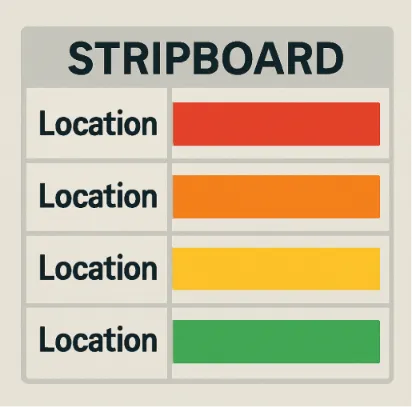
This is where the “stripboard” saves the day. Think of a stripboard as a visual puzzle board where every scene becomes a colorful, draggable row. By optimizing stripboards for efficient film shoots, you instantly reorganize your day. For example, you can capture everything in one corner of a room before relocating the camera.
Modern, automated film production scheduling software options like Studiovity handle this heavy lifting automatically. To keep your set moving swiftly, you should prioritize grouping your schedule by three crucial factors:
Location: Film all kitchen scenes before moving outside.
Lighting: Shoot all bright daytime setups before rigging dark, moody shadows.
Cast Availability: Consolidate an actor’s scenes into a single timeframe.
When you estimate realistic shoot durations, this film production scheduling software guarantees your team wraps before exhaustion hits.
The Domino Effect: Why Connecting Your Script to Your Schedule Saves Days of Admin
Rewriting a scene the night before a shoot often triggers a frustrating realization. Suddenly, you must manually update your spreadsheet, schedule, and shot list. This tedious cycle of copy-pasting is exactly where mistakes happen. Furthermore, crucial angles are easily forgotten. When you treat your production documents as separate islands, a single creative change becomes a mountain of stressful busywork.
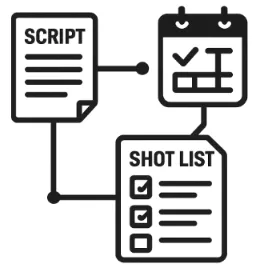
Modern filmmaking tools solve this problem completely. Specifically, a connected film production scheduling software turns your project into a “living document.” This creates a central hub where everything communicates. By seamlessly integrating script breakdowns with production schedules, Studiovity ensures that altering a scene in your script instantly updates your timeline. This syncing creates a “single source of truth.” Therefore, you never have to guess which file contains the most accurate plan.
This level of automation is the ultimate secret to reducing pre-production time for independent films by up to fifty percent. When comparing platforms like Studiovity vs StudioBinder, the true value lies in effortless version control. Instead of juggling scattered files confusingly named “Schedule_Final_V4,” this film production scheduling software pushes every adjustment across your entire project instantly.
Because the software handles administrative data entry automatically, you can focus entirely on directing your actors. With your script, schedule, and shots perfectly aligned, sharing this plan is effortless.
Professionalism on Autopilot: Generating Real-Time Call Sheets for Your Crew
The morning of your shoot sets the tone for the entire day. To avoid a barrage of confused “where do I park?” texts, professionals use a Call Sheet. This is a daily master itinerary for the cast and crew. Leveraging a collaborative film production scheduling software turns creating this essential document into a breeze.
Instead of manually typing out logistics, Studiovity handles real-time call sheet generation from schedules you’ve already built. In seconds, your professional sheet automatically includes these five must-have items:
Call Time (the exact moment your crew must arrive)
Weather
Nearest Hospital
Parking Info
Scene Order
Figuring out how to sync production calendars with crew availability used to require endless email chains. Now, pushing instant updates directly to digital calendars keeps team morale high and everyone aligned.
From 'Messy' to 'Masterful': Transforming Your Creative Workflow in One Afternoon
You no longer must let chaotic set days steal your creative focus. By relying on modern systems, you buy back the freedom to actually direct your film. Transitioning from scattered spreadsheets to a dedicated film production scheduling software ensures every camera angle and time slot aligns beautifully before you ever yell “action.”
Importing your script, building a visual shot list, and generating a dynamic schedule keeps your preparation organized. Ultimately, applying this automated approach to your next project helps turn your cinematic vision into a professional reality without the administrative friction.