
A call sheet is the daily instruction document that tells cast, crew, and departments where to be, when to arrive, what scenes are being filmed, and what they need to know for that specific shoot day. A shooting schedule is the larger production plan that organizes when scenes, locations, cast, equipment, and company moves will happen across the full shoot. In practical film scheduling, the shooting schedule sets the roadmap; the call sheet turns one day of that roadmap into actionable instructions.
Related video: Film scheduling and call sheet creation in 30 seconds
For filmmakers and production teams, understanding the difference is not just a paperwork issue. It affects how departments prepare, how time is protected on set, how communication flows, and how a production avoids preventable delays.
What is the difference between a call sheet and a shooting schedule?
The simplest distinction is scope: a shooting schedule covers the production as a whole, while a call sheet covers one specific day of production. The shooting schedule is built during pre-production to determine the best order for filming scenes. The call sheet is created from that schedule, usually one shoot day at a time, and distributed to the people who need to execute that day’s work.
A shooting schedule answers questions such as: Which scenes will be filmed on which days? What locations are grouped together? Which cast members are needed on each date? How many pages or estimated hours are planned per day? A call sheet answers more immediate questions: What time is crew call tomorrow? Where is parking? What scenes are first up? Who is on set? What is the weather, nearest hospital, and department-specific timing?
Both documents are essential production planning tools, but they serve different levels of decision-making. The shooting schedule helps producers, assistant directors, department heads, and production managers plan the full logistical arc of the shoot. The call sheet helps everyone execute the next day safely, efficiently, and with the same information.
The distinction in one view
| Document | Main purpose | Timeframe | Primary users | Typical creator | Level of detail |
|---|---|---|---|---|---|
| Shooting schedule | Plans the order and timing of scenes across the production | Full shoot or major block | Producers, AD team, department heads, production manager | 1st AD, production team, scheduler | Strategic and scene-based |
| Call sheet | Communicates the plan for a single shoot day | One day | Cast, crew, departments, vendors, production office | AD team or production office | Operational and time-specific |
The shooting schedule is the plan that shapes the production. The call sheet is the daily briefing that puts that plan into motion.
The shooting schedule is the production roadmap
A shooting schedule is a structured plan for how a film, commercial, series, or video project will be shot. It is usually built after script breakdowns are complete, because the production team needs to know which scenes require which cast, locations, props, vehicles, stunts, visual effects, animals, special equipment, and department support. Without that breakdown, a schedule is little more than a calendar with guesses attached.
The shooting schedule is rarely arranged in script order. Instead, scenes are grouped according to practical production logic. If five scenes take place in the same apartment, the production may shoot them together even if they appear in different parts of the story. If an actor is only available for three days, the schedule may cluster that actor’s scenes into a tight block. If a company move is expensive or time-consuming, the schedule may be built to reduce unnecessary travel.
This is why shooting schedule tips often focus on efficiency, realism, and risk management. A good schedule does more than list scenes. It balances creative needs with budget, daylight, location access, actor availability, turnaround rules, equipment requirements, and the stamina of the crew. The best schedules are ambitious enough to serve the production but grounded enough to be achievable.
Common elements of a shooting schedule
A shooting schedule can vary by production size, but it usually includes several core components:
Shoot days and dates: The calendar structure of the production, including workdays, weekends, company moves, pickups, or hold days.
Scene numbers: The script scenes planned for each day or block.
Scene descriptions: Brief notes that identify the content or action being filmed.
Locations: The set, practical location, stage, exterior, interior, or unit location needed for each scene.
Cast requirements: Actors, background performers, stand-ins, doubles, or specialty performers needed on specific days.
Page count or estimated workload: A way to assess how much scripted material is planned for each day.
Day/night and interior/exterior indicators: Key scheduling details that affect lighting, crew timing, permits, and location access.
Special requirements: Stunts, effects, vehicles, animals, weapons, intimacy coordination, water work, drones, picture vehicles, or other elements that require advance planning.
Department notes: Information that helps production, camera, grip, electric, art, wardrobe, makeup, sound, locations, transportation, and other teams prepare.
These details allow the production team to see the shoot as a connected system. Moving one scene can affect actor holds, location agreements, equipment rentals, overtime exposure, and downstream call sheets. That is why the shooting schedule is usually controlled carefully and revised through formal updates rather than casual changes.
The call sheet is the daily execution plan
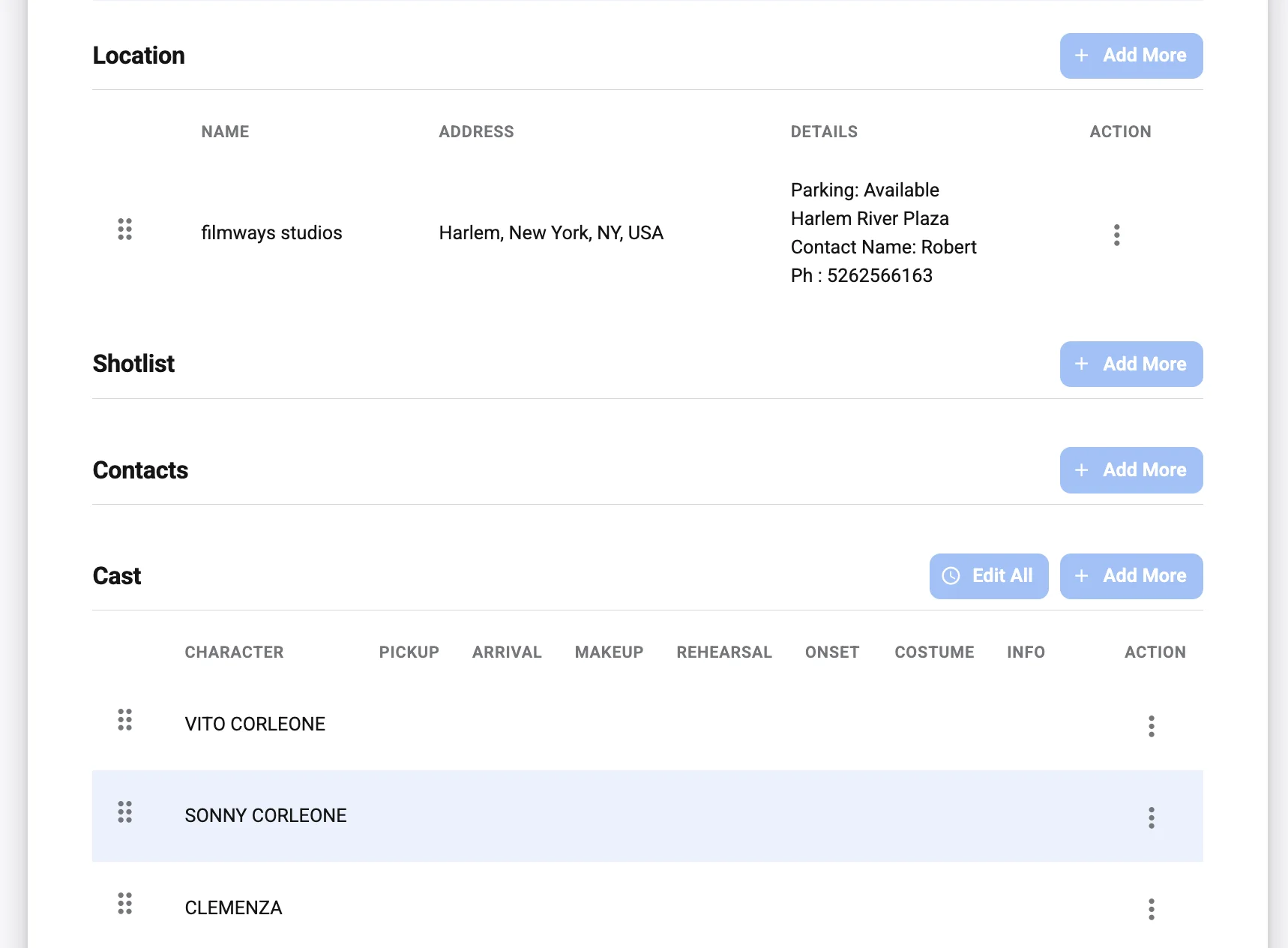
A call sheet is a day-specific document that tells the production exactly what is happening on the next shoot day. It translates the broader schedule into practical instructions: call times, locations, scene order, contact details, parking instructions, safety information, weather expectations, meal timing, and department-specific notes.
The call sheet is one of the most important communication documents in film production because it reaches nearly everyone involved in the day’s work. A department head may already know what scenes are planned, but the call sheet confirms when their team is expected, where they should report, and what conditions they should prepare for. A cast member may know they are working tomorrow, but the call sheet tells them their pickup time, makeup call, wardrobe call, set call, and scene numbers.
Unlike the shooting schedule, the call sheet is not primarily a strategic document. It is a coordination tool. Its value comes from clarity, accuracy, and timeliness. If the call sheet is confusing or incomplete, people may arrive late, report to the wrong place, miss critical preparation, or rely on outdated assumptions.
Call sheet essentials
A strong call sheet guide should emphasize the details that prevent confusion on the day. Most professional call sheets include:
Production title and shoot day: Identifies the project, episode, unit, and day number.
Date and general call time: Confirms the calendar date and main crew call.
Key contacts: Usually includes the production office, assistant directors, production manager, location contact, and emergency contact information.
Location details: Address, parking instructions, holding area, base camp, stage, set name, or map notes.
Nearest hospital or emergency facility: A critical safety detail, especially on remote or high-risk shoots.
Weather and sunrise/sunset: Helps departments prepare for conditions, daylight, and exterior work.
Scene list for the day: Scene numbers, script pages, short descriptions, cast required, and day/night indicators.
Cast call times: Individual times for pickup, report, makeup, wardrobe, rehearsal, blocking, or set.
Crew call times: Department or individual call times, including pre-calls where needed.
Meal timing: Breakfast, lunch, estimated meal break, or second meal notes when applicable.
Special instructions: Safety notes, parking rules, wardrobe requirements, confidentiality reminders, location restrictions, or department-specific needs.
Schedule notes: Planned order of work, company moves, wrap targets, or key timing assumptions.
These details make the call sheet practical rather than decorative. The goal is not to create a dense document for its own sake. The goal is to give every recipient the information they need to arrive prepared and make decisions without unnecessary calls, texts, or last-minute clarification.
How do the two documents work together during production?
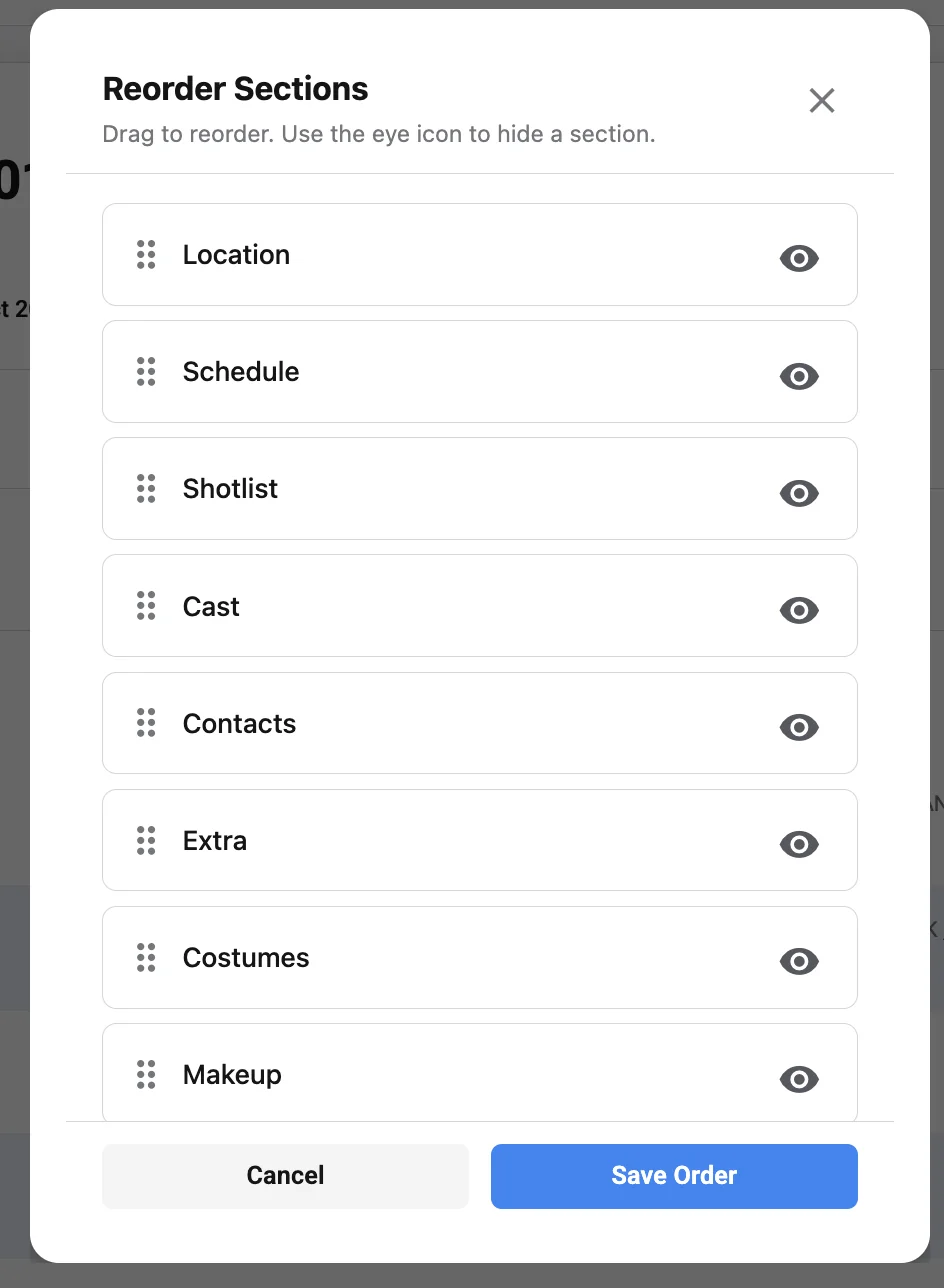
The shooting schedule provides the source plan, and the call sheet extracts the next day’s work from that plan. In a typical workflow, the assistant director team reviews the shooting schedule, confirms any changes with production and department heads, then prepares the call sheet for the upcoming shoot day. Once approved, the call sheet is distributed to cast, crew, and relevant stakeholders.
This relationship matters because a call sheet should never be created in isolation. If the shooting schedule says scenes 12, 18, and 24 are planned for Day 7, the call sheet should reflect the version of that plan that production has confirmed for Day 7. If the plan changes because of weather, actor availability, location restrictions, or an unfinished scene from the previous day, the call sheet becomes the official daily communication of that updated plan.
A well-managed production keeps these documents aligned. When they do not match, confusion spreads quickly. Departments may prep the wrong set, actors may be called unnecessarily, transportation may be routed incorrectly, or the crew may arrive without the equipment needed for the actual work of the day.
A practical example from set
Imagine a short film has three scenes in a diner, two scenes in a parking lot, and four scenes in the lead actor’s apartment. The shooting schedule might group all diner scenes into one day because the location is only available on Monday. It may then schedule the parking lot scenes that evening because the location is nearby and the scene requires night lighting.
The call sheet for that Monday would be more specific. It would list the diner address, parking instructions, crew call, cast calls, scene numbers, estimated first shot, meal plan, company move details if the parking lot is separate, night exterior notes, and safety reminders for traffic or generator placement. The shooting schedule explains why the day exists in that form. The call sheet tells everyone how to execute it.
That is the heart of the call sheet vs shooting schedule distinction. One document organizes production logic across time. The other turns a single day into clear operational instructions.
Defining characteristics of each document
The clearest way to understand the difference is to look at each document’s defining characteristics. Both are planning documents, but they are designed for different decisions, audiences, and levels of detail. Confusing them can lead to either overloading the crew with strategic scheduling information or under-informing them about daily logistics.
A shooting schedule is defined by planning logic
A shooting schedule is built to answer the production’s largest logistical questions. It considers scene order, location availability, actor availability, budget pressure, daylight, company moves, and department workload. It may change throughout pre-production and production, but its purpose remains the same: to shape the most workable path through the shoot.
Its defining characteristics include:
Multi-day scope: It covers the entire shoot or a substantial block of production.
Scene-based structure: It is organized around script scenes, locations, page counts, and production requirements.
Strategic decision-making: It helps leadership decide what should be shot when.
Resource coordination: It supports planning for cast, crew, locations, equipment, vehicles, and department labor.
Revision sensitivity: A change in one part of the schedule can affect many other days.
Pre-production importance: It becomes one of the foundations for budgeting, hiring, rentals, permits, and department prep.
Because the shooting schedule has broad implications, it is not usually treated as a casual daily handout. It is a working plan that department heads and production leadership use to anticipate needs before the shoot day arrives.
A call sheet is defined by daily clarity
A call sheet is built to answer the immediate questions people have before reporting to work. It does not need to explain the entire production strategy. It needs to tell the right people what they need to do tomorrow, where to go, and when to be ready.
Its defining characteristics include:
Single-day scope: It covers one shoot day, one unit, or one specific production call.
Time-based detail: It lists call times, scene order, meal timing, and location timing.
Operational communication: It gives cast and crew the information they need to execute the day.
Safety relevance: It includes emergency contacts, nearest hospital information, weather, and special warnings.
Wide distribution: It goes to people who may not need the full shooting schedule but do need day-specific instructions.
Late-stage accuracy: It is usually prepared close to the shoot day so it reflects the most current plan.
A strong call sheet reduces avoidable questions. It does not eliminate communication, but it gives the production a shared reference point for the day’s work.
Why this distinction matters for production planning
The difference between these documents affects budget, communication, prep, and on-set efficiency. When the shooting schedule is solid but call sheets are weak, the production may have a good long-term plan but poor daily execution. When call sheets are polished but the shooting schedule is unrealistic, each day may look organized on paper while the production slowly falls behind.
Production planning depends on both levels of thinking. The schedule helps the production decide whether the shoot is achievable. The call sheet helps the team execute each day without ambiguity. One is not a replacement for the other, and neither should be treated as a formality.
For independent filmmakers, this distinction is especially valuable because smaller productions often combine roles. A producer may also coordinate locations, an assistant director may also manage daily communication, and department heads may work with limited prep time. Clear documents help compensate for limited resources by reducing confusion and making responsibilities visible.
Practical benefits of keeping them separate
Keeping the shooting schedule and call sheet separate creates several operational advantages:
Cleaner communication The crew receives only the details they need for the day instead of sorting through the entire production plan.
Better department preparation Department heads can use the shooting schedule to plan ahead, while their teams can rely on call sheets for daily execution.
Faster revisions A changed shoot day can be communicated through a revised call sheet without rewriting the entire scheduling document.
Reduced risk of outdated information The call sheet reflects the latest approved plan for the day, while the shooting schedule remains the broader framework.
More professional set operations Clear documentation signals that production is organized, respectful of time, and prepared for the practical demands of filming.
These benefits are not just administrative. They directly affect morale, punctuality, safety, and the production’s ability to protect creative time on set.
What belongs on a shooting schedule but not necessarily on a call sheet?
A shooting schedule should include the broader structure of the production, but not every detail belongs on the daily call sheet. The schedule often contains planning information that is useful for producers and department heads but unnecessary for every crew member on a given day. Overloading a call sheet with too much long-range information can make the document harder to read and easier to misinterpret.
For example, a shooting schedule may show that an actor is needed on Days 3, 7, 8, and 12. The call sheet for Day 3 only needs that actor’s instructions for Day 3. It does not need to show every future appearance unless there is a specific reason to remind the actor or department.
A shooting schedule may also include internal planning assumptions that are still being refined. Those assumptions should not be distributed as daily instructions until they are confirmed. The call sheet should represent the approved plan, not every possibility the production has considered.
Details better suited to the shooting schedule
The following details are often more appropriate for the shooting schedule or internal planning documents than for the general call sheet:
- Full production calendar across all shoot days
- Long-range scene grouping and location blocks
- Actor availability across the entire shoot
- Department prep and wrap days outside the immediate call
- Internal contingency plans not yet activated
- Broad budget-related scheduling assumptions
- Full page-count balance across the production
- Future company moves not relevant to the current day
- Preliminary plans that have not been approved for distribution
This does not mean the call sheet should hide important information. It means the call sheet should be selective. The best call sheets are complete for the day without becoming a substitute for every production document.
What belongs on a call sheet but not necessarily on a shooting schedule?
A call sheet contains practical details that are too specific, variable, or immediate for the main shooting schedule. These details often depend on final confirmations made close to the shoot day. They may include weather, exact parking instructions, daily safety notes, department pre-calls, transportation timing, or the nearest emergency facility.
The shooting schedule may say the company is filming at a warehouse on Day 10. The call sheet explains which gate to enter, where to park, what time background reports, whether closed-toe shoes are required, which restroom area is available, and who to contact if a crew member gets delayed. Those details are essential, but they are not usually part of the strategic schedule.
This distinction helps keep each document useful. The shooting schedule remains a planning document that can be reviewed at a high level. The call sheet becomes the daily operating manual for cast and crew.
Details better suited to the call sheet
- A professional call sheet often includes day-specific information such as:
- Exact crew call and individual department pre-calls
- Cast pickup, makeup, wardrobe, rehearsal, and set calls
- Parking, shuttle, rideshare, or base camp instructions
- Daily weather and daylight information
- Nearest hospital or emergency care location
- Contact numbers for the day’s production leadership
- Location rules and access restrictions
- Meal timing or catering notes
- Special safety reminders for that day’s work
- Confidentiality instructions for sensitive locations or talent
- Notes on background holding, extras check-in, or crowd control
These are call sheet essentials because they affect whether people can physically and safely do the day’s work. A production may have an excellent shooting schedule, but if the call sheet sends crew to the wrong entrance or omits a critical safety note, the day can still lose valuable time.
Practical examples and common misconceptions
Because both documents deal with timing and scenes, it is easy for newer filmmakers to treat them as interchangeable. In practice, they answer different questions and are used at different points in the production workflow. The following examples and misconceptions show how the distinction plays out on real productions.
Practical examples
Location grouping: The shooting schedule groups all courthouse scenes into one day to reduce permit costs and travel. The call sheet for that day provides the courthouse address, security entrance, parking plan, cast calls, and restrictions on where equipment can be staged.
Actor availability: The shooting schedule clusters a supporting actor’s scenes into two consecutive days because the actor has limited availability. Each call sheet lists that actor’s specific report time, makeup call, wardrobe needs, and scenes for that day only.
Night exterior work: The shooting schedule places a chase scene on a night shoot because the scene requires darkness. The call sheet communicates late crew call, meal timing, safety notes, lighting setup, traffic control instructions, and expected wrap.
Company move: The shooting schedule shows two locations planned for the same day. The call sheet explains the order of work, estimated move time, parking at both locations, and which departments need to pre-rig or travel early.
Weather adjustment: The shooting schedule originally places an exterior scene on Day 5. If rain threatens, production may revise the plan and issue a call sheet with an interior cover set instead.
Common misconceptions
“The call sheet is just a shorter shooting schedule.†Not exactly. It uses information from the shooting schedule, but it also includes daily logistics that the broader schedule does not carry.
“The shooting schedule only matters to the assistant director.†The AD team may build or manage it, but producers, locations, transportation, art, wardrobe, camera, grip, electric, sound, makeup, and post-related teams may all depend on it.
“Once the shooting schedule is built, it should not change.†A schedule should be controlled, but productions often adjust for weather, performance needs, location problems, or unfinished work.
“A call sheet can be sent as a casual text.†Quick messages can supplement communication, but they should not replace a clear, centralized call sheet that everyone can reference.
“Small productions do not need both.†Even a lean crew benefits from separating the overall plan from the daily instructions. The format can be simple, but the functions still matter.
Shooting schedule tips for stronger film scheduling
A reliable shooting schedule starts with a thorough script breakdown. Before placing scenes on a calendar, identify every production element that affects time, cost, labor, or risk. This includes cast, locations, props, wardrobe changes, vehicles, stunts, effects, animals, specialty gear, minors, night work, exterior exposure, and any scenes that are likely to require additional setup time.
The next step is to schedule for reality, not just ambition. A scene that looks short on the page may require complex blocking, lighting, company movement, emotional performance, or reset time. A realistic schedule protects the creative process because it gives the team enough time to do the work properly.
Good film scheduling also requires collaboration. The AD team may build the schedule, but department heads can identify practical issues early. Camera may flag a complicated rig. Locations may warn that access is limited. Art may need more time to dress a set. Wardrobe may note that a continuity change requires more preparation than the schedule assumes.
Useful scheduling practices
Group locations intelligently. Avoid unnecessary returns to the same location unless story, cast, or technical needs justify it.
Respect daylight and night work. Exterior scenes should be planned with realistic light windows, setup time, and weather risk.
Balance heavy days with manageable days. A schedule packed with difficult scenes back-to-back can exhaust cast and crew.
Track company moves carefully. Moving the entire production costs time, even when locations are close.
Plan around cast availability early. Actor conflicts can reshape the entire schedule if discovered late.
Build in contingency thinking. Weather cover sets, alternate scenes, and flexible day structures can save a production.
Consult departments before locking. A schedule that ignores department realities will create problems on set.
Avoid page-count tunnel vision. Page count matters, but complexity matters more.
These shooting schedule tips are especially important when budgets are tight. Limited resources make clarity more valuable, not less. A thoughtful schedule helps the production spend time where it matters most.
Call sheet guide for clearer daily communication
A call sheet should be specific enough to guide the day but organized enough to scan quickly. The people reading it may be doing so late at night, early in the morning, between setups, or while coordinating multiple responsibilities. Structure, hierarchy, and accuracy are therefore as important as the information itself.
The top of the call sheet should make the most urgent information immediately visible. Production title, date, shoot day, general call, primary location, weather, and key contacts should be easy to find. Cast and crew call times should be clear, and any unusual instructions should be highlighted rather than buried.
Before distribution, the call sheet should be checked carefully. Errors in addresses, dates, call times, scene numbers, or contact information can create avoidable delays. When a revised call sheet is necessary, the revision should be clearly labeled so recipients know which version is current.
Daily call sheet checklist
Use this checklist before sending a call sheet:
Confirm the date and shoot day. Make sure the calendar date, weekday, and production day are correct.
Verify the location. Check the address, parking, entrance, holding, base camp, and any access restrictions.
Review every call time. Confirm cast, crew, department pre-calls, transportation, makeup, wardrobe, and background timing.
Match scenes to the approved plan. Confirm that scene numbers, descriptions, page counts, and cast requirements align with the latest schedule.
Check safety information. Include emergency contacts, nearest hospital, weather risks, stunt notes, intimacy notes, animal notes, or special hazards where applicable.
Clarify meal and break expectations. Give the team enough information to plan without promising details that are not confirmed.
Add department-specific notes. Include only notes that are useful to the recipients and approved for distribution.
Proofread names and contacts. Misspelled names may be minor, but incorrect phone numbers or email addresses can become serious problems.
Label revisions clearly. If a call sheet changes, make the latest version unmistakable.
Distribute through a consistent channel. Use the agreed production communication method so no one has to hunt for the document.
The best call sheets are not necessarily the longest. They are the ones that anticipate the day’s most important questions and answer them clearly.
Film production tools can support both documents
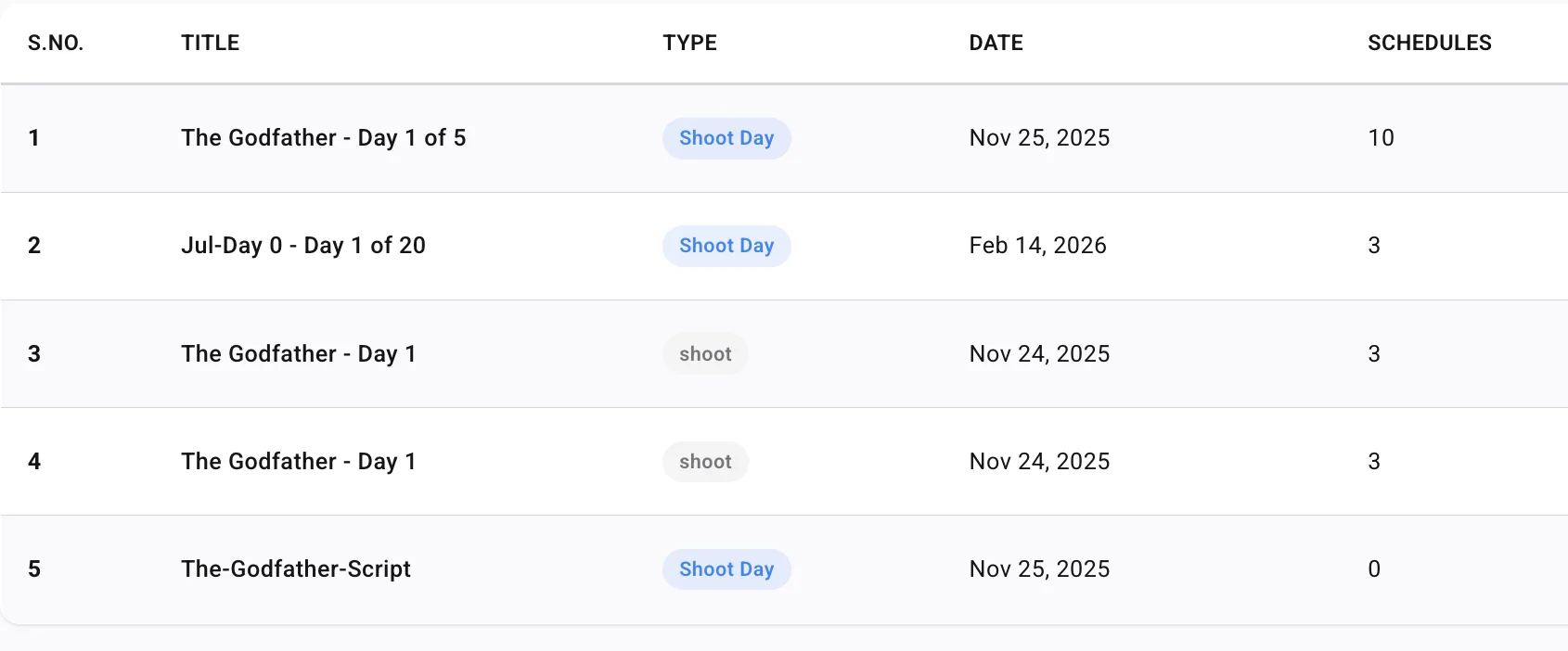
Film production tools can make scheduling and call sheet creation more accurate, consistent, and collaborative. Dedicated scheduling software, spreadsheets, production management platforms, and shared document systems can all be useful, depending on the size and complexity of the project. The tool matters less than the discipline behind it: accurate inputs, clear ownership, version control, and timely updates.
For larger productions, specialized software can help manage scene breakdowns, cast conflicts, stripboards, production calendars, and call sheet distribution. For smaller productions, a well-built spreadsheet and a clean call sheet template may be enough. In either case, the production should avoid scattering critical information across too many disconnected systems.
A good tool should help the team reduce errors, not create new ones. If the shooting schedule is updated in one file but call sheets are built from an old version somewhere else, the production is exposed to avoidable confusion. Strong production planning depends on one source of truth, or at least a clear process for confirming which version is official.
What to look for in scheduling and call sheet tools
- When choosing film production tools, consider whether they support:
- Script breakdown details that can feed the schedule
- Scene, cast, location, and department tracking
- Calendar views and stripboard-style planning
- Version control and revision notes
- Exportable call sheets or reusable templates
- Contact management for cast and crew
- Secure distribution and confirmation workflows
- Mobile-friendly access for people on the move
- Permission controls for sensitive information
- Easy updates when the plan changes
The right tool should fit the production’s scale. A complex series may need robust production management infrastructure. A two-day branded shoot may need a clear schedule, a reliable call sheet template, and disciplined communication.
How to avoid confusion between the two
The most common source of confusion is using the same language for different planning levels. If “schedule†is used to mean the full shooting schedule, tomorrow’s order of work, individual call times, and department prep notes, people may not know which document to trust. Clear terminology helps the crew understand what is fixed, what is tentative, and what is immediately actionable.
Another common issue is distributing too many partial updates. If a producer texts a location change, an assistant director emails a revised call sheet, and a department head references an older schedule, the production can quickly lose alignment. Updates should be centralized, versioned, and confirmed.
Production teams should also train newer crew members and interns to read both documents correctly. A shooting schedule may help them understand the arc of the week, but the call sheet tells them what to do tomorrow. Knowing which document answers which question is a basic professional skill on set.
Best practices for document discipline
Name documents clearly. Use titles such as “Shooting Schedule,†“One-Liner,†“Day Out of Days,†or “Call Sheet†consistently.
Date every version. Include revision dates or version labels when documents change.
Control distribution. Share sensitive production information only with the appropriate recipients.
Confirm changes in writing. Verbal updates are useful, but the official plan should be documented.
Archive old versions carefully. Keep records without allowing outdated files to circulate as current documents.
Design for readability. Use clear headings, tables, and spacing so people can find information quickly.
Assign ownership. Make it clear who approves schedule changes and who sends the official call sheet.
These practices may seem administrative, but they are part of professional set management. Good paperwork protects time, budget, safety, and trust.
A production-ready way to think about the difference
A practical way to remember the distinction is this: the shooting schedule is for planning the shoot, and the call sheet is for running the day. The shooting schedule helps leadership decide how to use production time across the full project. The call sheet helps cast and crew use the next production day efficiently.
This difference also shapes how each document should be written. A shooting schedule can include planning logic, scene grouping, and future assumptions that help departments prepare. A call sheet should be direct, accurate, and specific to the day. It should not make people interpret the production’s entire strategy before finding their call time.
For filmmakers, assistant directors, producers, production coordinators, and department heads, mastering both documents is foundational. Strong film scheduling gives the project a realistic structure. Strong call sheets give the team the daily clarity to execute that structure.
Key takeaways
A shooting schedule is the strategic plan for when scenes will be filmed across the production.
A call sheet is the daily instruction document for one shoot day.
The shooting schedule is usually built during pre-production from the script breakdown.
The call sheet is usually prepared close to the shoot day using the latest approved plan.
Shooting schedules support budgeting, staffing, location planning, actor coordination, and department prep.
Call sheets support punctuality, safety, communication, and on-set execution.
The two documents should align, but they should not contain exactly the same information.
Professional production planning depends on clear ownership, accurate revisions, and consistent distribution.
When used properly, these documents work as a pair. The shooting schedule gives the production its roadmap; the call sheet gives each day its marching orders. Understanding that difference helps teams plan smarter, communicate faster, and protect the creative work that happens on set.