
A film call sheet is the daily operating plan for a shoot. It tells cast, crew, vendors, and department leads where to be, when to arrive, what is being filmed, and how the day is expected to run. This call sheet guide walks through the core production essentials that help a team stay aligned, reduce confusion, and protect valuable shooting time.
Related video: Studiovity AI Mobile Callsheet
For producers, assistant directors, production coordinators, and department heads, the goal is not simply to fill out a call sheet template. The goal is to create a clear, practical document that supports production planning from first call to wrap. The best call sheet format is easy to scan, accurate, and specific enough that every person can understand their responsibilities before they step on set.
What should a film call sheet include?
A film call sheet should include the production name, shoot date, call times, locations, schedule, scene details, cast and crew information, department notes, safety requirements, weather, parking, transportation, and emergency contacts. In practice, the 10 Essential Things Every Film Call Sheet Should Include are the details that help everyone answer three questions quickly: where do I go, when do I need to be there, and what do I need to know before work begins?
That may sound simple, but the call sheet is one of the most important documents in daily production planning. A weak call sheet can create late arrivals, missing gear, unprepared talent, duplicated questions, and avoidable delays. A strong one gives the production team a shared reference point and keeps the day moving with fewer interruptions.
Why the call sheet matters before anyone reaches set
A call sheet is more than a schedule. It is a communication tool, a coordination document, and a safety reference. When it is built carefully, it gives each department the information they need to prepare without requiring endless messages the night before a shoot.
For the assistant director team, the call sheet helps translate the shooting schedule into a practical daily plan. For production, it confirms logistics such as parking, crew parking, base camp, catering, and transportation. For cast, it clarifies individual call times, scenes, wardrobe needs, makeup requirements, and reporting points. For crew, it identifies the shape of the day, the work expected, and any special conditions that may affect setup.
A good call sheet also reduces assumptions. It should not make crew members guess whether a location has limited parking, whether a company move is planned, or whether a scene involves night exterior work, stunts, intimacy, animals, water, smoke, minors, or other special requirements. If the information affects readiness, safety, timing, or responsibility, it belongs in the call sheet or in a linked supporting document.
Think of the call sheet as the daily version of a film production checklist. It does not replace the schedule, script breakdown, risk assessment, shot list, or department paperwork. Instead, it gathers the most time-sensitive details into one document so the team can act on them quickly.
1. Production details and daily identification
The top of the call sheet should clearly identify the production and the specific shoot day. This is basic information, but it prevents confusion when crew members are moving between units, locations, pickup days, reshoots, or multiple productions. A clear header also helps people quickly confirm that they are reading the most current document.
At minimum, include the production title, production company or entity if relevant, shoot date, day number, and version status. Many teams also include the episode number, commercial client, unit name, production office contact, or project code when those details apply. The goal is not to crowd the page; it is to make the document unmistakable.
Version control matters. If a call sheet is revised after distribution, mark it clearly as revised and include the revision time or date. This helps prevent one department from working from an outdated copy while another department has newer information. On busy productions, a small version note can prevent large mistakes.
A strong production header may include:
- – Production title: The official project name or working title.
- – Shoot day: For example, Day 8 of 20, if the schedule is organized that way.
- – Shoot date: Written clearly to avoid confusion across regions or formats.
- – Unit: Main unit, second unit, splinter unit, or stills unit when applicable.
- – Call sheet version: Original, revised, or final, with a timestamp if needed.
- – Key production contact: Usually the production office or production coordinator.
This section is often overlooked because it feels administrative. However, professional call sheet format depends on clarity from the first line. If someone opens the document quickly on a phone, they should know immediately which project and shoot day it covers.
2. General crew call, individual call times, and wrap expectations
Call times are the heart of any call sheet. They tell people when they are expected to report and help departments coordinate labor, transportation, setup, and handoffs. The general crew call should be easy to find, but individual call times are just as important because not everyone starts at the same moment.
A common mistake is treating the general crew call as enough. It rarely is. Cast, hair and makeup, wardrobe, camera, grip, electric, art, locations, production assistants, drivers, and special departments may all need different start times. The more complex the day, the more important these details become.
Call times should be realistic, not optimistic. If hair and makeup needs two hours before a performer can be camera-ready, the call sheet should reflect that. If the art department requires a pre-call to dress a location before the rest of the crew arrives, that should be shown. If transportation needs to pick up talent before sunrise, the pickup time should be specific.
Include these timing details where appropriate:
- – General crew call: The main report time for the day.
- – Pre-calls: Earlier call times for departments that need setup time.
- – Cast call times: Individual performer call times, not just a group call.
- – Makeup, hair, and wardrobe times: Especially for cast with longer preparation needs.
- – Camera-ready or set-ready times: When the performer or department must be ready to work.
- – Estimated first shot: A practical planning target, if used by the production.
- – Meal timing: Breakfast, lunch, second meal, or planned breaks when applicable.
- – Estimated wrap: A helpful expectation, while making clear that production schedules can change.
A good call sheet does not promise what it cannot control. Weather, location access, performance needs, equipment issues, and creative decisions can all change the shape of the day. Still, the call sheet should give the team the best available plan so everyone can prepare intelligently.
3. Location information, maps, parking, and access instructions
Location information should be exact, complete, and practical. A street address alone is often not enough. Crew members need to know where to park, where to report, which entrance to use, where base camp is located, whether there are security checkpoints, and whether access is limited by time, noise, permits, neighborhood restrictions, or building rules.
For large locations, include both the filming location and the reporting location if they are different. A museum, campus, park, warehouse, studio lot, hospital, hotel, or office complex may have multiple entrances and loading areas. If the wrong entrance delays a truck, a cast member, or a key department, the day can lose time before it starts.
The location section should also account for people arriving in different ways. Drivers may need parking coordinates, van passengers may need pickup points, and department trucks may need loading zones. Talent may require a separate holding area or entrance. Background performers may have a different check-in point than principal cast.
Useful location details include:
- – Primary filming address with any floor, stage, room, or zone details.
- – Crew parking instructions including lots, permits, street restrictions, or shuttle needs.
- – Base camp address if separate from set.
- – Truck parking and load-in details for departments bringing equipment.
- – Check-in location for crew, cast, background, and visitors.
- – Security or access notes such as gates, badges, guards, or sign-in requirements.
- – Nearest cross streets or landmarks when GPS may be unreliable.
- – Company move details if the unit changes locations during the day.
4. Shooting schedule and scene breakdown
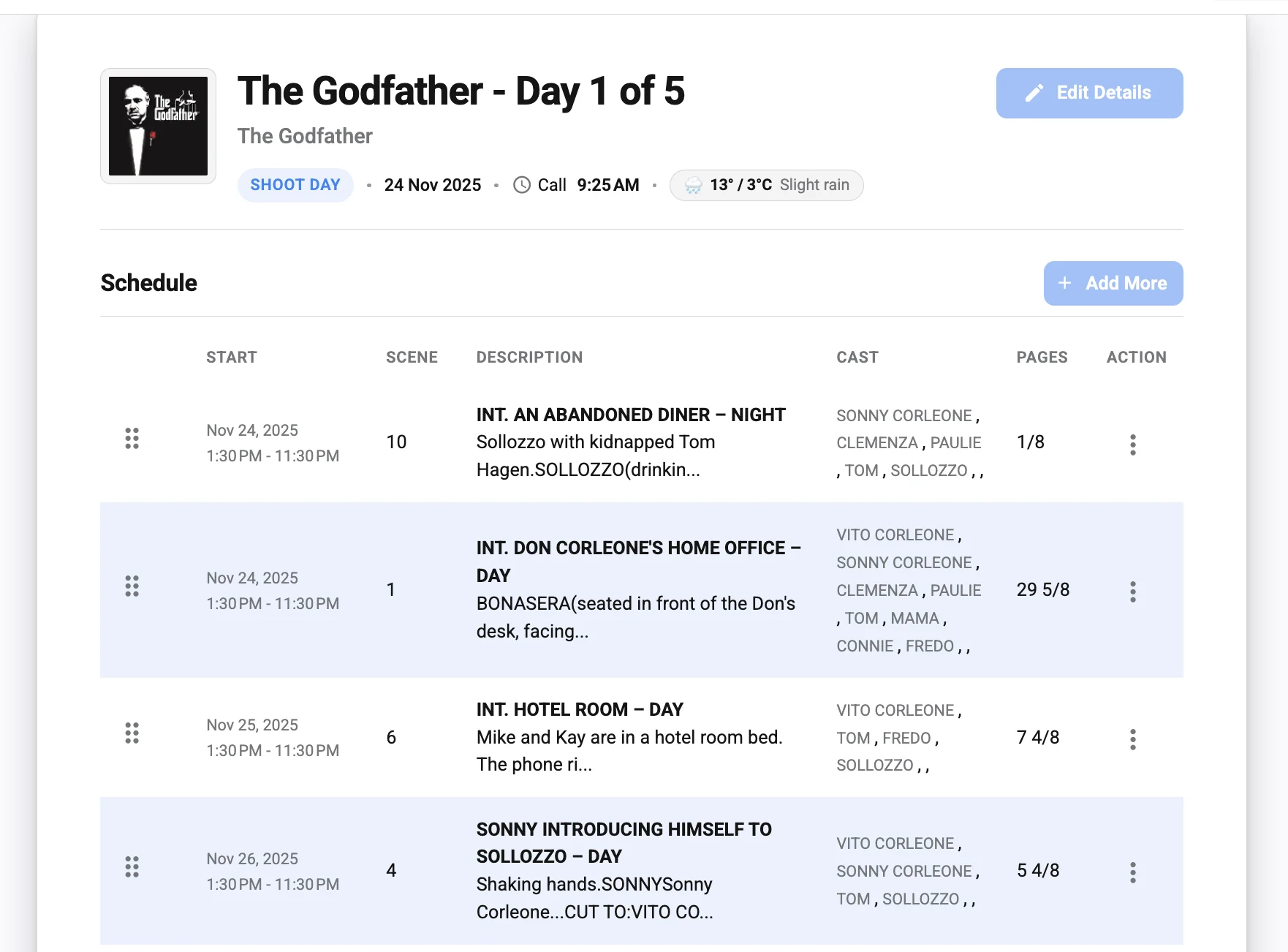
The shooting schedule section tells the team what work is planned for the day. It should connect the script breakdown to the practical order of filming, showing which scenes are expected, where they take place, whether they are day or night, and which cast members are involved. This section gives departments the context they need to prepare efficiently.
A basic scene breakdown often includes scene numbers, set descriptions, page count, day or night notation, brief scene descriptions, cast IDs, and location notes. For commercial, corporate, documentary, or branded content work, this may translate into setups, interview blocks, product shots, b-roll sequences, or company moves rather than scripted scenes. The principle is the same: explain what is being filmed in a way that helps the team anticipate needs.
Avoid making the scene descriptions too long. The call sheet is not the script, the shot list, or the director’s treatment. It should summarize enough to orient the team without overwhelming the page. If a department needs more detail, the call sheet can refer them to the sides, shot list, production notes, or department-specific breakdowns.
A clear schedule section may include:
- – Scene or setup number: Matching the script, schedule, or production board.
- – Set or location: The story location or practical location.
- – Day/night designation: Important for continuity, lighting, and scheduling.
- – Brief description: A concise action summary.
- – Cast numbers: Identifying who is required for each scene.
- – Pages or estimated work size: Useful for scripted productions.
- – Special notes: Stunts, picture vehicles, props, effects, animals, playback, inserts, or continuity concerns.
The schedule should also reflect the intended order of work. If the day begins with an exterior scene before moving inside, say so. If the company plans to shoot all scenes in one direction before turning around, the assistant director may not need to explain that in full, but the order should make operational sense to the departments reading it.
This part of the call sheet connects directly to production planning. It lets hair and makeup know who must be ready first, helps wardrobe prepare changes, tells camera and lighting what environments are coming, and gives sound, art, props, locations, and production a shared expectation for the flow of the day.
5. Cast list, status, and reporting details
The cast section should show which performers are working, what time they are called, when they should be ready, and which scenes require them. It should also identify cast status clearly enough that production can manage arrivals, holding, transportation, and paperwork.
For scripted projects, cast members are often listed by cast number, character name, performer name, pickup time if applicable, call time, makeup and wardrobe timing, set-ready time, and scenes worked. For documentary or unscripted projects, the section may identify interview subjects, featured participants, hosts, contributors, or on-camera clients. For commercial productions, it may include hero talent, hand models, voiceover talent, extras, or product demonstrators.
Privacy should be handled professionally. A call sheet often circulates widely, so only include personal information that is necessary for the production day and appropriate for the distribution list. Some productions separate sensitive contact details into a protected crew list rather than placing everything directly on the call sheet.
The cast section should help answer:
- – Who is working today?
- – What scenes or setups are they needed for?
- – What time do they arrive?
- – Do they report to holding, hair and makeup, wardrobe, base camp, or set?
- – Are they being transported by production?
- – Are there special preparation notes, wardrobe notes, or continuity needs?
Background performers require their own clear handling. If the production uses background actors, include background call time, check-in location, holding area, wardrobe direction, parking instructions, and the person or department responsible for processing them. Background confusion can slow a morning quickly, especially when large groups arrive at once.
A well-managed cast section protects both creative momentum and professional courtesy. Performers should not arrive without knowing where to go or what to prepare. Departments should not have to chase basic answers while trying to begin the day.
6. Crew list, department contacts, and communication chain
The crew list gives everyone a practical reference for who is working and who leads each department. It does not need to replace a full contact sheet, but it should identify the people most relevant to the day’s work. On smaller productions, the call sheet may include most crew members. On larger productions, it may focus on department heads, key roles, and essential contact numbers.
A useful crew section is organized by department. Grouping camera, grip, electric, sound, art, wardrobe, hair and makeup, production, locations, transportation, post or data, and special departments makes the document easier to scan. Department order can vary by production type, but consistency helps the team find information quickly.
The communication chain should also be clear. Not every question should go to the producer or director. Crew members need to know whether to contact the production coordinator, 1st AD, 2nd AD, key PA, location manager, transportation captain, or department head for specific issues. This reduces bottlenecks and keeps leadership focused on the right decisions.
Consider including:
- – Department heads: Names and phone numbers where appropriate.
- – Production office or coordinator: The central contact for logistics.
- – Assistant director team: Especially the 1st AD and 2nd AD.
- – Location contact: For access, parking, and site-specific issues.
- – Transportation contact: For pickups, shuttles, and vehicle coordination.
- – Safety contact: Medic, safety officer, COVID compliance role if used, stunt coordinator, or relevant specialist.
- – After-hours contact: If the crew needs urgent help before call time.
The best call sheet template makes communication easy without exposing unnecessary personal information. If the production has a secure internal contact system, the call sheet can direct people there. If not, include the essential numbers people need to solve real problems before and during the day.
7. Weather, sunrise, sunset, and environmental conditions
Weather affects production more than almost any other daily variable. It can change lighting, wardrobe, safety, sound, transportation, equipment protection, and the feasibility of exterior work. Even interior shoots benefit from weather details because travel, parking, loading, and holding may still be affected.
At minimum, include the expected temperature range, precipitation risk if relevant, sunrise, sunset, and any notable environmental conditions. For exterior work, add more detail: wind concerns, tide information, heat advisories, cold exposure, smoke, dust, terrain, insects, or other conditions that may affect crew readiness. If the production is shooting golden hour, night exteriors, dawn scenes, or day-for-night material, accurate sun timing becomes especially important.
Weather notes should be practical rather than decorative. “Bring rain gear†is more useful than a generic weather icon if rain could affect the day. “Exterior location has limited shade†is more actionable than simply listing a high temperature. The call sheet should help departments prepare, not just report the forecast.
Environmental information can support decisions such as:
- – Whether camera and electric need weather protection.
- – Whether wardrobe should prepare warm layers, cooling options, or duplicates.
- – Whether production should arrange tents, heaters, fans, water, or additional holding.
- – Whether locations must protect floors from mud or rain.
- – Whether sound should prepare for wind, traffic, construction, aircraft, or crowd noise.
- – Whether transportation should build in extra time for difficult access.
Weather can change, so the call sheet should avoid overstating certainty. Use the best available information at the time the sheet is issued, and revise if conditions create a meaningful production or safety impact. A responsible call sheet format keeps the team informed while recognizing that forecasts are planning tools, not guarantees.
How detailed should safety and emergency information be?
Safety and emergency information should be detailed enough for the team to act quickly without searching through separate documents in a crisis. The call sheet should identify emergency contacts, nearest appropriate medical facility, on-set medic or first aid contact, safety notes, hazards, and any special risk factors for the day. More complex productions may also have separate safety plans, but the call sheet should still surface the most immediate information.
Safety notes should be specific to the day’s work. A generic reminder to “work safely†has limited value. If the shoot involves stunts, weapons, vehicles, intimacy, minors, animals, water, heights, pyrotechnics, smoke, haze, loud sound, extreme temperatures, remote locations, or difficult terrain, the call sheet should highlight the relevant department lead or safety procedure.
Emergency information often includes:
- – Emergency number: The correct emergency response number for the filming location.
- – Nearest hospital or urgent medical facility: Name, address, and practical travel information where appropriate.
- – On-set medic or first aid contact: Name, role, and contact method.
- – Safety officer or responsible lead: Especially for higher-risk work.
- – Location hazards: Stairs, low ceilings, uneven ground, water, traffic, animals, industrial areas, or restricted zones.
- – Special activity notices: Stunts, simulated weapons, atmospheric effects, drones, vehicles, fire, or loud effects.
- – Required protective equipment: High-visibility vests, closed-toe shoes, hard hats, hearing protection, weather gear, or other requirements.
- – Check-in procedures: Important when access control, remote locations, or head counts are needed.
Safety details should never be buried in tiny print. If a hazard affects the day, it deserves visible placement. Crew members should be able to identify important risks before they arrive, not after they are already working around them.
This is also where professional judgment matters. The call sheet is not a substitute for a safety briefing, stunt meeting, intimacy coordination process, risk assessment, or legal compliance. It is the daily reminder that points the team toward the right people, places, and precautions.
8. Department notes and production essentials
Department notes turn the call sheet from a schedule into a working production tool. This section captures reminders that do not fit neatly into the scene breakdown but still affect the day. When written well, department notes prevent repeated questions and help teams arrive ready.
These notes should be concise, specific, and relevant. A long block of vague reminders is easy to ignore. A short set of targeted notes can be extremely useful. For example, wardrobe may need cast to arrive in base layers, sound may need quiet shoes for a walking scene, art may need time to reset a practical location, and production may need crew to avoid parking on a restricted street.
Common department notes include:
- – Camera: Special rigs, media needs, drone work, lens tests, data workflow, or camera truck access.
- – Grip and electric: Pre-light details, generator placement, power restrictions, condor access, or load-in limits.
- – Sound: Noise concerns, lavalier requirements, playback, room tone needs, or challenging locations.
- – Art department: Set dressing timing, picture vehicle needs, clearance notes, resets, or location protection.
- – Props: Hero props, duplicates, consumables, weapons protocols, food styling, or continuity items.
- – Wardrobe: Outfit changes, weather layers, specialty costumes, modesty garments, or background clothing direction.
- – Hair and makeup: Special looks, effects makeup, continuity, grooming notes, or additional prep time.
- – Locations: Restricted areas, neighbor relations, restroom access, smoking rules, trash handling, or floor protection.
- – Production: Check-in procedure, meal location, walkie distribution, sides pickup, start paperwork, or visitor policy.
Department notes should be reviewed before distribution. If every department submits a paragraph, the call sheet can become too dense. The production team should prioritize information that affects the broader day, timing, safety, access, or readiness.
A practical approach is to ask, “Will someone make a mistake or lose time if this note is missing?†If the answer is yes, include it. If the note is useful only to one department and already covered in that department’s paperwork, consider keeping it off the main call sheet.
9. Meals, breaks, transportation, and crew logistics
Logistics shape the experience of the production day. Meals, breaks, transportation, parking, restrooms, holding, and company moves may not be creative elements, but they directly affect morale and efficiency. A call sheet that handles logistics clearly helps the crew focus on the work instead of chasing basic information.
Meal details should include the planned meal time or meal window, catering location, dietary instructions if the production has a process for them, and any special notes about staggered breaks. If breakfast is available before call, state when and where. If lunch location differs from set, make that clear. If the production is remote or exterior, crew should know whether food and water are on site or at base camp.
Transportation notes are equally important. Include pickup times for cast when arranged, shuttle schedules, van routes, driver contacts, parking instructions, and company move plans. If crew must self-drive between locations, note whether parking is available at each location. If equipment trucks must follow a specific route, that should be communicated directly and, when useful, summarized on the call sheet.
For strong logistics coverage, include:
- – Breakfast or pre-call refreshments: Time and location if provided.
- – Lunch plan: Estimated timing, location, and whether the unit moves for lunch.
- – Water and restrooms: Especially for remote, exterior, or temporary locations.
- – Holding areas: Cast, background, crew, client, agency, or video village where applicable.
- – Transportation pickups: Names, times, locations, and responsible drivers.
- – Shuttle details: Pickup point, frequency, and final shuttle timing.
- – Parking restrictions: Permits, towing risk, residential limitations, or reserved areas.
- – Company moves: Destination, estimated move time, parking changes, and check-in procedure.
These details are part of the film production checklist because they determine whether the day runs smoothly. Even a talented crew can lose time if people cannot find the correct parking area, meal location, or shuttle. Good logistics are not glamorous, but they are one of the clearest signs of professional production planning.
10. Distribution, approvals, attachments, and revision process
A call sheet is only useful if the right people receive the right version at the right time. Distribution should be planned, not improvised. Before the call sheet goes out, department heads should review the information relevant to them, production should confirm logistics, and the assistant director team should verify timing and schedule details.
The approval workflow varies by production. On many sets, the 2nd AD or production coordinator prepares the call sheet, the 1st AD reviews the schedule and call times, production confirms logistics, and the producer or unit production manager approves final distribution. Smaller teams may use a simpler process, but someone should still be responsible for accuracy and final signoff.
Attachments should be handled thoughtfully. Sides, maps, parking passes, safety bulletins, permits, shot lists, schedules, and department documents may accompany the call sheet when relevant. However, too many attachments can create confusion. Make it clear which documents are required reading and which are supplemental.
A professional distribution process should define:
- – Who drafts the call sheet. Assign ownership so updates do not become scattered.
- – Who verifies each section. Locations, transportation, cast, safety, and department notes may need separate checks.
- – Who approves final release. One final authority helps prevent conflicting versions.
- – When it is distributed. Give the team enough time to prepare whenever possible.
- – How revisions are labeled. Revised call sheets should be unmistakable.
- – Where the latest version lives. Email, production software, shared drive, or messaging channel.
- – How urgent changes are communicated. Last-minute revisions may need direct texts, calls, or confirmations.
The revision process is especially important. If call times change, a location shifts, parking instructions are updated, or weather creates a new plan, the production team should not rely on passive distribution alone. People who are directly affected need clear notification and confirmation when appropriate.
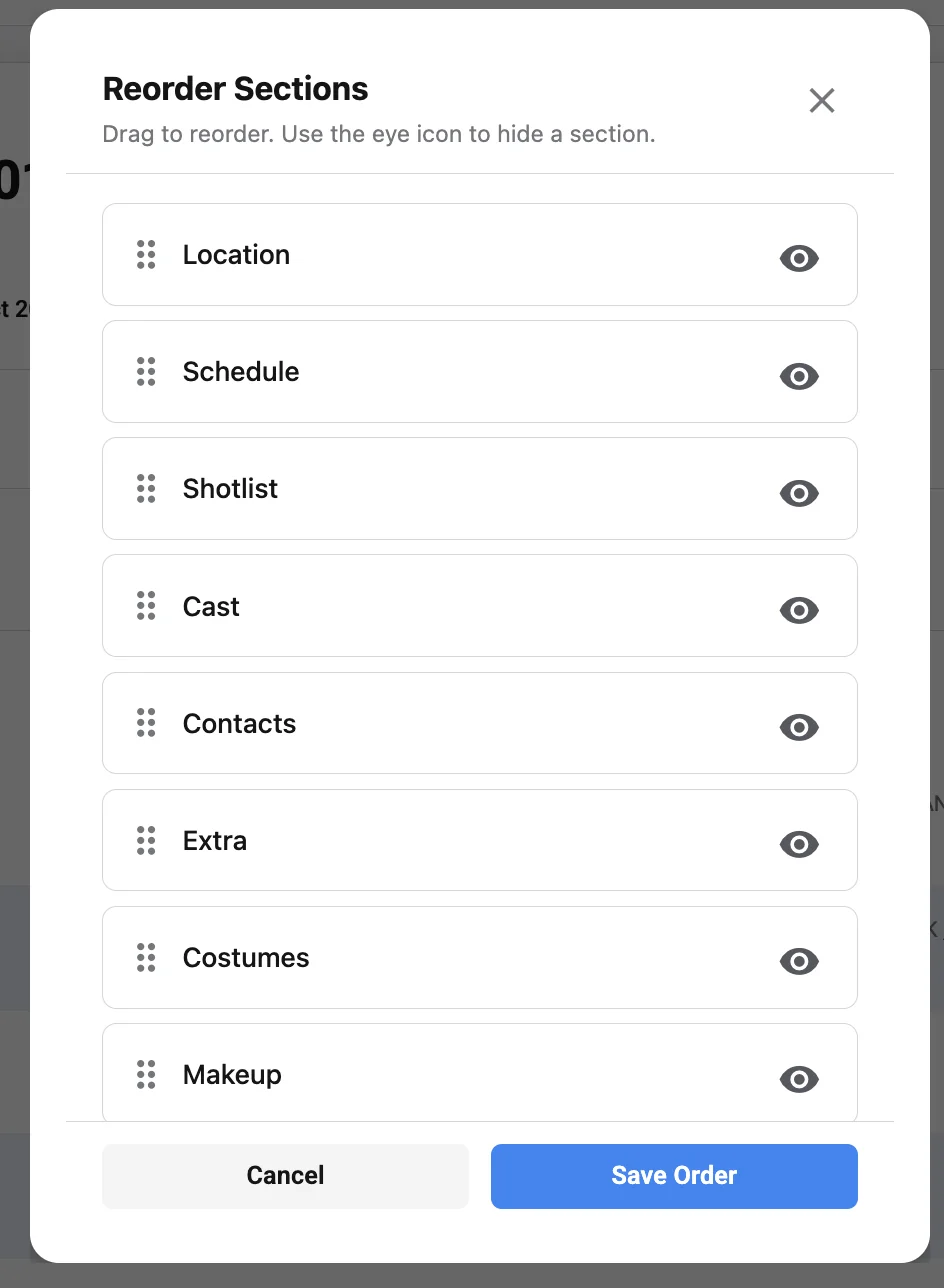
A practical call sheet template structure
A call sheet template should be structured so the most urgent information is easy to find first. There is no single universal layout for every production, but most effective templates share a similar logic: identify the day, show the call times, explain where to go, outline what is being filmed, and provide the contacts and notes needed to work safely.
Here is a practical call sheet format that can be adapted for short films, features, commercials, music videos, documentaries, branded content, and smaller digital productions:
| Section | What to include | Why it matters |
|---|---|---|
| Header | Production title, date, shoot day, unit, version | Confirms everyone is using the correct document |
| Key times | General call, pre-calls, cast calls, meal, estimated wrap | Sets expectations for the day |
| Locations | Set address, base camp, parking, maps, access notes | Prevents late arrivals and confusion |
| Schedule | Scenes, setups, cast IDs, page count, order of work | Helps departments prepare for the planned work |
| Cast | Names, character names, call times, ready times, scenes | Supports talent movement and readiness |
| Crew | Department heads, essential contacts, communication chain | Keeps questions moving to the right people |
| Weather | Forecast, sunrise, sunset, special conditions | Helps departments plan for environment and light |
| Safety | Emergency contacts, nearest medical facility, hazards | Supports fast action and risk awareness |
| Department notes | Specific reminders for camera, sound, art, wardrobe, locations, production | Reduces repeated questions and missed details |
| Logistics | Meals, transportation, shuttles, restrooms, holding, company moves | Keeps the day functional and organized |
| Attachments | Sides, maps, permits, parking passes, safety notes | Directs the team to supporting documents |
This structure can be simplified for a small crew or expanded for a large production. The important thing is consistency. When crew members know where to look for information every day, they can scan the document faster and prepare with more confidence.
Common call sheet mistakes that slow down production
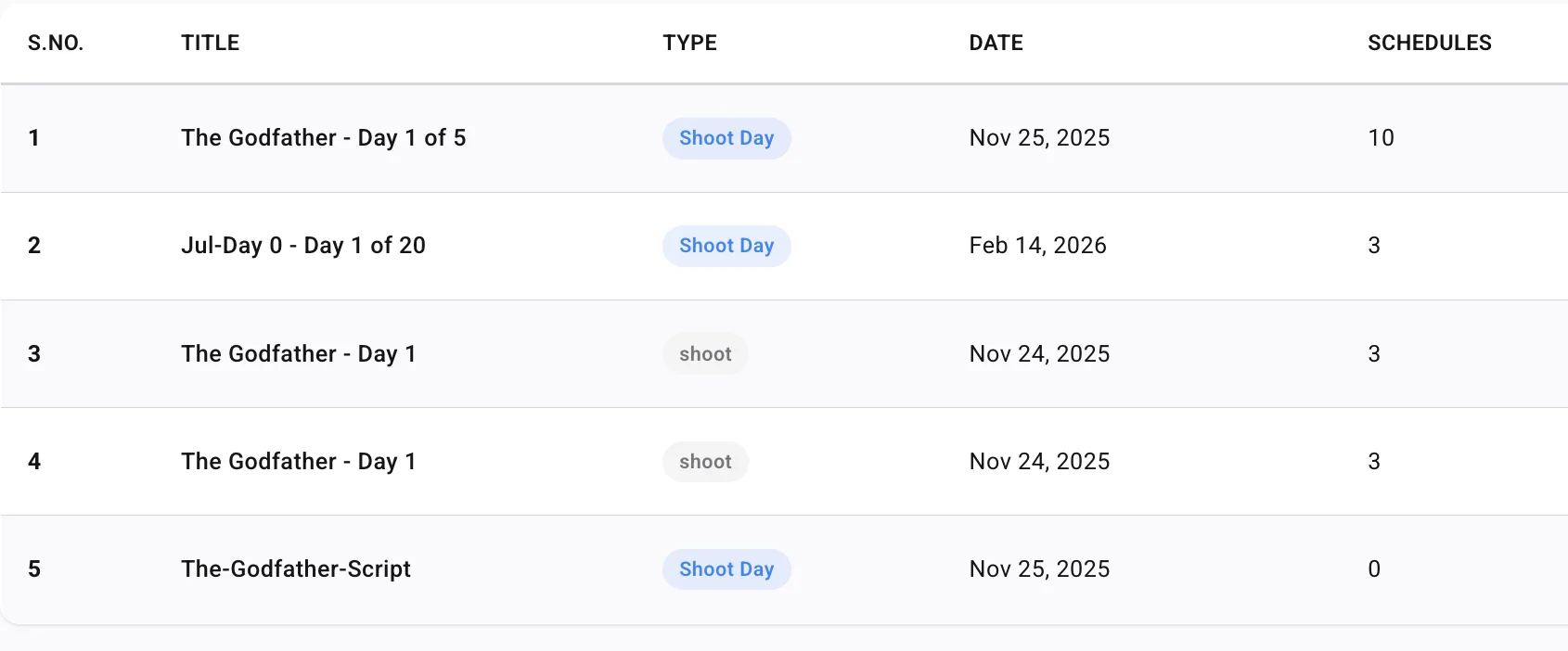
Even experienced teams can make call sheet mistakes when the schedule is changing quickly. The issue is rarely a lack of effort. It is usually a combination of late updates, scattered communication, incomplete confirmations, and pressure to distribute the sheet quickly.
The most common problems include missing parking instructions, unclear call times, outdated addresses, unconfirmed department notes, vague safety language, incorrect cast scenes, and revisions that are not labeled clearly. These mistakes may seem small on paper, but they can cost real time on set. If enough people arrive with different assumptions, the assistant director team has to spend the morning solving problems that could have been prevented.
Use this quality-control checklist before sending the call sheet:
- – Confirm the date, shoot day, and version. Make sure the header is accurate.
- – Check all call times against the schedule. Include pre-calls, cast calls, and ready times.
- – Verify locations and parking. Test map links and clarify entrances.
- – Review cast scenes and status. Confirm who is working and when they are needed.
- – Confirm department notes. Remove outdated notes from previous days.
- – Review safety information. Highlight day-specific hazards and emergency contacts.
- – Check weather and sun times. Update exterior-relevant details before release.
- – Proof contact numbers. A wrong phone number is not a small error when time matters.
- – Label attachments clearly. Avoid sending a pile of files with no context.
- – Mark revisions visibly. Make it obvious when a new version replaces an old one.
A final proofread should focus on operations, not just spelling. Ask whether a new crew member could use the call sheet to arrive at the right place, at the right time, with the right expectations. If the answer is no, the document needs another pass.
How can production teams make call sheets easier to use?
Production teams can make call sheets easier to use by organizing information in a consistent order, prioritizing the most time-sensitive details, using clear labels, and removing anything that does not help the team prepare or work safely. The best call sheets are not necessarily the most elaborate; they are the ones people can scan under pressure and trust.
Design matters because the call sheet is often read on phones, printed pages, tablets, and laptops. Small type, dense blocks of text, inconsistent labels, and buried changes make the document harder to use. A clean layout helps the production look more professional and helps the crew find what they need quickly.
To improve readability:
- – Use bold labels for call times, locations, safety notes, and contacts.
- – Keep the top section focused on the day’s most important details.
- – Group related information instead of scattering notes across the page.
- – Use tables for cast, crew, schedule, and logistics when appropriate.
- – Avoid unexplained abbreviations unless the whole team understands them.
- – Separate general notes from department-specific notes.
- – Highlight revisions without making the page visually chaotic.
- – Make digital links descriptive, especially for maps and attachments.
- – Keep paragraphs short so the sheet is usable on mobile devices.
For recurring productions, consistency is a major advantage. If each day’s call sheet follows the same structure, crew members become faster at reading it. That speed matters on productions where information changes often and people need answers quickly.
A call sheet is part of a larger production planning system
A call sheet works best when it is supported by strong production planning. It should reflect information from the shooting schedule, stripboard, script breakdown, location agreements, transportation plan, safety planning, cast availability, department prep, and crew communication. If those inputs are incomplete, the call sheet will show the gaps.
This is why a call sheet should not be treated as a last-minute clerical task. It is the daily summary of many planning decisions. When the call sheet is rushed, inaccurate, or disconnected from the rest of production, the crew feels it immediately.
A reliable process might look like this:
- – Confirm the next day’s creative priorities. Review scenes, setups, shot priorities, and director needs.
- – Check practical constraints. Confirm location access, daylight, weather, cast availability, and department requirements.
- – Build realistic timing. Work backward from readiness needs, company moves, meals, and wrap expectations.
- – Gather department notes. Ask for concise, day-specific information from key departments.
- – Verify logistics. Parking, transportation, catering, holding, restrooms, and security should be confirmed before release.
- – Review safety details. Identify hazards and confirm responsible contacts.
- – Proof and approve. Give the call sheet a final operational review before distribution.
- – Distribute and track changes. Make sure the latest version reaches the right people.
When this process becomes routine, the call sheet becomes more dependable. The production team spends less time correcting confusion and more time supporting the work on set.
Final takeaway for a stronger daily call sheet
A strong call sheet is clear, accurate, and useful under real production conditions. It identifies the project, sets call times, explains locations, outlines the shooting schedule, lists cast and crew needs, highlights weather and safety, and organizes the logistics that keep the day moving. Whether you are refining a call sheet template or building your first film production checklist, these production essentials should form the foundation of your daily paperwork.
The most effective call sheets are not overloaded with information, but they do not leave people guessing. They give every department enough context to prepare, arrive, communicate, and work safely. When the call sheet is treated as a serious production planning tool, it becomes one of the simplest ways to protect time, reduce confusion, and keep the entire team focused on the work in front of the camera.