
A feature breakdown is a deep read of one script. A television breakdown is that work, repeated, under a calendar that does not pause. While one episode is shooting, another is being prepped, and a third may still be in the writers’ room. Recurring characters and standing sets have to stay consistent, even as guest casts and one-off locations change every week.
That is the job of AI script breakdown for TV series: not simply tagging one teleplay faster, but helping the AD team, UPM, and department heads keep a season’s worth of elements organized when several episodes are moving at once. The tool will not run the pattern of production for you. It can give each new script a consistent first pass so the team can focus on the differences that matter this week.
How Episodic Breakdowns Differ From Feature Breakdowns
The categories are familiar – cast, extras, props, wardrobe, locations, vehicles, stunts, effects – but the production context is not.
Several scripts are alive at the same time
In a feature, you can often wait for a fairly stable draft before a full breakdown. In episodic work, episode 4 may be shooting while episode 6 is being broken down and episode 7 is still being rewritten. If each script has its own naming quirks, recurring props and standing sets start to fragment. A series needs a repeatable method so “the kitchen” or a regular character’s wardrobe does not get reinvented in every file.
The standing world is as important as the new scenes
Most series have a core geography: homes, workplaces, regular vehicles, and standing sets. A good episodic breakdown still has to catch the guest location, unique prop, and one-time stunt. It also has to recognize what is already part of the series engine, so departments can plan around existing stock rather than treating every script like a new show.
Cast is a mixture of regulars, recurring players, and guests
A feature usually has one company of characters. A series has regulars, recurring players, and guests who may be in only one installment. The breakdown has to make those distinctions usable for scheduling, because a regular’s workdays across a block are planned differently from a guest star’s two-day stint.
Watch how Studiovity tags scenes quickly, which is the pace episodic teams need when a new script lands in prep:
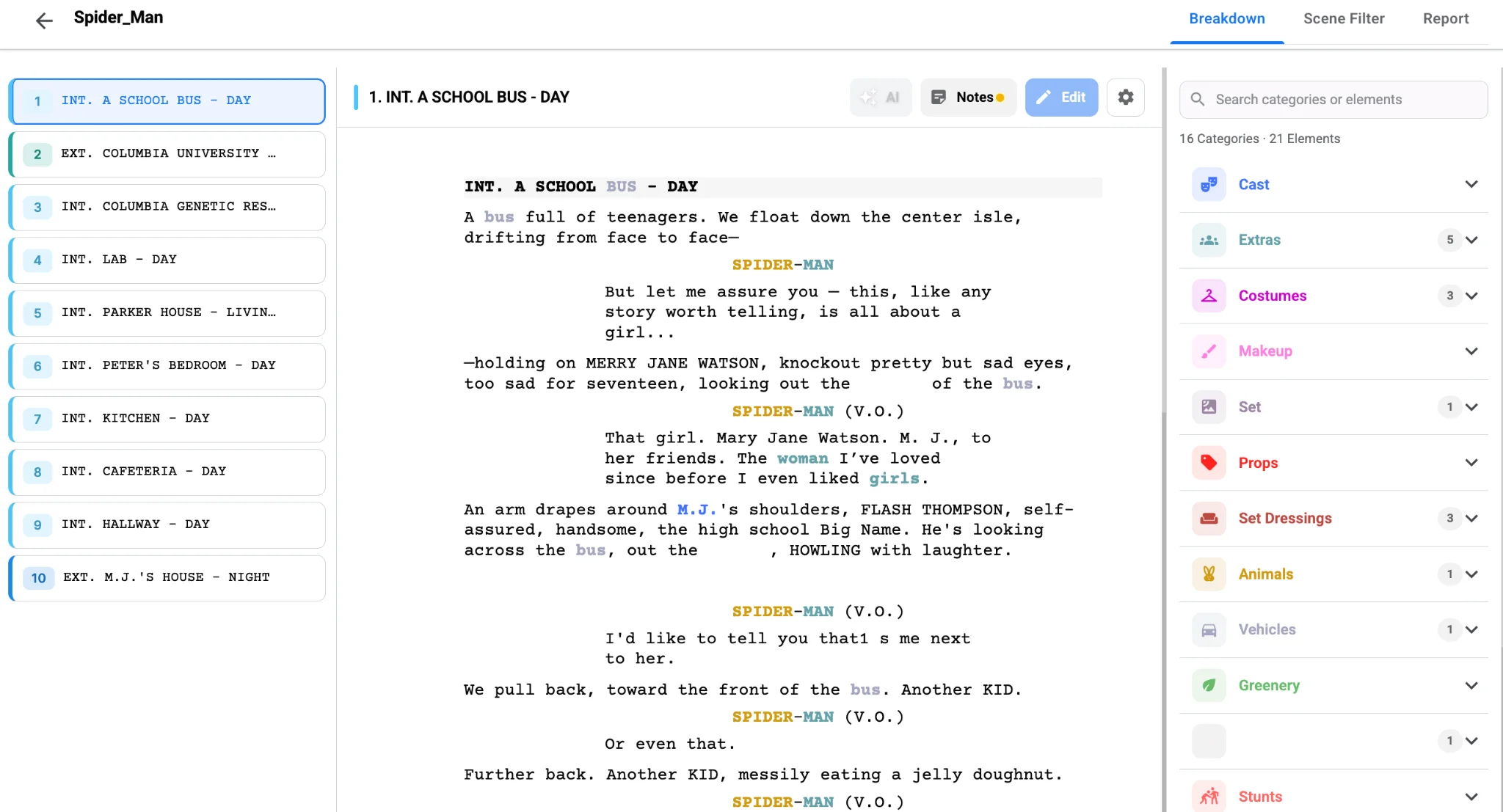
Where AI Helps Most on a Series
An AI script breakdown is especially useful in television because the clock between receiving pages and needing a board is short.
A consistent first pass on every new teleplay
When each episode starts with the same categories and a fast tag of characters, locations, and elements, the AD team can compare episodes more easily. The first pass is consistent; the human review then focuses on series-specific judgment: Is this the standing apartment or a new swing set? Is this character a regular, or a new guest with a similar first name?
Faster visibility into this week’s exceptions
The scenes that disrupt an episodic week are often the exceptions: a new street, a crowd, a stunt, a child, a night-exterior, or a prop that has never appeared before. AI tagging helps those items surface quickly, so they do not hide inside a familiar “office episode.”
Better support when pages keep changing
Episodic scripts change late. A cold open is rewritten. A guest scene is added. A location falls through. Updating a breakdown is more realistic than starting a manual highlight pass over again every time new pages arrive, provided someone still reviews the changes before they reach the board.
If you have a teleplay in prep right now, run an AI script breakdown on that episode, review the tags against your standing sets and regulars, and share the scene summary with the departments that have to turn it around this week.
A Week-to-Week Breakdown Workflow for Episodic Teams
Television already has a rhythm. The breakdown should fit that rhythm rather than adding a new one.
1. Break down the episode as soon as a producible draft exists
Do not wait for a locked production white if the team already needs to scout, budget guest days, or talk to locations. Run the first AI pass early, label the draft version clearly, and plan to update it when new pages come in.
2. Reconcile the tags with the series bible
This is the most important human step in episodic work. Check character names against the official series names. Confirm that standing sets use the same labels from episode to episode. Merge duplicate tags for a recurring prop or vehicle. If episode 3 called it “Maya’s sedan” and episode 5 calls it “the blue car,” transportation will treat them as two problems.
3. Separate standing needs from episodic needs
Give departments a way to see what is new this week. Wardrobe needs the guest looks and any regular-character changes. Art needs the swing set and unique props. Locations needs the new exteriors, plus any standing set used in an unusual way, such as a night shoot on a set that is usually a day interior.
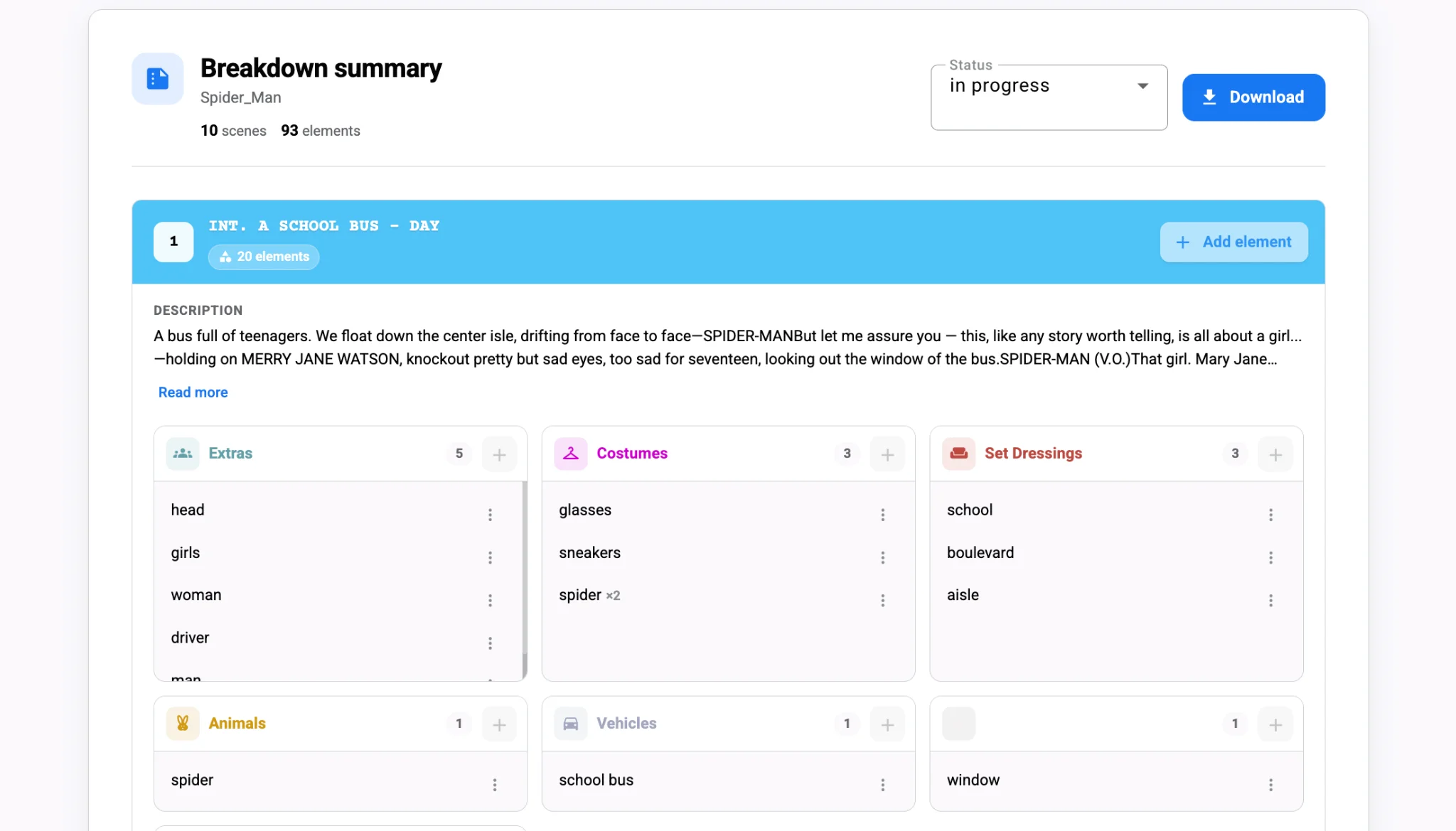
4. Hand the reviewed breakdown to scheduling and the production calendar
Once the episode’s elements are trustworthy, they should feed the board and the wider production calendar. Cross-boarding only works if each episode’s scene list, cast, and locations are accurate. A reviewed breakdown lets an AD see that two episodes share a location or a guest and might be planned in the same block. Studiovity’s shooting schedule software is the natural next step.
Special Cases That Show Up All Season
Certain episodic situations deserve extra attention during the review, because they are where a fast AI pass is helpful and where an unreviewed pass can still cause trouble.
Cross-boarding and episode blocks
When two episodes are shot together, the breakdowns have to be comparable. If locations or character names are inconsistent, the combined board will hide collisions and missed company moves. Standardize names before you combine the work.
Bottle episodes and “small” episodes
A contained episode can still be dense: many pages on one standing set, tight coverage, and a regular cast working long days. The breakdown should still be complete, because page count on a familiar set can tempt teams to overbook the day.
Stunt, effects, or crowd-heavy episodes
These installments usually need earlier department involvement. An early AI pass that flags stunts, effects, vehicles, or extras gives those teams more of the prep window. Review those tags carefully; a missed stunt is not a small typo when the shooting week is already full.
Recurring props and planted payoffs
Series often plant an object or a costume in one episode and pay it off later. AI may tag the object where it appears, but it will not remember the season arc. Keep a running list of recurring story items so a later episode can be checked against it.
Keeping Departments Aligned Across a Season
In episodic production, departments live with the series week after week, so consistency matters more than a perfectly designed one-off document.
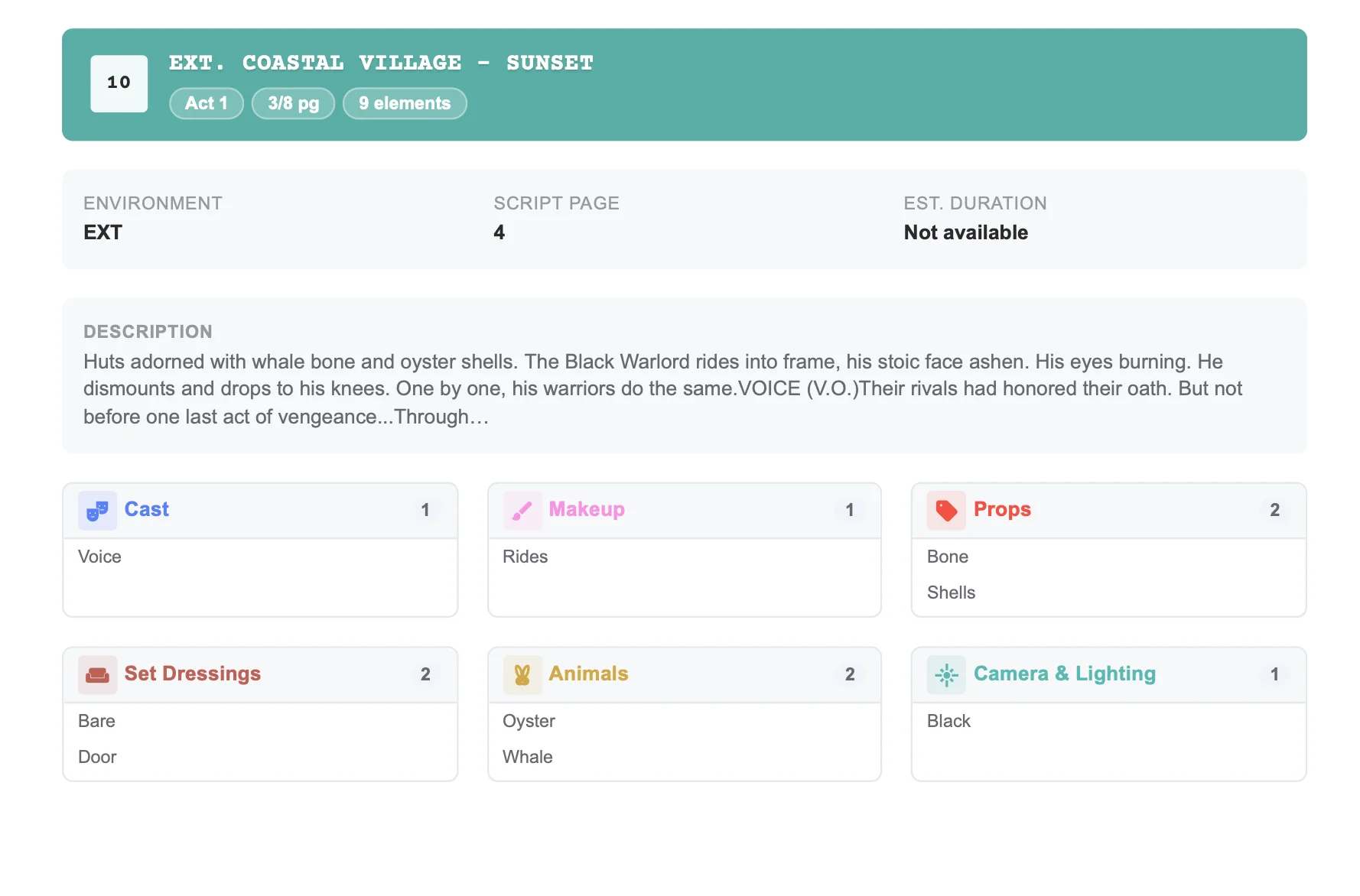
Share scene-level summaries, not only full scripts, so art, costume, and transportation can see this week’s work quickly. Keep one official breakdown per episode and one naming standard for standing sets and regulars. When a revision lands, update the breakdown and tell departments what changed.
Studiovity’s script breakdown software supports that workflow: run an AI pass on each new script, correct tags so they match the series, review a scene summary, and keep the same workspace connected to scheduling as the week moves forward.
FAQ
Can AI script breakdown keep up with late episodic page changes?
It can help you update faster than a full manual pass, but only if someone reviews the new tags and communicates the changes. AI script breakdown for TV series is most useful when the team already versions each draft and reconciles names with the series standard.
Should every episode use the same breakdown template?
Yes, as much as possible. The categories and the names for standing sets and regulars should be stable. What changes is the content of each episode. A consistent template is what makes block shooting and department planning across a season realistic.
How does this help with recurring cast?
A reviewed breakdown shows which regulars, recurring players, and guests appear in which scenes. That is what the AD and UPM use to estimate workdays and avoid calling a regular for a day they are not needed.
Do I still need a human breakdown artist or AD to review the tags?
Yes. AI will not reliably understand that two descriptions refer to the same standing set, or that a character is recurring rather than new. The first pass is the time saver. The review is where series knowledge lives.
Try Studiovity’s AI Script Breakdown Free
Episodic production rewards teams that can turn a new script into a clear plan without losing the week to paperwork. Try Studiovity’s AI Script Breakdown free on your next episode, reconcile it with your standing world, and give departments a first pass they can actually use.