
Learning how to break down a script is one of the most practical skills a filmmaker can build. A script breakdown turns a written screenplay into a production plan: who is needed, where, with what props, costumes, vehicles and effects, and how all of it shapes the schedule and the budget. Whether you are prepping a short film, a commercial, a music video or a feature, the process follows the same logic. You read carefully, identify what each scene needs, organize it scene by scene, and use that information to plan the shoot.
What is a script breakdown?
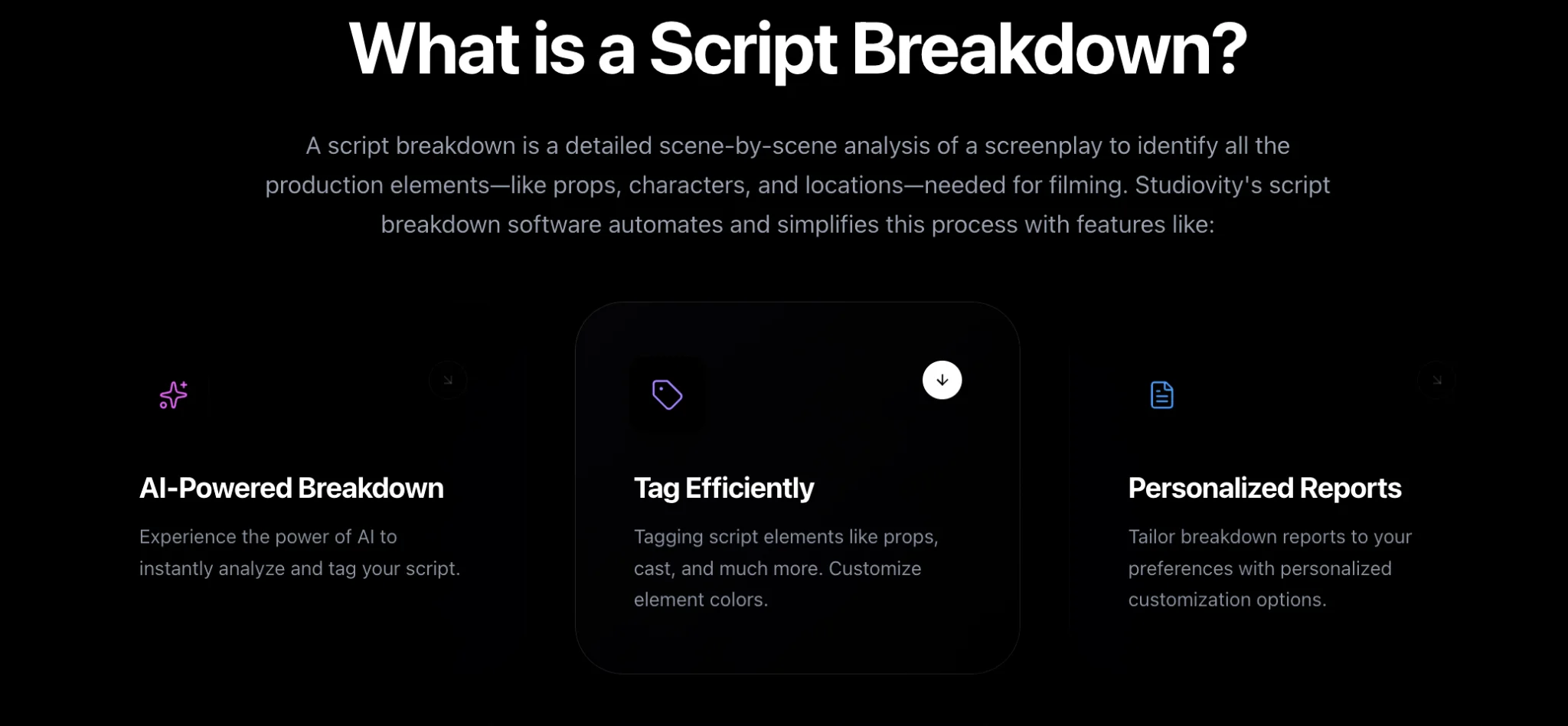
A script breakdown is the process of reading a screenplay scene by scene and identifying every element needed to film it, from cast and props to locations, wardrobe, stunts and visual effects. A screenplay describes what the audience will see and hear; the breakdown explains what the production must arrange to make that happen.
One line shows the difference. “She runs through the rain holding a cracked phone” reads as a single moment, but it can trigger an actor, an exterior location, a rain effect, wet wardrobe with duplicates, a phone prop, a movement note, sound concerns, continuity tracking and possibly night lighting. The goal is not to complicate the script. It is to make hidden production needs visible early enough to solve them cheaply.
Why breaking down a script matters before you schedule
Scheduling without a breakdown is guesswork. Scripts are rarely shot in story order, and two scenes of the same length can carry completely different workloads. A one-page kitchen conversation may need two actors and a few props; a one-page street scene with extras, picture cars, an animal and weather continuity needs far more planning. A complete breakdown helps you:
- Build a realistic shooting schedule by grouping scenes by location, time of day, cast availability and complexity.
- Estimate the budget accurately, because each department can see what must be sourced, built, rented, hired or approved.
- Prepare department heads with clear information about what appears in each scene.
- Reduce continuity errors by tracking props, costumes, makeup and story timing.
- Spot risks early, such as stunts, weapons, minors, animals, water, vehicles, crowds or effects.
- Keep everyone on one plan, so the director, producer, AD and crew work from the same foundation.
The point is not to make the script less creative. It is to make the creativity shootable.
How to break down a script in 8 steps
The short version: lock a clean draft, read it once for story, set up your categories, tag every scene, build breakdown sheets, measure scenes in eighths, review with your key collaborators, then turn the result into a schedule and budget that you keep updated with every revision.
1. Start with a clean, locked working draft
Break down the right draft. If the screenplay is still changing heavily, your work will go stale fast. Before you start, confirm the basics:
- The script is the agreed production draft, and everyone knows where the master file lives.
- Every scene has a proper heading with INT./EXT., location and time of day.
- Page numbers are in place and scene numbers are assigned or ready to be assigned.
- Character names are consistent throughout.
- Major planned revisions have been discussed with the director or producer.
- Drafts are dated and named so nobody tags an outdated version.
Formatting matters because scene numbers, page counts and scene lengths feed directly into scheduling. If the layout is messy, fix it first; our guide on how to format a screenplay for script breakdown covers the habits that make this step painless.
2. Read the script for story before tagging anything
Your first read is about understanding the film, not labeling props. Read it start to finish like an audience member, noting tone, genre, pacing, character arcs and the set pieces that feel logistically heavy. This story-first read prevents mechanical mistakes: a coffee mug that appears once may not matter much, but a cracked wristwatch tied to a character’s backstory is a hero prop that needs duplicates and care. Make light notes on crowd scenes, action, period detail, children, animals, vehicles, food, weather and VFX. Then read again with a technical eye.
3. Set up your categories and color system
Decide how you will track cast, background, props, set dressing, wardrobe, hair and makeup, locations, vehicles, stunts, effects, sound and production notes before you mark a single line. Assign each category a color or tag and do not change the system halfway through; inconsistent tagging makes every later report harder to trust. Not every scene needs every category: a quiet bedroom conversation may touch only cast, wardrobe, props, set dressing and location, while a market chase can touch nearly all of them.
4. Tag every scene, line by line
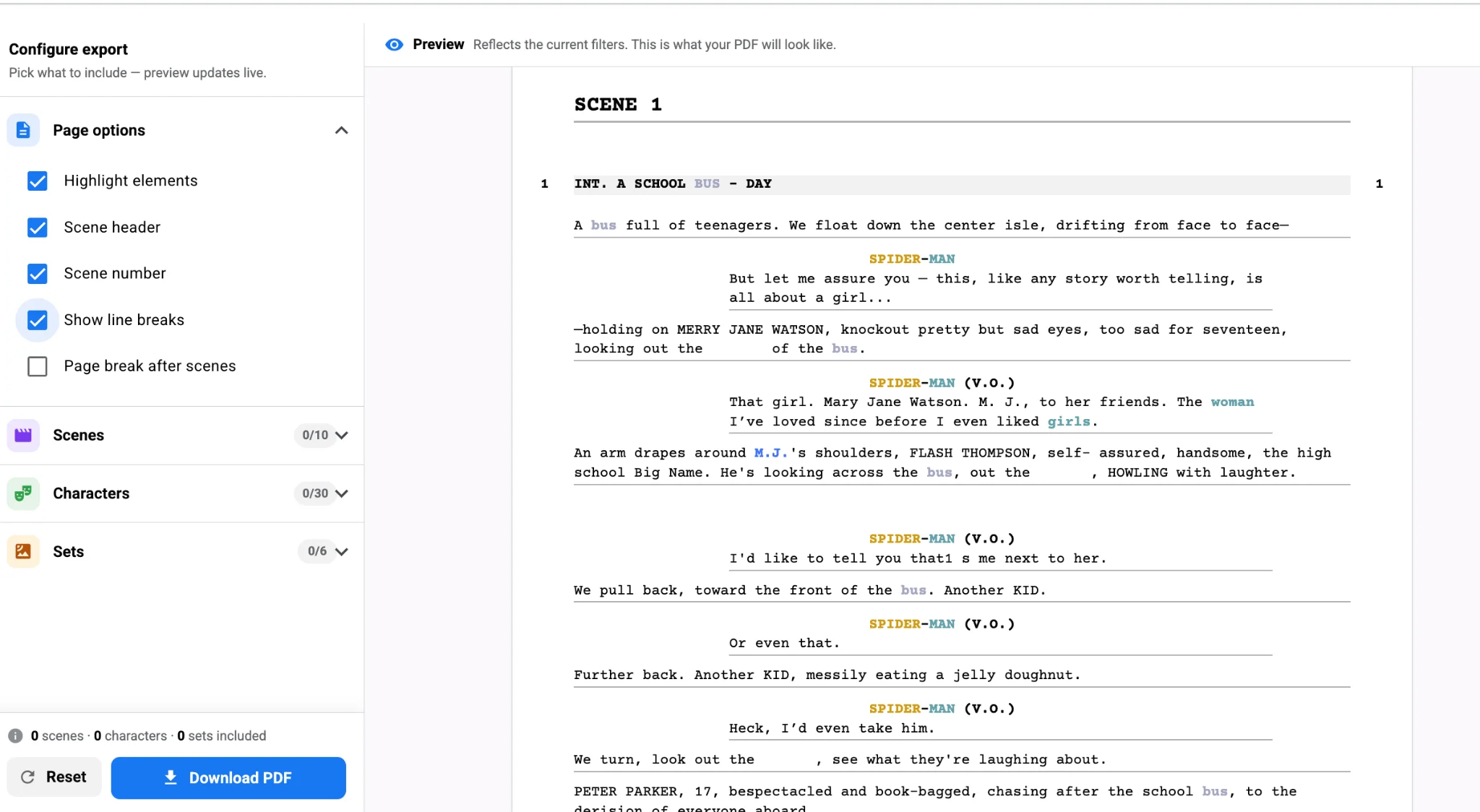
Work one scene at a time. Read every action line and every line of dialogue, and tag anything that must be cast, sourced, built, dressed, scheduled, cleared, supervised or prepared. Tag elements when they are stated, when they are implied by the action, and when the circumstances of the scene require them. If a character “starts the car,” the car is a vehicle and probably a prop interaction too. If a character says “I brought the documents,” the documents must exist even if the action line never mentions them.
Track repeated elements consistently. If the same backpack appears in ten scenes, continuity depends on knowing when it appears, what condition it is in and whether it changes. Highlighters on a printed script work fine for a first project, but digital tagging is far easier to update when pages change, which is why many teams now tag and organize breakdown elements in Studiovity instead of retyping lists across spreadsheets.

5. Create a breakdown sheet for every scene
Once the script is tagged, summarize each scene on its own breakdown sheet, a scene-specific list of everything required to shoot it. A practical sheet includes:
- Scene number and script page reference.
- Scene heading: interior or exterior, location and time of day.
- Scene length in pages and eighths.
- Story day, when the timeline affects wardrobe, makeup or props.
- Cast and background required, with a description of the background when known.
- Production elements grouped by department.
- Special notes on safety, permissions, weather, effects or sound.
- Open questions for the director or producer.
Be specific where the script is specific. Avoid vague notes like “some props” or “crowd,” and when the script only implies a need, mark it as a note to confirm. Breakdown sheets are conversation starters, not paperwork for its own sake.
6. Measure each scene in eighths of a page
Productions measure scene length in eighths: one page equals 8/8, half a page is 4/8, and a scene of a few lines may be 1/8. Eighths give the AD a consistent baseline for how much script is scheduled on a given day and make workloads easy to compare. Page count alone never determines difficulty, though. A 1/8 scene with a car crash can take longer than three pages of dialogue, so always pair the measurement with complexity notes.
7. Review the breakdown with key collaborators
Walk the director, producer, AD and department heads through the sheets and let them question it. A prop master may ask whether a letter must be readable on camera; a costume designer may ask whether a jacket is worn before or after the fight; a sound mixer may ask whether the rain is practical or added in post. Those questions are the production doing its job before problems get expensive. Keep the director’s vision at the center: when something is unclear, ask what the story needs, because meaning is what helps you prioritize when resources are tight.
8. Turn the breakdown into a schedule and a budget
With every scene on a sheet, the AD can build a stripboard or digital schedule, with each scene as a strip that can be rearranged into the most practical shooting order. When ordering scenes, weigh:
- Locations: group scenes to reduce company moves and setup time.
- Cast availability: principal actors, minors, day players and background.
- Time of day and interior versus exterior, including weather, light, noise and permits.
- Complexity: avoid stacking too many difficult scenes on one day.
- Continuity: story order still matters when wardrobe, makeup or emotional states change.
- Special equipment: consolidate days that need cranes, drones, vehicles or effects.
- Safety: give stunts, weapons, effects and animals enough prep time.
The same data gives the budget a factual foundation. “Ten police officers” means uniforms, badges, vehicles, background actors and location coordination; a “small party” means food styling, extras, playback and cleanup. Seeing the cost drivers early also shows where the script can flex without hurting the story: merging two locations, staging a crowd with a smaller group, or simplifying a practical effect.
Watch: a script breakdown in action
A quick script breakdown example
Take this short scene: INT. MOTEL ROOM – NIGHT. Lena enters, soaked from the rain. She drops a muddy backpack on the bed, checks her cracked phone and notices blood on her sleeve. Outside, police lights flash through the curtains.
| Category | What the breakdown records |
|---|---|
| Cast | Lena |
| Location | Motel room, interior, night |
| Wardrobe | Wet clothes, mud, blood on sleeve; duplicates for resets |
| Props | Muddy backpack, cracked phone |
| Makeup | Wet look, distress, blood continuity |
| Set dressing | Motel bed, curtains, practical room details |
| SFX and lighting | Rain if seen before entry; police light effect through curtains |
| Sound | Rain ambience, distant sirens |
| Continuity | Wetness, mud, blood and phone damage must match adjacent scenes |
Emotionally, the scene says Lena is in trouble. The breakdown turns that into tasks: the cinematographer needs a lighting plan, wardrobe needs a wet-down strategy, props must source the phone and backpack, and makeup must track the blood.
Keep the breakdown current when the script changes
Scenes get rewritten, locations shift and characters are combined, and one added line can introduce a new prop, cast member, clearance issue or visual effect. Treat the breakdown as a living document. When a new draft arrives:
- Compare it against the previous version and list scenes that were added, cut, moved or changed.
- Re-tag new or revised elements and update the breakdown sheets.
- Lock scene numbers carefully so departments already in prep are not confused.
- Notify the affected department heads.
- Archive the old version so nobody uses it by mistake.
- Confirm the schedule and budget still match the latest script.
Common script breakdown mistakes to avoid
- Breaking down the wrong draft.
- Tagging only what is explicitly named and ignoring implied needs.
- Confusing props (handled by actors) with set dressing (decorates the space).
- Forgetting story-day continuity for injuries, wet or torn clothing and broken props.
- Underestimating food, weather, vehicles or crowd scenes.
- Treating VFX as something to “fix later” without planning it.
- Building the schedule from page count alone.
- Not updating the breakdown after revisions, or keeping it where the team cannot reach it.
Final takeaway
Breaking down a script is how a story becomes a shoot. Start with a clean draft, read for story, tag consistently, build clear breakdown sheets, measure in eighths, review with your team and keep everything updated as the project evolves. If you want AI to handle the first tagging pass, read our guide on how to use AI for script breakdown, or start your next breakdown free in Studiovity.