
A professional call sheet keeps a film production organized, punctual, and aligned before the first crew member arrives on set. For filmmakers, producers, directors, assistant directors, and production teams, it is the daily operating document that turns the shooting schedule into clear instructions. A strong film call sheet tells everyone where to be, when to arrive, what scenes are being filmed, who is needed, and what risks or logistics require attention.
Related video: How to generate an industry-standard call sheet in Studiovity
What should a film call sheet include?
A film call sheet should include the production title, shoot date, call times, location details, weather notes, scene schedule, cast and crew contacts, department-specific instructions, safety information, parking guidance, and emergency contacts. In practical terms, it should answer the questions your team will ask before and during the shoot day: where am I going, when do I report, what are we filming, what should I bring, and who do I contact if something changes?
The call sheet is usually prepared by the assistant director team or production office and approved by the producer, director, or production manager before distribution. It is not just an administrative form. It is a communication tool that helps prevent delays, missed pickups, confusion at basecamp, and last-minute calls that could have been avoided with clearer planning.
Why the call sheet matters in the film production process
Film production moves through layers of planning: script breakdown, budget, scheduling, location scouting, casting, crew hiring, equipment rental, rehearsals, shoot days, and post-production handoff. The production call sheet sits at the center of the shoot-day workflow because it translates weeks of planning into one practical document.
A director may be focused on performance and visual storytelling. A producer may be watching budget, permissions, and company moves. An assistant director may be managing time, background action, safety, and communication between departments. The call sheet connects all of these priorities so every person understands the day’s plan.
Without a consistent call sheet format, teams may rely on scattered texts, verbal updates, or outdated schedule versions. That creates risk. A grip might arrive at the wrong entrance, an actor may miss a makeup call, or a department head may not know a company move is planned after lunch. A clear call sheet reduces that friction by placing essential information in one shared reference.
Start with the production header
The top section of a professional call sheet template should identify the production at a glance. This header is especially important when crew members are moving between multiple projects, units, locations, or shoot days.
Include the production title, episode or project number if applicable, shoot day number, date, and version number. If the schedule changes after distribution, label the revision clearly so nobody confuses an old call sheet with the updated one. Many teams use version notes such as “Rev. 1” or “Updated at 8:30 PM” to make changes obvious.
The header should also show the general crew call and key contacts. The general crew call is the standard arrival time for most crew members, but not everyone will share that time. Hair, makeup, transport, cast, background, camera prep, and special effects may have separate calls. The header gives the big picture, while later sections provide department-level detail.
Build the day around the shooting schedule
The shooting schedule is the backbone of the call sheet. It should list the scenes planned for the day in the expected shooting order, along with enough context for each department to prepare properly.
For each scene, include the scene number, script pages or page count, set name, brief description, day or night setting, interior or exterior, cast required, and any major notes. Keep descriptions short, but make them useful. “INT. KITCHEN — NIGHT — argument after dinner” tells the team far more than simply listing “Scene 24.”
A practical shooting schedule section may include:
- Scene number: Helps departments match the call sheet to the script breakdown.
- Set or location: Clarifies where the action takes place, especially when one physical location doubles for several story locations.
- INT./EXT. and day/night: Guides lighting, grip, camera, wardrobe, makeup, and continuity planning.
- Page count: Helps estimate the workload for the day.
- Cast IDs: Shows which performers are needed for each setup.
- Special notes: Flags stunts, intimacy work, weapons, animals, minors, vehicles, VFX, rain towers, drones, or special equipment.
Avoid overloading this section with unnecessary detail. The goal is to give each department enough information to prepare without forcing them to read the full production schedule during a busy morning.
How do you create a call sheet step by step?
To create a call sheet step by step, begin with the approved shooting schedule, confirm the location and call times, add cast and crew details, include safety and logistical notes, review everything with the key production leads, and distribute the final version with enough time for the team to prepare. The best workflow is simple, repeatable, and tied to the real needs of the next shoot day.
1. Review the next day’s scenes
Start by checking the latest shooting schedule and script breakdown. Confirm which scenes are approved for the day, whether any scenes are being added or dropped, and what each department needs to know. If the director or producer has changed priorities, update the call sheet before it reaches the crew.
This is also the time to check page count, estimated setup complexity, location restrictions, and any scene-specific requirements. A short dialogue scene in a controlled interior may need less prep than a half-page exterior with picture vehicles, extras, weather exposure, and special effects.
2. Confirm locations and movement
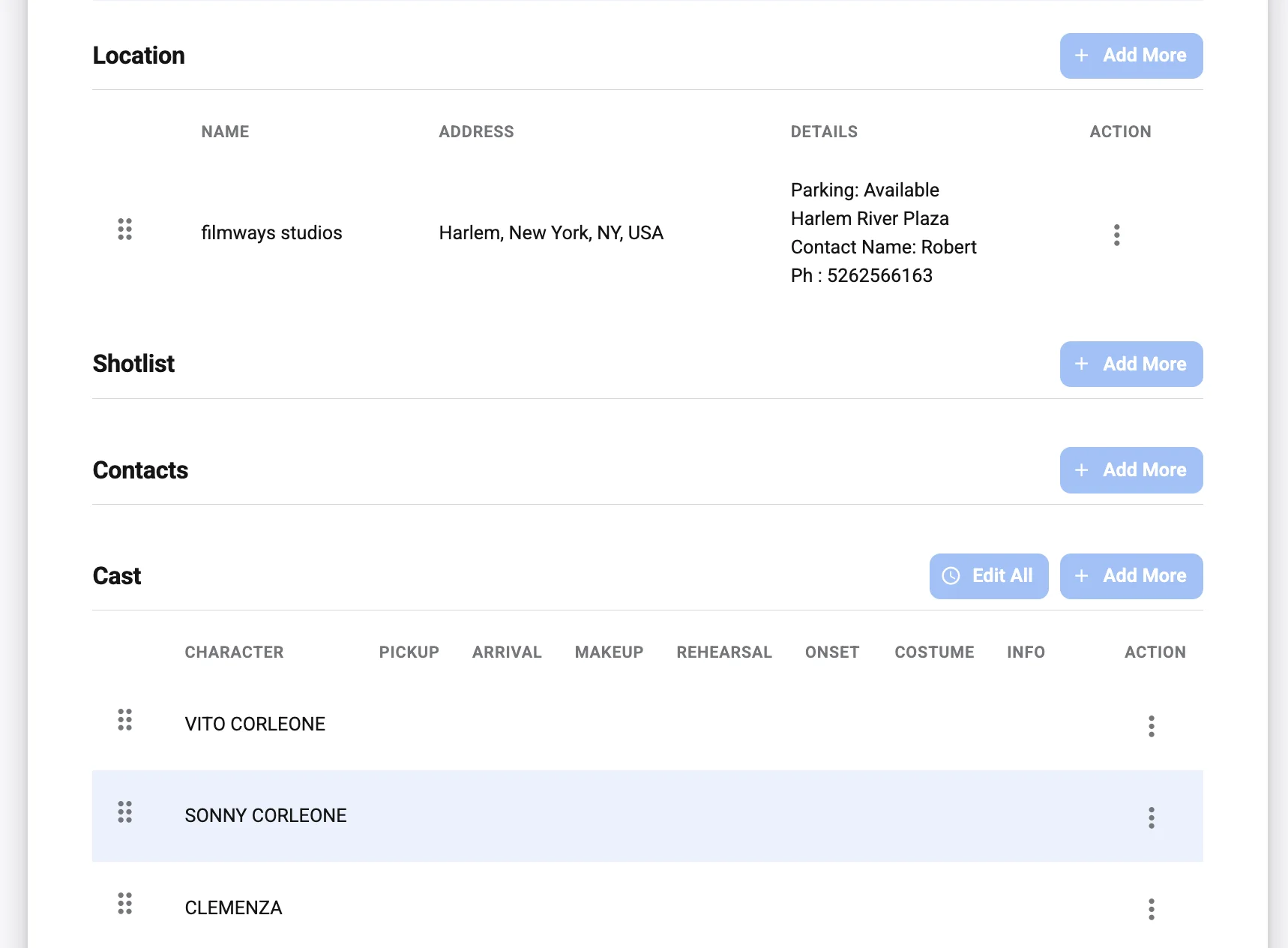
Next, verify every address and movement plan. The location section should include the shooting location, parking location, basecamp, crew entrance, holding area, nearest restroom access, and any restrictions from the location agreement.
If the production has a company move, make it obvious. Include departure times, destination details, and whether cast and crew are driving themselves, using production transport, or moving by shuttle. Company moves often cause delays when instructions are vague, so clarity here protects the day.
3. Set call times by group
Do not rely on one general call time for everyone. A polished production call sheet separates call times by role and department. Actors may need pre-call for hair, makeup, wardrobe, rehearsal, or prosthetics. Camera and grip may need an earlier load-in. Art department may require dressing time before the main crew arrives.
Use staggered call times when they support the workflow. This keeps departments from waiting unnecessarily and helps production control meal penalties, overtime risks, and location congestion. Always confirm the timing with the first assistant director, production manager, and relevant department heads.
4. Add contacts and communication channels
A call sheet should tell people who to contact, but it should not become a messy phone directory. Include essential production contacts such as the producer, production manager, first assistant director, second assistant director, location manager, transportation captain, medic, and emergency contact.
For larger productions, list department heads and direct crew to communicate through proper channels. This keeps the set organized and prevents the director or producer from receiving every small logistical question during the shoot day.
5. Review, approve, and distribute
Before sending the call sheet, check it line by line. Confirm dates, times, addresses, cast numbers, scene numbers, weather notes, safety issues, and meal timing. A single typo in an address or call time can cost the production real money and trust.
Once approved, distribute the call sheet through the agreed channel. This may be email, production software, messaging apps, or a combination. If you use call sheet software such as Studiovity call sheet software, the value is in keeping the call sheet template, schedule details, and distribution process easier to manage from one place. Whatever tool you choose, make sure every recipient receives the correct version.
The standard call sheet format
A consistent call sheet format helps crew members find information quickly. Even when productions vary in scale, most professional documents follow a recognizable structure. Consistency matters because nobody wants to hunt for parking instructions or emergency contacts at 5:00 AM.
A useful format often follows this order:
- Production header: Title, date, shoot day, call sheet version, and general crew call.
- Key contacts: Producer, director, assistant director, production office, location contact, transport, and medic.
- Location details: Shooting address, parking, basecamp, holding, nearest hospital, and map notes.
- Weather and sunrise/sunset: Helps departments prepare for exterior work and available daylight.
- Daily schedule: Scenes, sets, cast, page count, and special requirements.
- Cast section: Cast IDs, character names, performer names, status, pickup times, makeup, wardrobe, and set calls.
- Background or extras: Count, call time, holding location, wardrobe notes, and check-in contact.
- Department notes: Camera, grip, electric, sound, art, wardrobe, makeup, props, SFX, VFX, locations, transport, and catering.
- Safety notes: Hazards, medical support, stunt or weapons notes, weather risks, and emergency procedures.
- Advance schedule: A brief look at the next shoot day, if appropriate.
This structure works because it moves from general information to specific operational details. The top of the document answers where and when. The middle explains what will be filmed. The lower sections support individual departments.
A practical call sheet example
A call sheet example does not need to be complicated to be useful. The purpose is to show how information fits together in a way that a busy production team can understand quickly.
Here is a simplified example of how a daily schedule section might look:
| Order | Scene | Description | Set | Cast | Pages | Notes |
|---|---|---|---|---|---|---|
| 1 | 12 | Lead character finds the letter | Apartment bedroom | 1 | 2/8 | Insert shots needed |
| 2 | 14 | Phone call with sister | Apartment kitchen | 1, 3 | 1 1/8 | Playback audio |
| 3 | 18 | Neighbor interrupts argument | Hallway | 1, 2, 4 | 1 5/8 | Background: 3 |
A simplified cast section could include:
| Cast ID | Character | Performer | Pickup | HMU | Wardrobe | Set Call |
|---|---|---|---|---|---|---|
| 1 | Maya | Performer Name | 6:00 AM | 6:30 AM | 7:15 AM | 8:00 AM |
| 2 | Daniel | Performer Name | 7:00 AM | 7:30 AM | 8:00 AM | 9:15 AM |
| 3 | Sister Voice | Performer Name | Remote | N/A | N/A | 10:30 AM |
This example is intentionally simple. On a real production, you may add meal timing, rehearsal notes, transport, union or guild requirements, background holding, special equipment, and confidentiality reminders. The principle remains the same: make the document specific enough to guide the day, but clean enough to read quickly.
Details that make a call sheet feel professional
Professionalism is often found in the details. A call sheet can contain all the basic information and still feel confusing if the layout is crowded, the language is vague, or the instructions are scattered.
Strong call sheets use plain labels, readable spacing, and consistent terms. If you call an area “basecamp” in one section, do not call it “crew parking area” somewhere else unless those are different locations. If the cast section uses character names and cast numbers, keep that system consistent across the production.
Pay close attention to the following details:
- Weather information: Include practical notes, not just temperature. Mention rain cover, heat precautions, wind concerns, or cold-weather wardrobe needs when relevant.
- Sunrise and sunset: Essential for exterior scenes, golden hour planning, night work, and turnaround expectations.
- Nearest hospital: Include the name, address, and emergency contact process. Production should also know who the set medic is.
- Parking and access: Specify gates, permits, loading zones, elevators, security check-in, and restricted areas.
- Meal timing: List breakfast, lunch, catering, or meal break expectations clearly.
- Confidentiality notes: Useful for sensitive projects, public locations, celebrity cast, or unreleased story material.
- Safety notices: Highlight hazards such as water, fire, weapons, vehicles, animals, heights, drones, crowds, or extreme weather.
A professional call sheet template should also leave room for department-specific notes. Camera may need lens or media reminders. Sound may need information about noisy locations. Art and props may need dressing deadlines. Wardrobe and makeup may need continuity alerts. These notes prevent small oversights from becoming set delays.
Common mistakes that slow down production
Many call sheet problems come from rushing the document at the end of a long production day. When the team is tired, it is easy to copy yesterday’s information, miss a changed location, or forget that a performer has a special pickup time. A disciplined review process helps catch these mistakes.
Common issues include:
- Sending the call sheet before scene order is confirmed.
- Listing the wrong date after duplicating a previous document.
- Forgetting to update parking or basecamp information.
- Using one call time when departments need staggered calls.
- Omitting background actor instructions.
- Leaving out safety notes for stunts, weapons, vehicles, or weather.
- Failing to mark revised versions clearly.
- Including too much clutter instead of prioritizing essential instructions.
The best way to avoid these problems is to build a repeatable checklist. Before distribution, ask: Are the scenes final? Are locations confirmed? Are cast calls approved? Are department notes current? Has the assistant director reviewed timing? Has production approved logistics? If the answer is uncertain, pause before sending.
How can a call sheet improve communication on set?
A call sheet improves communication on set by giving every department the same source of truth for the day’s plan. Instead of relying on separate messages and assumptions, the team can refer to one document for timing, location, scene order, contacts, and safety expectations.
This shared reference is especially important when plans change. If weather forces a scene swap or a location becomes unavailable, the production team can issue a revised call sheet or update the relevant instructions through the chosen communication channel. The clearer the original document is, the easier it is to communicate changes without confusion.
A good call sheet also supports leadership. The director can focus on creative decisions, the producer can manage resources, and the assistant director can run the floor with fewer avoidable interruptions. Departments still need verbal communication, but the call sheet gives those conversations a reliable starting point.
Final checklist before sending the call sheet
Before you distribute the final version, give yourself time for a careful review. The call sheet represents the production’s professionalism, and the crew will judge the day’s organization partly by how clear and accurate it is.
Use this final checklist:
- Confirm the shoot date, day number, and version label.
- Verify all scene numbers, page counts, and shooting order.
- Check every cast, crew, and department call time.
- Confirm location addresses, parking, basecamp, and access notes.
- Add weather, sunrise, sunset, and exterior work considerations.
- Include meal timing, transport notes, and company moves.
- Review safety hazards, medic details, and emergency information.
- Make sure department notes are current and concise.
- Remove outdated information copied from previous call sheets.
- Get approval from the appropriate production lead before sending.
Once the call sheet is approved, send it in a format the crew can open easily on mobile devices. If your production uses a PDF, keep file names clear. If you use a digital call sheet template, confirm that access permissions and notifications work before relying on them during a fast-moving shoot.
Bringing it all together
Learning how to create a professional call sheet for a film production is really about learning how to communicate a shoot day with clarity. The document should be accurate, readable, and practical enough for every department to act on without needing constant clarification.
A strong film call sheet does more than list names and times. It protects the schedule, supports safety, helps departments prepare, and gives the production team a shared plan. Whether you build your own call sheet template, adapt a professional call sheet template, or use dedicated software, the goal is the same: help the right people arrive at the right place, at the right time, ready to do their best work.