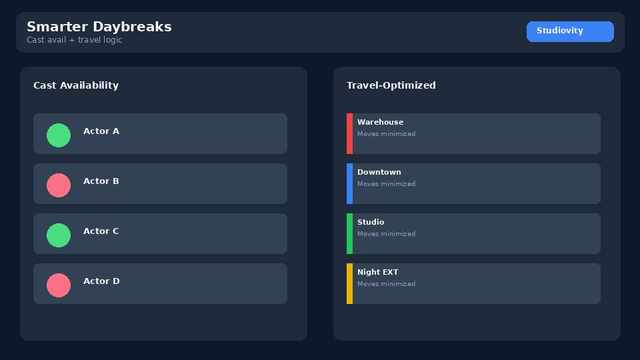
Two constraints decide whether a daybreak survives contact with reality: who is available, and how far the unit must travel. Ignore either and you inherit overtime, holding fees, or a company move that erases the afternoon. AI Film Scheduling treats cast availability and travel logic as first-class inputs—so the proposed stripboard already respects conflict checks and location clustering before the AD fine-tunes.
Why cast windows and travel break manual boards
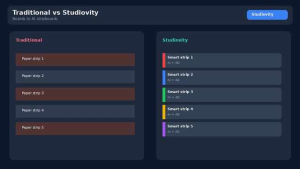
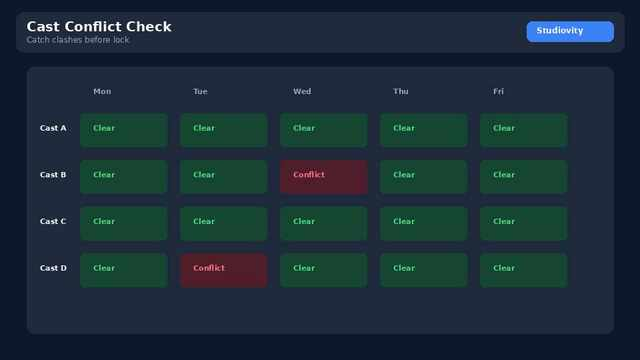
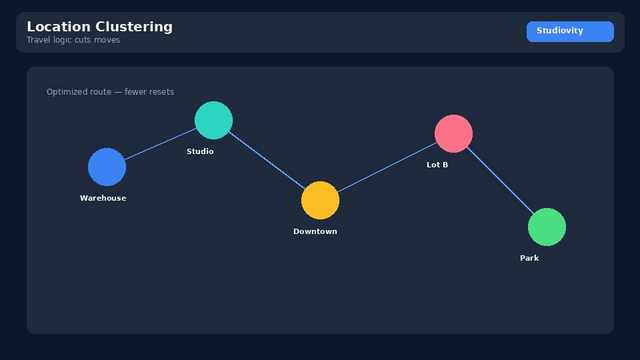
A manual board can look efficient by page count and still fail: Actor A is booked elsewhere midweek; Location B sits across town from Location A with no shared setup. Traditional sorting rarely weighs both at once. Conflict checks catch availability clashes early. Travel logic groups scenes to reduce truck packs and reset time. Together they protect production days that manual drag-and-drop often spends twice—a point covered in depth in How AI Film Scheduling Cuts Company Moves and Saves Production Days.
Studiovity’s AI Film Scheduling auto-optimizes from scenes, locations, cast availability, and production resources. Auto-optimize and smart sorting give you a stronger first pass; cast-avail conflict checks and location travel logic keep that pass honest.
From smarter order to usable production documents
Optimization only helps if the rest of the workflow follows. Instant call sheets from daybreaks pull scheduled scenes, cast, and tagged elements so the published sheet matches the board, and Studiovity’s call sheet software keeps cast call times in step with every re-optimization. Shot List Sync keeps duration estimates and camera plans attached so a “light” cast day is not secretly a heavy setup day. The boneyard holds pending scenes without deleting them when availability shifts. Shooting schedule reports—one-liners and Day Out of Days (DOOD)—plus PDF and Excel export give producers clean distribution packs.
Teams comparing tools can study Studiovity film scheduling software for how AI scheduling, episodic multi-script stripboards, mobile and web access, offline support, and real-time collaboration sit in one product. Ecosystem logos familiar across Netflix, Disney+, and peer platforms reflect the bar modern crews already expect.
A practical planning loop for ADs and UPMs
Import or complete the breakdown, confirm cast calendars, and flag hard location distances. Run AI optimization for a draft that clusters travel and respects availability. Review with AD craft—protect turnaround, night-to-day transitions, and unit capacity. Park unresolved scenes in the boneyard. Lock the daybreak, generate the call sheet, and export DOOD and one-liner reports for department heads (see DOOD reports, one-liners, and boneyard for what each report covers). When a cast window changes midweek, re-optimize the affected stretch instead of rebuilding the entire board by hand.
Mobile and offline access keep that loop alive on set; real-time collaboration keeps the office version identical.
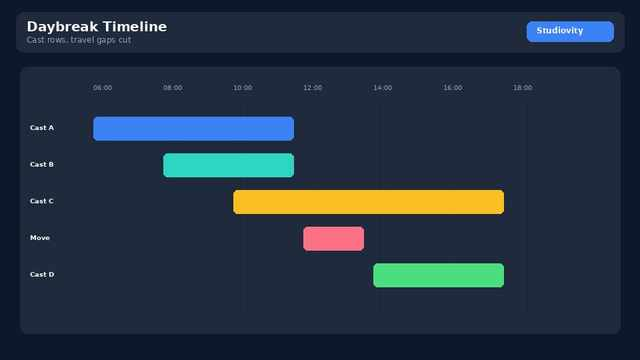
Smarter daybreaks are not about removing the AD—they are about giving the AD a board that already respects cast and travel. Start on the video TV film scheduling software product page, or dig into AI planning on Studiovity’s scheduling platform.