
Imagine your cast is ready to film an emotional coffee shop scene. However, shooting grinds to a halt because the lead actor’s custom mug never arrived. According to industry data, nearly 40% of indie filmmaking time is lost to exactly this type of administrative rework and miscommunication.
Consequently, this chaos usually stems from the “fragmentation trap.” Aspiring creators often try to wrangle a movie using a dozen scattered tools. For instance, they bounce between Google Sheets for schedules, buried email threads for props, and Word documents for scripts. Therefore, managing these disconnected apps drains your creative energy before the cameras even start rolling.
Fortunately, modern film production software provides a powerful remedy. Centralized data acts as the ultimate architect’s blueprint for your project. Functioning as a comprehensive cloud-based film production management platform, Studiovity completely replaces that messy web of software with a single source of truth for your entire crew.
Navigating this system feels exactly like hiring a tireless digital production assistant. By streamlining pre-production workflows through intuitive AI features, the platform automatically syncs schedule and script changes across every department. Thus, it prevents the communication breakdowns that cause frustrating set delays.
Writing That Works for You: How Integrated Screenplay Tools Speed Up the Creative Process
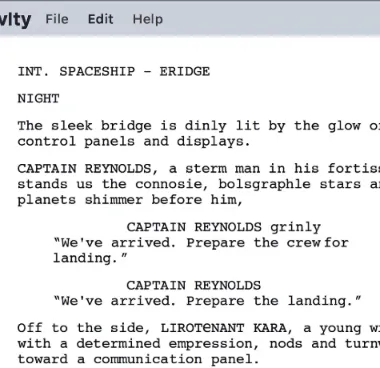
Imagine pouring your heart into a brilliant movie idea, only to have a producer reject it because your margins are wrong. Fortunately, Studiovity acts as your personal writing assistant to prevent this. Recognized as top-tier screenplay software for Mac and Windows 2026, it functions as an intuitive, industry-standard script formatter. As a result, you never have to memorize confusing spacing rules again.
Instead of wrestling with traditional documents, you focus entirely on the story. Meanwhile, the platform automatically organizes your typing into the three specific formats professionals demand:
Scene Headings: Tells the crew exactly where and when we are (like an indoor coffee shop during the day).
Action: Describes what is physically happening on the screen.
Dialogue: Centers character names and their spoken lines instantly.
Filmmaking rarely happens alone today. Thanks to collaborative script editing for remote film teams, multiple writers can revise the exact same scene simultaneously. Consequently, this eliminates messy, conflicting file versions.
Meanwhile, an ingenious ‘Auto-Detect’ feature quietly works behind the scenes. This tool turns your newly typed character names into trackable production assets automatically.
Because the system uses integrated screenplay writing and scheduling tools, your completed story is already prepared for the next logistical hurdle. Once your script is properly formatted, the next step is identifying your required physical elements seamlessly.
Stop Highlighting by Hand: Automating Script Breakdowns to Identify Every Prop and Location
Once your story is written, the logistical work begins with a “Script Breakdown.” This process requires scanning your screenplay to pinpoint every physical item you must find before filming. Historically, creators used a rainbow of highlighters to manually color-code scripts for characters and settings.
Today, automating script breakdowns in Studiovity eliminates that tedious chore. The built-in AI reads your text to instantly identify and tag required props, actors, and locations. Therefore, choosing the right film production software saves massive amounts of time.
Indeed, this intelligent categorization reduces pre-production planning time by nearly 80 percent. Instead of manually counting how often a specific vehicle appears across ninety pages, you simply click a button to generate a comprehensive Master Asset List. Serving as the ultimate shopping and casting directory for your project, this seamless tool brings intuitive digital asset management for film productions directly to your laptop.
Best of all, these requirements stay dynamically linked to your evolving screenplay. If you rewrite a scene and delete a coffee shop, the required mugs and tables vanish from your required inventory automatically. With physical elements effortlessly cataloged, you are perfectly positioned to manage complex shoot logistics.
Mastering the 50-Person Road Trip: Using Production Schedules and Gantt Charts to Stay on Time
Organizing a film shoot resembles planning a massive 50-person road trip. Rather than juggling messy calendars, Studiovity uses a “Stripboard.” This features a digital board where every scene becomes a movable colored strip. By dragging and dropping these strips, you intuitively group scenes by location. Thus, you easily manage complex film production schedules efficiently.
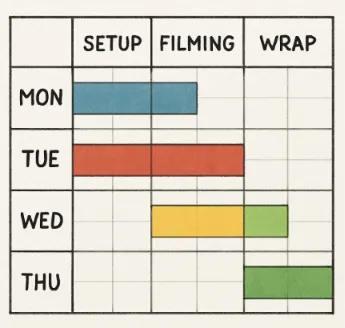
This ordered timeline then feeds into a “Gantt Chart.” This functions as a living visual calendar that stacks tasks side-by-side so you can see exactly who is working when. Operating as integrated production tools, these charts proactively prevent actor “double-booking” by generating instant visual alerts if schedules collide:
Red icons on overlapping actor shifts.
Grayed-out blocks for unavailable locations.
Flashing borders warning of crew overtime.
Yellow signs indicating missing physical props.
Real-world filming rarely goes perfectly, which makes “Automatic Rippling” a creative lifesaver. If sudden rain cancels your Tuesday exterior shoot, simply drag it to Friday. Consequently, the system instantly shifts all connected tasks, updating your 20-day schedule in seconds. With the timeline secured, the focus shifts to predicting and managing real-world costs.
Making Every Dollar Count: How AI-Driven Budgeting Predicts Real-World Costs
Running out of money mid-shoot is terrifying, but modern film production software now provides a robust financial safety net. Studiovity automatically spots expensive script elements—like a vintage car—and links them directly to budget line items.
By analyzing local crew salaries and equipment rentals, its AI-driven film budgeting software instantly suggests realistic costs before you spend a dime. Therefore, it functions as a highly cost-effective production tool.
Financial flexibility is crucial for indie creators, which is exactly where “What-If” cost scenarios shine. If a specific location is too expensive, you can ask the system, “What if we move this scene to a free public park?” Then, you can watch your projected bottom line adjust instantly. This digital sandbox lets you test different choices safely without risking your actual bank account.
During production, survival relies on “Budget-to-Actual” tracking. This process simply compares your planned budget against your daily receipts. If camera rentals run slightly high, the system flags it immediately. Therefore, you can reduce tomorrow’s catering order, keeping the project in the green. With finances safely secured, ensuring the crew arrives efficiently becomes the next priority.
The End of Lost Call Sheets: Streamlining Communication with Automated Daily Updates
Picture showing up to set, only to realize your lead actor went to the wrong address. To prevent this chaos, productions rely on a “Call Sheet.” This consists of a detailed daily itinerary telling everyone exactly where to be and when to arrive.
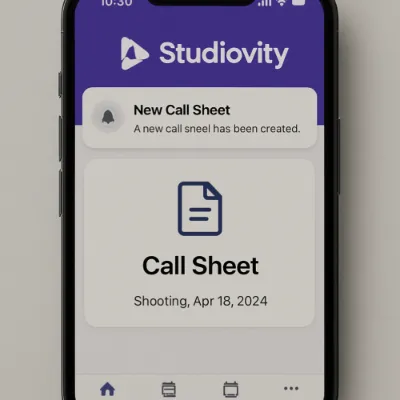
Instead of manually typing these out late at night, Studiovity provides automated call sheet generation for film sets. It pulls data straight from your schedule to build 100% accurate instructions. Complete with map links and weather forecasts, it finishes the job in under five minutes.
Delivering these updates is entirely effortless thanks to the system’s cross-platform film production mobile app. Your crew instantly receives personalized arrival times right on their phones. Consequently, this completely eliminates the need for confusing group texts.
Crucially, Studiovity utilizes “Digital Signature Tracking.” This feature lets you see exactly who has opened and acknowledged their daily instructions so you know the message landed. With communication running flawlessly, it is worth comparing Studiovity’s value against industry alternatives.
Is it Worth the Investment? Comparing Studiovity to Industry Giants like Final Draft and StudioBinder
Traditionally, making a movie meant buying several expensive subscriptions. Creators write in one app, schedule in another, and track costs in Excel. This fragmented approach creates endless manual data entry.
Fortunately, the “All-in-One” advantage of Studiovity solves this. It lets your script data flow instantly into schedules and budgets without re-typing. Thus, it stands out as the ultimate film production software for creators. It also remains one of the best affordable alternatives to Final Draft in 2026.
The financial contrast is undeniable when evaluating Studiovity vs StudioBinder for independent filmmakers. By consolidating workflows into a single ecosystem, you can save up to $300/year:
Scripting: Studiovity includes built-in writing tools; StudioBinder requires importing external scripts.
Scheduling: Both offer visual timelines, but Studiovity automatically updates your budget when shoot dates shift.
Cost: One unified film production software platform replaces the need for three separate paid subscriptions.
Ultimately, asking if Studiovity is worth it for film students or indie producers comes down to project size. Fortunately, the generous free tier provides everything needed to completely produce your first short film. Therefore, transitioning away from chaotic spreadsheets requires a straightforward action plan.
Launching Your Project: A 3-Step Action Plan to Transition Your Production
You no longer have to let logistical chaos keep your movie stuck on the page. By adopting modern film production software, you transform the daunting mountain of scheduling into a clear, simple path straight to your set. This specialized film production software guides you through every step of the creative journey.
Experience this momentum today by importing your current .fdx or .pdf script. Then, watch the automated breakdown build your prop and actor lists.
After that, invite one collaborator to test the real-time editing features together. Finish by mapping out your first day of production using the visual stripboard.
Ultimately, the greatest advantage of a modern film production software platform is improving your “Time-to-Set” metric. This measures how fast you move from a blank page to actually filming. As an accessible management ecosystem, it ensures technical hurdles will never stop your great story. You have the tools and the vision, so go make your movie.