
We’ve all had that “million-dollar movie idea” while stuck in traffic, only to abandon it because we simply do not have six months to sit down and figure out screenplay formatting. That massive time barrier to entry has historically kept incredible stories locked safely inside people’s heads. However, exploring AI Scriptwriting in 2026 reveals a creative landscape where the gap between a fleeting burst of imagination and a structured, finished draft is fundamentally collapsing.
During the highly publicized 2023 Hollywood strikes, public awareness skyrocketed regarding how technology might impact writers, though conversations mostly focused on basic chatbots that generated simple text. Today, industry data shows a rapid transition toward “agentic workflows,” fundamentally changing how stories are built. Think of this new approach like a relay race where the AI seamlessly passes the baton between different tasks—researching a historical era, outlining plot beats, and drafting dialogue—without you needing to constantly restart the machine. Rather than just guessing your next word, these modern AI writing tools act as dedicated co-pilots that understand your broader narrative goals.
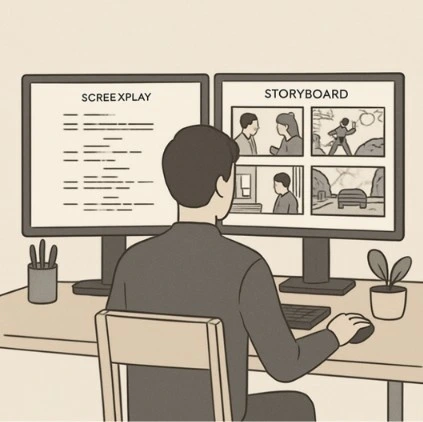
In practice, stepping into this new workflow shrinks the traditional six-month writing cycle down into highly focused 48-hour iterations. This incredible leap in efficiency is driven by Multimodal Generative AI, a system capable of processing and linking text, sound, and pictures all at the same time. Because the software understands context across different media, it provides three core benefits to everyday creators: unprecedented drafting speed, the structural integrity to ensure your character’s journey makes sense, and instant visualization that lets you literally “see” a storyboard as you write the scene.
Does a faster production timeline automatically mean a guaranteed blockbuster? That depends entirely on the human holding the mouse. Navigating AI Scriptwriting in 2026 is not about pushing an automated button to replace the writer; it is about tearing down the obstacles that keep your best ideas from reaching the page.
From 'Chatbot' to 'Creative Partner': Understanding the Rise of Multimodal Generative AI
Anyone who tried writing a script with early chatbots knows the frustration of a goldfish memory. You could explain an intricate sci-fi plot, only for the AI to forget your protagonist’s name by the second act. By 2026, this hurdle vanishes thanks to “long-term context windows”—a major upgrade giving the AI a flawless memory. Your digital co-pilot now remembers a character’s eyes were green on page one, ensuring they don’t randomly turn blue on page ninety.
The shift goes beyond just retaining text. We are entering the era of multimodal generative AI for screenwriters, meaning the system processes images, audio, and text simultaneously to grasp your story’s vibe. Imagine uploading a gloomy photograph and saying, “Write a scene that feels like this.” This leap from a basic chatbot to a true creative partner brings three vital changes:
- Flawless Recall: The AI never forgets character histories mid-script.
- Sensory Input: It uses visual mood boards to directly shape the tone of your scene.
- Deeper Comprehension: It performs real-time AI narrative structure analysis, immediately flagging if your pacing drags.
Because the technology now grasps subtext rather than just grammar, it understands what characters leave unsaid during a tense romantic comedy argument. With the entire emotional weight of a feature-length story securely held, you can skip straight to the fun part: using AI brainstorming to generate dynamic plot twists in seconds.
Kill Writer's Block Forever: Using AI Brainstorming to Generate 50 Plot Twists in Seconds
Staring at a blinking cursor while trapped in a plot hole is a universal frustration. Historically, pushing through this meant pacing the room for weeks hoping for inspiration. By 2026, you can pair your imagination with a high-speed digital sounding board. Overcoming writer’s block with AI brainstorming turns the isolating struggle of asking “What should happen next?” into a dynamic conversation where you simply choose the best path forward.
This momentum highlights the gap between AI screenplay generators versus traditional script software. Older programs merely organized your typing, but a modern co-pilot actively pitches ideas. If your action hero is cornered, you can ask the AI for ten logical ways they might escape. Instead of agonizing over a single solution, you transition from generating ideas to selecting your favorite, compressing weeks of frustration into minutes.
Beyond generating fresh concepts, your partner excels at “narrative stress-testing”—essentially looking for cracks in your story’s foundation before you build the house. You can feed the AI your outline to easily find structural weaknesses. If the romance between your leads feels unearned, the system will spot that gap and immediately suggest specific scenes to fix the pacing.
Once your plot is rock-solid, the actual drafting becomes incredibly smooth, eliminating the need to memorize exact margins or indentation rules that typically slow down the creative flow.
Ditch the Tab Key: How AI Automates Screenplay Formatting and Routine Chores
Anyone familiar with Hollywood scripts knows they look like blueprints, bound by incredibly strict rules for margins, indentation, and spacing. Historically, keeping track of these rules forced creators to constantly hit the “Tab” key instead of focusing on the story. By 2026, automated formatting engines will eliminate this friction completely. Think of these engines as a dedicated assistant instantly organizing your raw text into an industry-standard layout. By delegating this busywork, you can reclaim up to 30% of your writing time, effectively stepping out of the typist role to become the true “showrunner” of your script.
Letting the software handle the layout frees your imagination to flow uninterrupted. Modern systems are exceptionally good at automating repetitive script formatting tasks that traditionally derail momentum:
- Sluglines: Auto-generating perfectly formatted scene headings.
- Parentheticals: Aligning acting cues seamlessly under dialogue.
- Character Lists: Identifying and logging new roles instantly.
- Scene Numbering: Dynamically updating numbers whenever you rearrange the story.
Beyond basic layout, these systems also act as digital production managers. The best AI scriptwriting tools for independent filmmakers automatically scan your draft to track complete Cast Lists and Set Lists, revealing exactly how many actors or locations you will need to shoot. With your formatting chores handled and your assets neatly organized, you can finally visualize the movie itself.
The 2026 Workflow: A Step-by-Step Guide to AI-Assisted Storyboarding
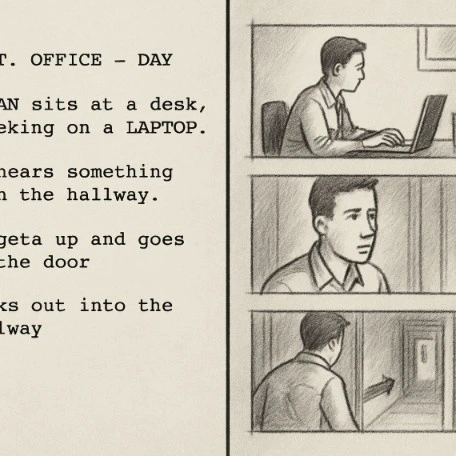
Now that your formatting chores are entirely automated, the real magic of modern storytelling begins: seeing your movie before you ever pick up a camera. In the past, turning a script into a visual storyboard took weeks of sketching or hiring expensive artists. By 2026, the industry standard will feature instant pre-visualization (pre-viz)—a technology that translates your written words directly into cinematic concept art. This shift represents the ultimate step-by-step guide to AI-assisted storyboarding, turning anyone with a keyboard into a visual director.
Imagine typing, “A neon-lit hovercar races through the rainy cyberpunk streets,” and immediately watching four distinct camera angles populate on the right side of your screen. This immediate feedback loop bridges the traditional gap between writing and directing within a single software window. Instead of guessing how a complex sci-fi chase scene might look, you can visually experiment in real-time. If the generated angle feels too wide or lacks tension, you simply tweak your descriptive text, and the AI redraws the frame instantly.
Spotting narrative flaws becomes remarkably intuitive when you can “watch” your script unfold. Because collaborative AI co-writing platforms sync the text and imagery perfectly, you can instantly identify pacing issues by looking at the visual density of your scenes. If a tense thriller sequence yields ten identical, static frames of two characters talking at a table, you immediately know the scene needs more physical action to keep an audience engaged.
Reviewing this visual blueprint empowers you to step onto a set with total confidence. Once the visuals are locked, the next logical step is making sure your script actually sounds human through personalized voice synthesis.
Hearing Your Characters: Perfecting Dialogue with Personalized Voice Synthesis
We’ve all written a snappy comeback that looked brilliant on paper, only to realize it sounds unnatural when spoken aloud. Writers used to wait for early table reads with live actors to discover these clunky phrases. Today, you can rely on instant audio-testing directly within your drafting software. Simply highlight a scene and listen as the AI reads it back, instantly revealing awkward sentences or jokes that fail to land.
Moving beyond generic text-to-speech, modern tools utilize personalized AI character voice synthesis to assign distinct vocal profiles to your cast. If your protagonist is a cynical detective and your sidekick is a sarcastic teen, you map those specific traits into the software. Hearing your characters speak with their intended attitudes guarantees their dialogue remains consistent, solving the common mistake where everyone in the script sounds exactly like the author.
Polishing these virtual performances saves the massive hassle of organizing preliminary read-throughs. By optimizing screenplay prompts for emotional depth, you can direct this digital cast to deliver lines with heartbroken hesitation rather than flat neutrality. Yet, as generated voices blur the line between software and human actors, the industry is drawing strict boundaries. Protecting your work requires playing by the rules and navigating WGA guidelines in an AI world.
Playing by the Rules: Navigating WGA Guidelines and Copyright in an AI World
When the 2023 Hollywood strikes dominated the news, writers fought to protect the human soul in filmmaking. Today, the industry has established a clear legal boundary between “AI-generated” and “AI-assisted” content. Think of it like cooking: if a machine creates a frozen pizza entirely on its own, you cannot claim to be the chef. That counts as AI-generated text, which cannot receive copyright protection. However, if you invent the recipe, prepare the ingredients, and use a smart oven to speed up the process, the final meal still belongs to you.
Protecting your screenplay now requires maintaining a “Human-in-the-Loop” (HITL) workflow. In simple terms, the writer must remain in creative control by editing, refining, and directing the AI instead of allowing the software to operate independently. To follow WGA AI usage guidelines for 2026, writers should follow these essential practices:
- Use AI tools for brainstorming, outlining, formatting, and idea generation.
- Avoid copying entire AI-written scenes directly into the final screenplay.
- Save version histories to document your creative revisions and human input.
At the same time, ethical AI storytelling depends on using platforms trained on licensed data rather than scraped or stolen scripts. Once your screenplay is legally protected and ethically developed, the focus shifts from content creation to audience response. That next stage involves using AI-driven metrics to evaluate emotional impact and viewer engagement.
Predicting the Box Office: Using AI Metrics to Measure Emotional Depth and Engagement
Many creators still ask, “Can AI write a movie script from scratch?” Yet that question overlooks the technology’s greatest advantage. Instead of replacing the writer, AI helps improve human-written stories through instant analysis and predictive feedback.
In the past, writers depended on traditional script coverage, where industry readers manually reviewed drafts and shared subjective opinions. Today, AI-powered predictive coverage creates a faster and more objective feedback system. The software analyzes audience engagement patterns and identifies weak pacing, emotional inconsistencies, or underdeveloped scenes within minutes.
One of the most powerful features is sentiment mapping. Think of it as a heart-rate monitor for your screenplay. The system visually tracks emotional highs and lows throughout the story. In a thriller, for example, tension should steadily rise toward the climax. If the emotional curve suddenly drops, the software highlights the exact dialogue or scene causing the problem.
Because of this instant analysis, writers can refine scripts for specific audience demographics with far greater precision. However, even the best predictive metrics cannot guarantee a masterpiece. Data can measure pacing and structure, but it cannot fully measure vulnerability, authenticity, or emotional truth. Beyond the charts and algorithms, the human soul still remains the most valuable creative asset.
Why the ‘Human Soul’ Is Still Your Most Valuable Asset in 2026
Even with advanced emotional analysis, fully machine-written scripts often feel strangely hollow. This effect resembles the “uncanny valley,” where something appears human on the surface yet feels artificial underneath. Algorithms can structure scenes effectively, but they still struggle to create genuine emotional resonance.
The difference comes down to pattern recognition versus lived experience. Modern AI systems generate content by analyzing massive datasets of existing screenplays and predicting what should come next. A machine can imitate a breakup scene from thousands of romantic comedies, but it cannot recreate the emotional reality of heartbreak from personal memory.
Human writers bring something fundamentally different: intentionality. Real experiences, painful memories, cultural nuance, grief, humor, and vulnerability shape authentic storytelling. When a character reacts to tragedy with an awkward joke because that reflects how someone coped in real life, that emotional detail comes from human observation rather than statistical prediction.
As AI continues automating formatting and technical tasks, human taste becomes even more valuable. Many people wonder how AI will impact screenwriting jobs in 2026, but the industry will continue prioritizing imagination, originality, and emotional authenticity over typing speed alone. Writers who combine AI efficiency with human storytelling instincts will stand out the most.
Your 2026 Scriptwriting Action Plan: Moving from Spectator to Screenwriter
In the 1990s, writers moved from typewriters to computers to write faster. Now, the industry is entering an era where software actively supports creativity itself. Writers no longer need to stare at blank pages worrying about margins, formatting, or scene structure. Instead, AI acts as a collaborative co-pilot that helps transform ideas into structured screenplays much faster.
The biggest advantage is not just speed. It is the elimination of analysis paralysis. By adopting a co-pilot mindset, writers stop treating AI as a replacement and start using it as an assistant that organizes ideas, accelerates iteration, and supports creative momentum.
For beginners, the best way to adopt AI-assisted writing is through a gradual workflow:
- Week 1 – Brainstorming: Generate character names, story worlds, and “what if” scenarios.
- Week 2 – Outlining: Build a three-act structure using AI-assisted organization.
- Week 3 – Drafting: Expand scenes one by one with AI-generated dialogue and action beats.
- Week 4 – Polishing: Rewrite, refine, and inject emotional authenticity into every scene.
While AI scriptwriting workflows in 2026 will automate technical processes efficiently, writers still provide the most important creative elements: empathy, lived experience, emotional honesty, cultural depth, and genuine surprise. Those qualities transform a technically correct screenplay into a powerful cinematic story.
Ultimately, AI-assisted storytelling is not about replacing artists. Instead, it removes the repetitive barriers between imagination and execution. Writers can now spend less time worrying about formatting and more time focusing on the emotional core of their stories. A faster screenplay does not automatically create a better movie. The final outcome still depends on the human guiding the narrative.
Create Smarter Screenplays Faster with Studiovity
As AI Scriptwriting in 2026 continues transforming filmmaking, Studiovity helps writers and filmmakers turn ideas into production-ready screenplays faster than ever. From AI-powered screenplay writing and script breakdowns to shot lists, storyboarding, scheduling, and call sheets, Studiovity combines the entire pre-production workflow into one collaborative platform. Whether you are developing your first short film or managing a large-scale production, Studiovity gives creators the tools to write smarter, visualize scenes instantly, and streamline the journey from script to screen.