A film set is a controlled explosion of creativity, but without rigorous protocols, that control can vanish in an instant. Every professional producer knows that a robust Health and Safety Policy for Film Production Companies is not just paperwork; it is the backbone of a sustainable production. Whether you are coordinating a high-octane stunt sequence or managing a quiet interior dialogue scene, the safety of your cast and crew is paramount.
[DOWNLOAD YOUR FREE HEALTH AND SAFETY POLICY TEMPLATE FROM THE LINK GIVEN BELOW]
Implementing a comprehensive Health and Safety Policy for Film Production Companies ensures that your creative vision never comes at the cost of human welfare. Furthermore, in an industry rife with unpredictability, this policy acts as your legal and ethical shield. Consequently, studios that prioritize safety often see increased efficiency and morale. Before we dive deep into the specific clauses and requirements, you can start organizing your production’s compliance today.
Why a Health and Safety Policy is Non-Negotiable
The stakes on a film set are incredibly high. Beyond the obvious moral obligation to protect life and limb, the financial implications of an accident can be devastating. Insurance premiums skyrocket, production halts, and reputations are ruined. Therefore, establishing a clear Health and Safety Policy for Film Production Companies is a critical business strategy.
This policy serves as a contract between the production company and the crew. It defines responsibilities, outlines hazards, and establishes clear protocols for emergencies. Additionally, it ensures compliance with local laws and union regulations. By using modern tools like Task Management software, you can assign safety checks to department heads, ensuring that no stone is left unturned.
Core Components of a Film Production Safety Policy
To create an effective policy, you must cover specific operational areas. Based on industry standards, here are the essential elements you must include.
1. General Responsibilities and Risk Assessments
First and foremost, accountability must be established. The film company bears the ultimate responsibility for ensuring that all work, including that of sub-contractors, has been assessed for hazards. A crucial rule is that contractors must provide a detailed written risk assessment prior to the commencement of any work.
This proactive approach prevents accidents before they happen. For example, if a grip team is rigging lights overhead, a risk assessment identifies the potential for falling objects and mandates safety cables.
2. Fire Safety and Hot Work Permits
Fire hazards are prevalent on sets, from lighting rigs to pyrotechnics. Your policy must state that a “Hot Work Permit” is required before any work producing sparks or flames commences.
Furthermore, clear evacuation protocols are vital. Upon hearing a fire alarm, all personnel must know to evacuate via the nearest fire exit and gather at a specified assembly point. To maintain order, fire exits must be kept free of obstructions at all times during filming.
3. Control of Substances Hazardous to Health (COSHH)
Art departments and special effects teams often work with chemicals. Therefore, strict control is necessary. Your policy should mandate that full trade names and product data sheets for all hazardous substances be supplied at least 24 hours prior to use. This allows for a full COSHH assessment, ensuring the crew knows exactly what they are handling.
4. First Aid and Personal Protective Equipment (PPE)
Accidents can happen despite our best efforts. Consequently, a suitable First Aid kit must be provided on-site. Moreover, it is the contractor’s duty to ensure that all employees know the procedures for contacting appointed First Aiders and emergency services.
Regarding prevention, Personal Protective Equipment (PPE) is essential. Following a risk assessment, if hazards cannot be eliminated, the film company must ensure that appropriate PPE is provided to operatives without charge. Crucially, operators must be fully trained in the use of this equipment.
Leveraging Tech for Safety Compliance
Managing these policies on paper is outdated and dangerous. Modern producers use integrated platforms to keep safety data accessible.
Emergency Contacts: Use Studiovity’s Contact Book to maintain an up-to-date list of local hospitals, emergency services, and crew next-of-kin.
Daily Briefings: Include specific safety notes for each day directly on your Call Sheets. For instance, if you are filming near water, the call sheet is the perfect place to remind the crew about life vest protocols.
Scheduling: When building your Production Schedule, factor in mandatory safety briefings and “tool-box talks” at the start of complex shoot days.
Security and Site Management
A secure set is a safe set. Your policy should designate a “Person in Charge” who will remain on-site to supervise works for the duration of the contract. This person must maintain direct communication with location management via mobile phone.
In addition, protecting the physical workspace is critical. The film company must provide adequate protection to property belonging to the location owner. This includes covering floors and finishes along access routes. Finally, to prevent unauthorized access and potential liability, ladders and scaffolding must not be left where they can be used by unauthorized persons.
Download Your Free Safety Policy Template
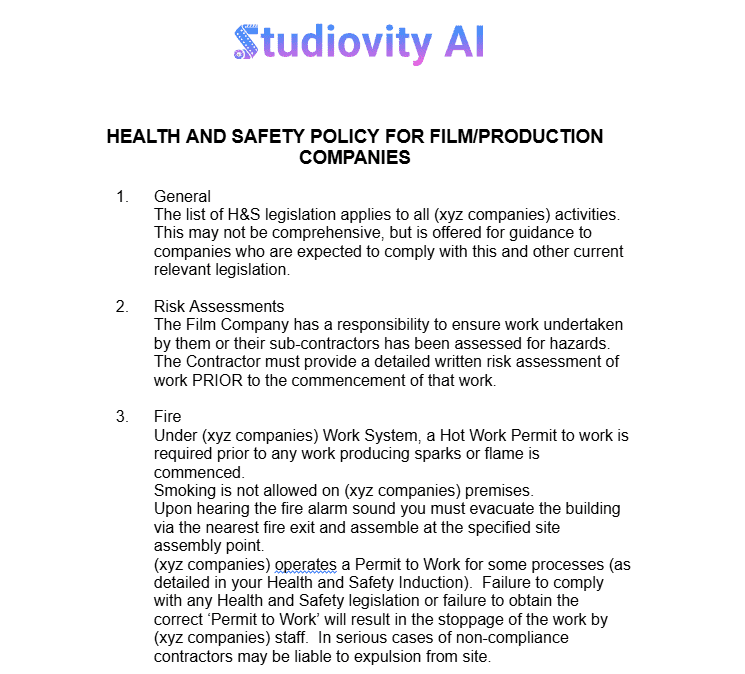
To help you get started, we have compiled a standard template based on rigorous industry requirements. You can copy and adapt the sections below for your next production.
[DOWNLOAD YOUR FREE TEMPLATE FROM THE LINK GIVEN BELOW]
General: Compliance with all H&S legislation is mandatory.
Insurance: The Film Company shall indemnify the location owner against loss, claim, or liability arising from personal injury or death.
Prohibited Items: Strict prohibitions on alcohol, drugs, weapons, and explosives (unless authorized for FX) must be enforced.
Equipment Safety: Scaffolds must be certified by a competent person upon completion and weekly thereafter.
(Note: Always consult with a legal professional or safety consultant to tailor this policy to your specific region and production needs.)
Conclusion: Safety Enables Creativity
A rigorous health and safety policy does not stifle creativity; it enables it. When your crew feels safe, they can focus entirely on their craft. They take calculated creative risks because they know the physical risks have been mitigated.
By integrating these policies into your daily workflow using Studiovity’s Production Calendar and planning tools, you transform safety from a burden into a seamless part of your production culture. Don’t wait for an accident to force your hand. Take control of your set’s safety today.