
Voice-over looks easy on the page. You add a V.O. next to a character name, let the character talk over the images and move on. In practice it is one of the most overused and most misused tools in screenwriting, and readers spot a lazy voice-over within a few pages.
This guide shows how to write voice over in a screenplay: the exact format, the difference between V.O. and O.S., how to handle narration, and how to decide whether your story needs it at all.
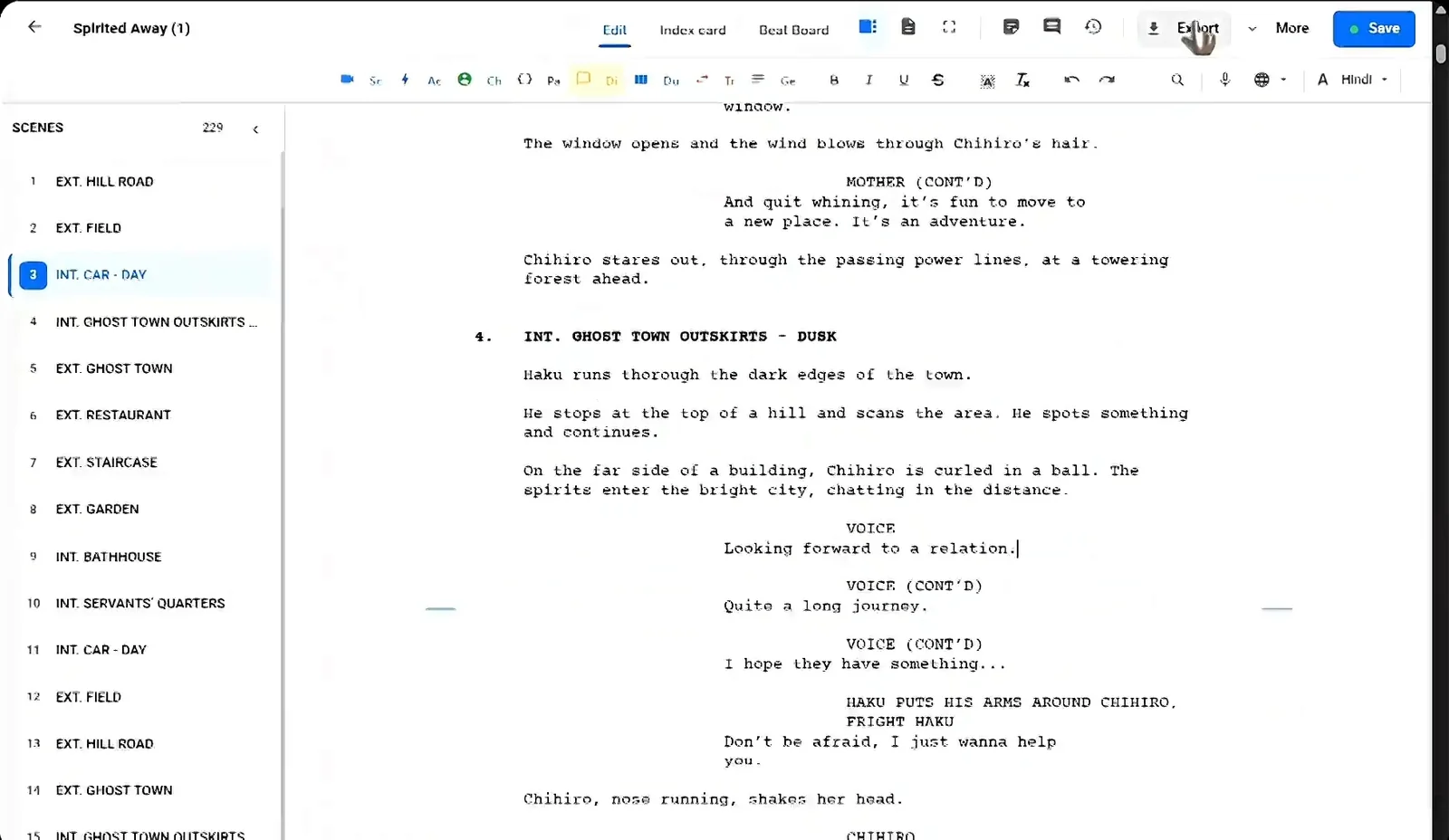
Here is a short Studiovity video on AI-powered screenwriting, including the editor where you format character cues:
What Voice Over in a Screenplay Means
Voice over, written V.O., is a voice the audience hears that does not come from a speaker visible in the scene. It might be a narrator, a character thinking aloud, a letter being read or a recorded message playing over images.
The format is simple. Put the extension in brackets beside the character name on the cue line, and write the dialogue underneath as usual:
                    MARA (V.O.)
          I left the town the same way
          I arrived. Quietly, and in the rain.
V.O. vs O.S.: Which One Do You Need?
Writers mix these two up all the time, and the difference matters.
- V.O. (voice over): the speaker is not in the scene. The voice is added over the picture, like narration or an inner thought.
- O.S. (off screen): the speaker is in the scene, in the same space and time, but outside the frame. Think of someone calling from the next room.
- O.C. (off camera): used by some writers as a near twin of O.S. Pick the one your production prefers and stay consistent.
A quick test: if the character could walk into frame and be part of the moment, use O.S. If the voice lives outside the moment, use V.O.
How to Format Voice Over Step by Step
- Write the scene heading and action lines as normal.
- Type the character name in capitals on the cue line, then (V.O.) after it.
- Write the dialogue directly below, indented like any other dialogue.
- When the voice continues after an action line, add (CONT’D) only if your format guide asks for it. Many writers now skip it.
- When you return to the same character on screen later, drop the extension and use the plain name.
If you want a refresher on cue lines and extensions in general, our guide on how to write a character cue in a screenplay covers the rules in detail.
Types of Voice Over You Can Write
Narration
A narrator tells the story, either as a character inside it or as an outside storyteller. Keep a narrator’s voice distinct. If the narration could be cut and the film would play the same, cut it.
Inner thoughts
Characters rarely think in full sentences, so inner voice-over works best when it is short, specific and slightly at odds with what we see on screen.
Letters, messages and recordings
A character reads a letter or a voicemail plays over images. Write it as V.O. and tell us whose voice it is. For one-sided calls and intercuts, see how to write a phone call in a screenplay.
Retrospective narration
An older version of the hero looks back on events. This is the most common form and the easiest to overdo, because the temptation is to explain everything.
When Voice Over Helps and When It Hurts
Voice-over earns its place when it adds something the picture cannot show: irony, memory, a hidden feeling, or a different time frame. It hurts when it only repeats the image.
- Good: the narrator says she is fine while we watch her pack in a hurry.
- Weak: the narrator says “I walked into the kitchen” while we watch her do it.
Ask three questions before you add a voice-over line:
- Does it tell us something we cannot see?
- Would the scene still work if the line were cut?
- Is the voice of the narrator clearly different from every other character?
Try It in Your Own Draft
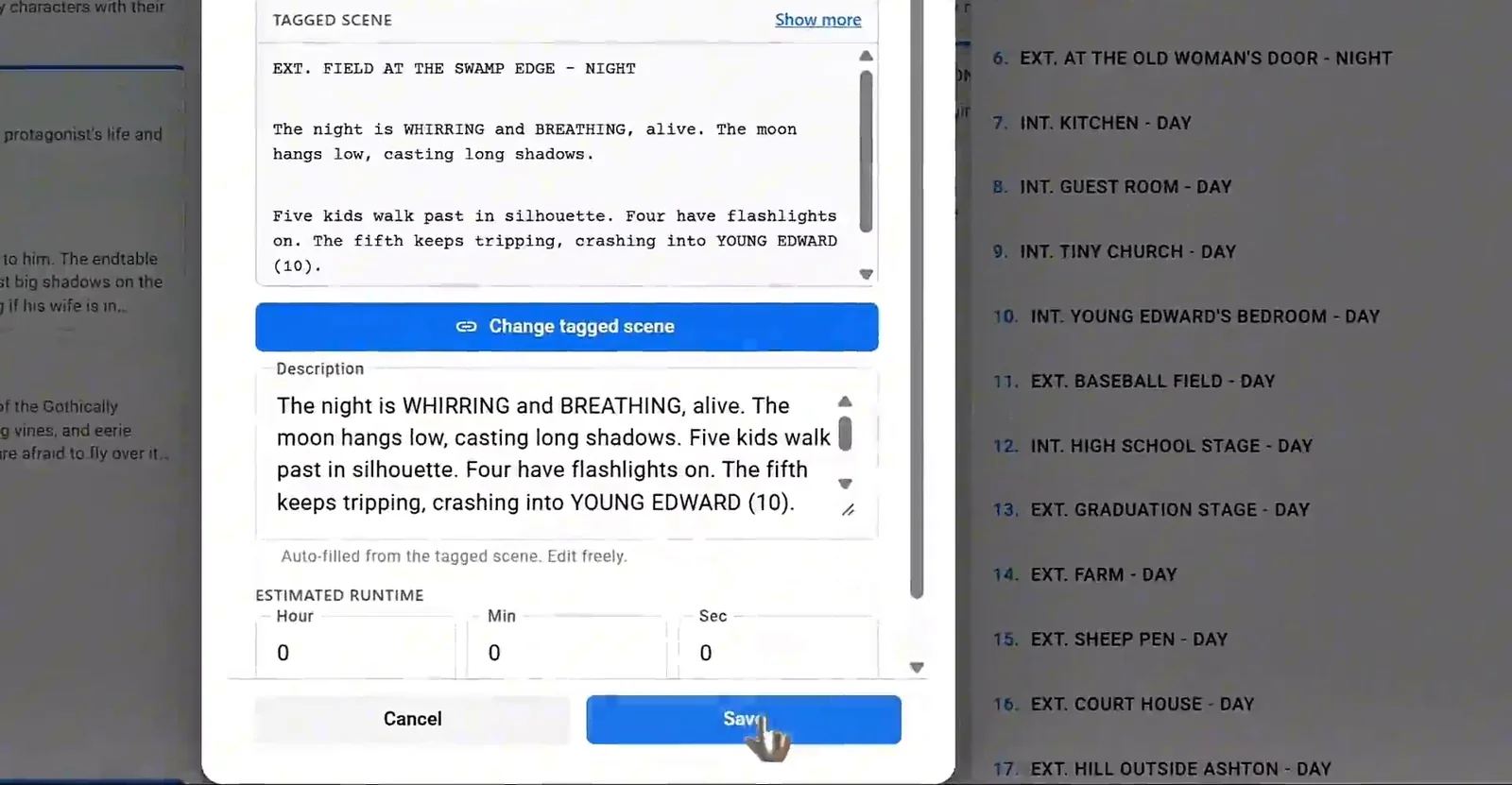
Voice-over is easier to judge when you can see where it falls in the whole script. In the Studiovity screenwriting software you write in standard screenplay format and jump between scenes from the scene list, so you can check how every V.O. line sits in its scene.
Common Voice Over Mistakes
- Using V.O. as an exposition dump. If the narrator explains the plot, ask whether a scene could do that work. Dramatize it in a scene instead.
- Switching the narrator’s voice. The same speaker should sound the same on page 3 and page 93.
- Starting and stopping with no pattern. If voice-over appears in the first ten pages, it should return at a steady rhythm, or readers will wonder why it vanished.
- Wrong extension. A character standing in the next room is O.S., not V.O.
- Over-long speeches. Break long narration into short beats between pictures.
Voice Over Format Checklist
- Character name in capitals with (V.O.) on the cue line
- Dialogue indented the same as normal speech
- O.S. used only for speakers inside the scene
- Narration short, specific and different from what we see
- Voice-over placed where it adds irony, memory or feeling
- Consistent extension style throughout the script
A good place to test your format is the Studiovity screenwriting editor, where you can draft a scene and export it to check the page.
FAQ
Do I write V.O. in the action lines or the dialogue?
Put V.O. beside the character name on the cue line. Use action lines only to describe what we see while the voice plays.
Is voice over allowed in a spec script?
Yes, but readers are cautious about it. Use it only if the story truly needs it, and keep the first lines short and sharp so the reader trusts it.
How much voice over is too much?
There is no fixed limit, but if the voice-over covers most of the story, the film is really a narrated novel. Most scripts use it in short bursts.
Can a character be V.O. and on screen at the same time?
Yes. A character can speak in V.O. while we watch them in the scene, for example reading their own diary entry. Use V.O. for the diary lines and the plain name when they speak aloud.
Write Cleaner Voice Over in Studiovity
Good voice-over is brief, purposeful and consistently formatted. Studiovity keeps your cue lines, extensions and scene order in one editor and exports to PDF, Fountain or FDX. Start your next script in Studiovity and check every V.O. line before the draft goes out.