
Documentary scripts start with research, not dialogue.
A documentary has no actors reading lines, so why write a script at all? Because a script is how you find the story inside hours of real footage. Learning how to write a documentary script helps film students plan what to shoot, what to ask and how narration and visuals fit together. This six-step guide covers the process, and Studiovity for Education’s plans for students and film schools give your class a shared place to write it.
Watch: write scripts in different formats
Not every script is a screenplay. This short Studiovity video shows the two-column AV format used for documentaries, ads, corporate films and short social videos.
Why Documentaries Need a Script
A documentary film captures real people and events, so you cannot control every word. The script works as a plan before the shoot and a map during the edit. It usually changes as you learn more, and that is normal.
How to Write a Documentary Script in 6 Steps
1. Research your subject
Read, watch and talk to people before you write. Collect facts, possible locations, archive material and potential interviewees. Note sources so you can check every claim later.
2. Find your question or angle
A topic is not a story. Turn “campus food waste” into a question, such as “Where does our canteen’s leftover food go?” A clear question keeps the film focused.
3. Outline the structure
Sketch a beginning that hooks, a middle that explores and an ending that answers or reframes the question. List the scenes, interviews and moments you hope to capture.
4. Plan interviews
Write open questions that start with “how” or “why” rather than yes-or-no questions. You cannot script answers, but you can script the path you hope they take.
5. Use the two-column AV format
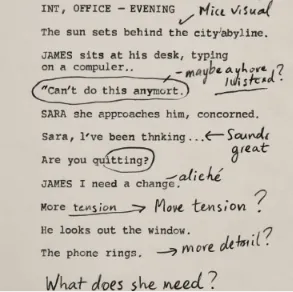
The documentary script format most students use is the AV script: visuals in one column, audio (narration, interview clips, music and sound) in the other, row by row. It shows how each line of narration matches what is on screen. Our guide on creating professional AV scripts in Studiovity goes deeper.
6. Rewrite after the shoot
Once you have footage, review your interviews, pick the strongest moments and update the script to match. This revised version becomes your editing plan.
Documentary Script Template for Students
- Title, logline and the central question.
- Sequence list: opening, key scenes, ending.
- Two-column table: visuals | audio/narration.
- Interview list with planned questions.
- Notes on archive footage, music and sources.
For a look at how a professional documentary is planned, see our breakdown of true crime documentary production in The Staircase.
Writing in Different Formats: AV Scripts Beyond Documentaries
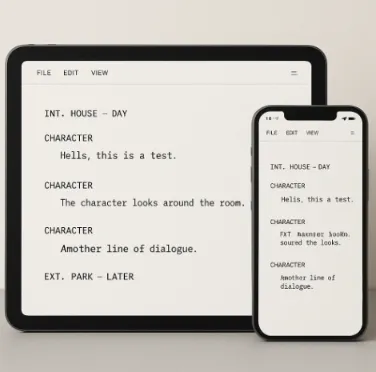
The same two-column AV script format is used for ads, corporate videos, music videos and short social clips. Studiovity’s screenwriting software with an audio-visual script mode offers a two-column layout, AI timing tools and image generation from your visual descriptions. You can also export to FDX, PDF and text, and faculty can review student scripts in one shared workspace.
Key Takeaways
- Research first and turn your topic into a question.
- Outline a beginning, middle and end.
- Script interview questions, not answers.
- Use two columns to match visuals and audio.
FAQ
Do documentaries have scripts?
Yes. Most start with an outline or treatment, and the script is refined after filming to guide the edit.
What format is a documentary script written in?
Usually a two-column AV script, with visuals on one side and narration, interviews and sound on the other.
Can students get documentary script software at a discount?
Yes. Studiovity’s education plans cover students, educators, registered institutes and accredited workshops. Education pricing is $18/mo billed monthly (10% off the regular $20), $14/mo on the semi-annual plan billed at $84 (30% off), or $10/mo on the annual plan billed at $120 (50% off). Plans start with 10 projects and 2 seats and extend up to 100 projects and 150 seats per institute.
Ready to start your documentary? Explore Studiovity education pricing for students and film schools and write your first AV script today.