
We all want to see our vision on the big screen, but the path to the director’s chair is paved with spreadsheets. Planning a film is a lot like organizing a massive home renovation; you can estimate the cost of new paint, but guessing on the plumbing will leave you in ruins. Industry data reveals that relying on rough guesses rather than accurate film cost planning is why countless indie projects stall before completion. Modern movie budgeting software is now used by filmmakers to avoid these costly mistakes.
There is nothing scarier than being halfway through a shoot and realizing you have run out of money for lunch. In practice, manual spreadsheets lead to budget overruns in three common ways: broken formulas, forgotten crew taxes, and an inability to track real-time changes. This highlights the critical difference between accounting (recording what you already spent) and budgeting (actively planning your future costs).
Fortunately, modern film production software provides a much-needed digital safety net. Cloud-based production management means your entire team can view critical updates instantly from anywhere. By using dedicated movie budgeting software like Studiovity, you gain a “Central Brain” that handles the boring math automatically, letting you focus entirely on your creative vision.

The Detective Phase: Why Your Budget Starts with a Script Breakdown, Not a Calculator
Arriving on set only to realize you forgot to rent lights because they weren’t explicitly written into the dialogue is a producer’s nightmare. Before touching a calculator, your financial planning starts with a script breakdown. Think of this as the detective phase. You are scanning your screenplay to uncover every clue that costs money.
Finding these clues is like writing a highly specific shopping list for a massive event. Every requirement you spot becomes a “line item entry”—a single, distinct expense on your final budget. During your read-through, hunt for five essential elements:
- Characters (who needs paying?)
- Locations (where are you shooting?)
- Special FX (does anything explode?)
- Vehicles (are cars needed on-screen?)
- Props (what objects do actors touch?)
Traditionally, translating these clues meant typing everything twice. However, modern film production software acts as a central brain to handle the heavy lifting. By integrating script breakdown with production budgeting, Studiovity automatically organizes your line items into “category groups”—logical folders that bundle related expenses together. This completely eliminates manual busywork, reducing your data entry time by fifty percent. Reliable movie budgeting software also helps teams maintain organized production records.
Embracing digital film production cost tracking means you stop guessing and start planning with investor-ready confidence. Once your script’s hidden costs are safely captured, you can begin assigning real dollar amounts to your production plan using industry-standard categories.
Demystifying 'The Line': Organizing Costs into Above-the-Line and Below-the-Line
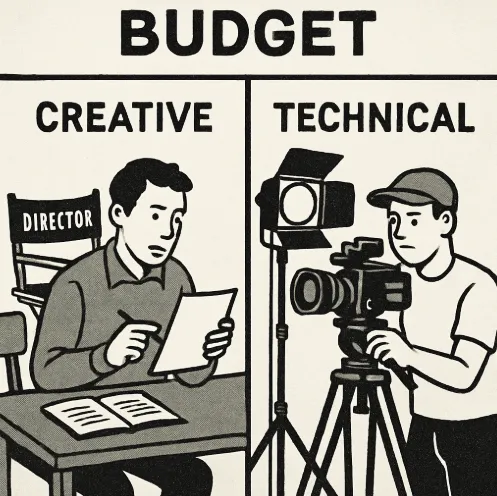
When planning a major event, you pay the visionary planner differently than the catering staff. Film budgets work exactly the same way. Managing above-the-line vs below-the-line costs separates the initial creative foundation from the physical execution. Above-the-Line (ATL) expenses cover the creative leads who guide the story, like writers, directors, and principal actors. Below-the-Line (BTL) costs encompass the technical crew, locations, and camera gear required to actually capture that story.
Keeping these two worlds organized requires a universal filing system known as a film production chart of accounts structure. Think of this as a standardized numbering system where every expense has a specific, predictable home. Instead of building this complex numerical web from scratch, modern production budgeting software like Studiovity automatically maps your expenses into these standard folders, guaranteeing your camera rentals stay firmly BTL while your director’s fee stays perfectly ATL. Professional movie budgeting software simplifies this structure for indie and studio productions alike.
Investors immediately check the ratio between these two halves before writing a check. A top-heavy budget with massive ATL fees but tiny BTL resources signals a project that might run out of money mid-shoot. Balancing this split proves you have a realistic, professional production plan. Next, you must secure the hidden costs that protect your categorized core team and gear.
Accounting for the 'Invisibles': Automating Fringes and Protecting Your Project with Contingency
Imagine hiring a sound mixer for $200 a day, only to realize later that taxes pushed your cost to $240. These extra percentages are called “fringes”—the mandatory employer taxes and fees added to a crew member’s daily rate. Figuring out how to calculate film production fringes manually across fifty people is a nightmare. Thankfully, budgeting software uses global budget variables. You type the percentage once, and the system applies it everywhere.
To successfully stop financial leaks from sinking your project, secure three “invisible” costs before cameras roll:
- Payroll taxes (Fringes): The mandatory employment fees attached to every paycheck.
- Production Insurance: Your protective safety net for damaged gear or location accidents.
- The 10% Contingency fund: An emergency cash reserve strictly for unpredictable disasters.
Mastering the “Rule of 10” for allocating contingency funds in movie budgets is your best tool for preventing film production budget overruns. When a rainstorm ruins your shoot, this emergency buffer keeps production alive. Studiovity calculates this safety net automatically, updating instantly whenever you adjust a line item. Advanced movie budgeting software also helps producers monitor changing contingency costs in real time.
Because these vital numbers shift constantly during planning, sharing the most up-to-date math with your partners is crucial.
Real-Time Collaboration: Why Your Budget Should Live in the Cloud, Not a Desktop Folder
Version control issues, like a director looking at a budget from three weeks ago, can derail a production. Relying on emailed spreadsheets inevitably creates confusing files named “Budget_Final_v4.xlsx.” This version confusion causes costly mistakes, like double-booking caterers or missing a camera payment. By using the best cloud-based film budgeting tools for producers, you establish a single source of truth for your entire team.
Moving finances online works exactly like sharing a Google Doc. Imagine a producer buying extra batteries on set; they can log that expense from a smartphone immediately. Studiovity’s real-time film expense collaboration features ensure those numbers sync instantly across all devices. Permission-based access even lets you hide sensitive crew salaries from junior assistants while they still log daily hardware receipts. Efficient movie budgeting software improves communication across every production department.
Keeping everyone aligned naturally builds investor confidence and team morale by improving film production financial transparency. When department heads see exactly what resources remain, they make smarter creative choices without constant guessing, allowing you to present your living budget professionally.
From Data to Decisions: Using Automated Reports and Top Sheets to Secure Funding
Pitching your film to an investor with a fifty-page spreadsheet is the fastest way to lose their attention. Instead, they expect a Top Sheet—a one-page summary acting as the cover letter for your finances, cleanly totaling your Above the Line (creative talent) and Below the Line (crew and gear) costs. Following manual steps to create a film production top sheet is notoriously tedious. Fortunately, Studiovity handles the automated film production cost reporting for you, instantly turning scattered line items into a pristine, pitch-ready summary.
To confidently secure funding, there are 3 reports every producer needs:
- The Top Sheet (your high-level summary)
- Category Detail (the itemized ‘why’ behind the numbers)
- The Tax Incentive Estimate (your potential state rebates)
Mastering and optimizing film tax incentive calculations—essentially projecting the percentage of money a local government refunds you for hiring locally—can drastically stretch a micro-budget feature’s resources, making your project undeniably attractive to financiers. Trusted movie budgeting software makes these financial projections easier to manage and present.
What if a partner asks how shooting in another state impacts your bottom line? Because your software links directly to your localized data, you can generate new numbers instantly without panicking over broken formulas, keeping your professional presentations ready to win over partners.

Your 48-Hour Action Plan: Transitioning from Spreadsheet Stress to Strategic Film Planning
You no longer have to stare at an intimidating spreadsheet hoping your math holds up. By treating movie budgeting software as your creative partner, you have bridged the gap between your script’s artistic vision and its practical reality. The journey from a basic draft to an investor-ready budget is now an empowering process rather than a stressful guessing game.
When producers ask what are the best alternatives to traditional film budgeting software, you can confidently advocate for automated tools. Migrating takes just four clear moves: leave Excel behind, upload your screenplay, assign your calculated costs, and establish a weekly budget review habit to prevent overspending. If you are comparing Studiovity vs Movie Magic Budgeting, remember that an accessible platform lets you spend less time battling accounting jargon and more time preparing for your actual shoot.
The fear of running out of money mid-production no longer controls your set. You now possess the practical framework to present your finances to any partner with absolute clarity and professional confidence. By leveraging modern movie budgeting software, you can upload your script for an automated breakdown and establish a reliable system to build a realistically funded production.
Why Studiovity Is the Smart Choice for Film Budget Planning
Studiovity helps filmmakers turn complex production finances into a streamlined, organized workflow. From AI-powered script breakdowns and automated budgeting to scheduling, call sheets, and real-time collaboration, the platform simplifies every stage of pre-production. Whether you are managing an indie short film or a large-scale production, Studiovity’s movie budgeting software gives producers the tools to plan accurately, reduce costly mistakes, and keep every department aligned. By combining budgeting, scheduling, and production management into one cloud-based platform, Studiovity helps creative teams spend less time on spreadsheets and more time bringing stories to life.